

 ChatGPT
 Perplexity
 Claude
 Gemini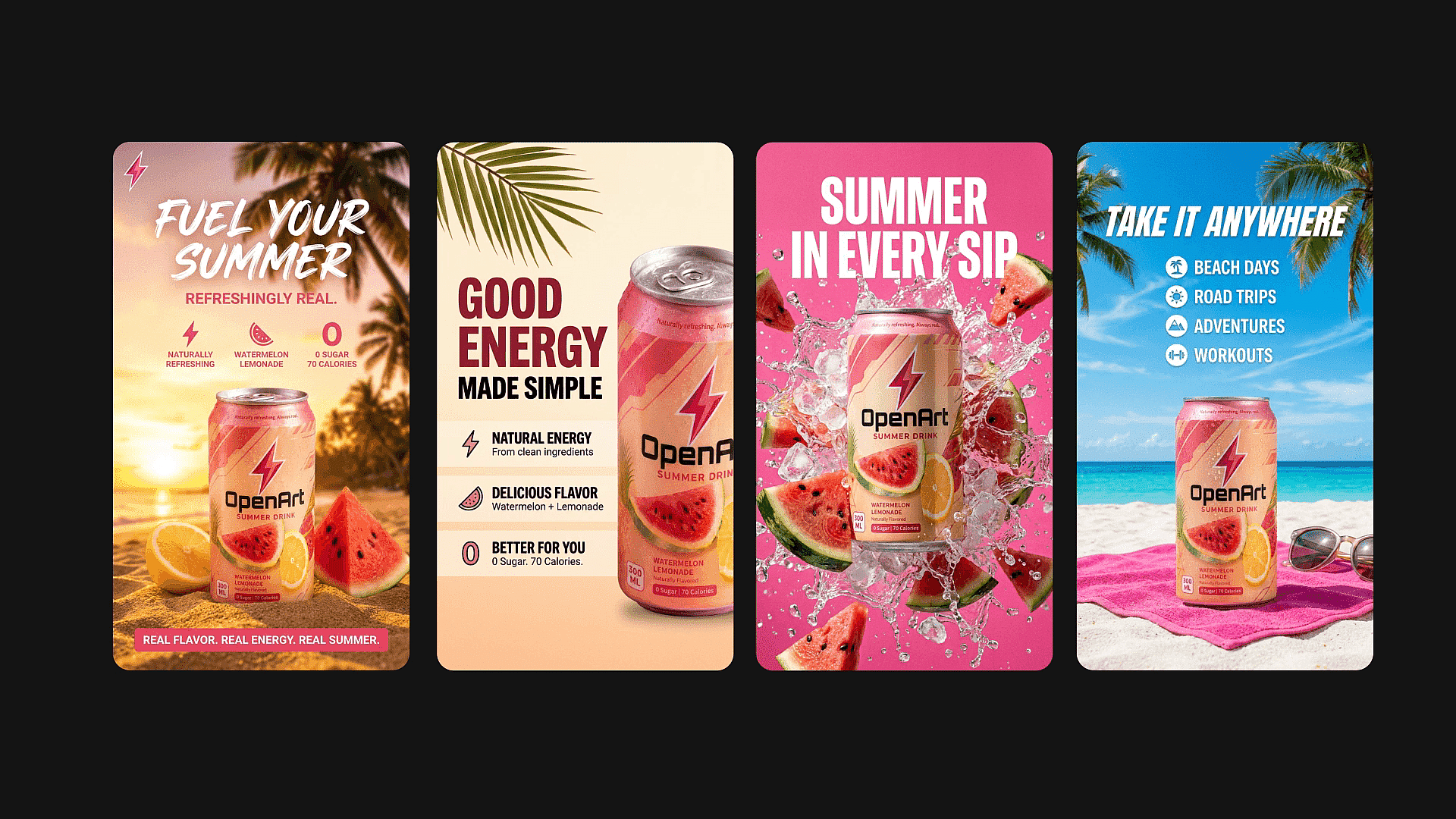
TL;DR
- OpenArt best fits turning one product photo into a consistent campaign, stills and video included, across multiple models. New accounts get 40 free trial credits, no credit card required. Commercial use rights start at the Plus plan and above.
- Canva Magic Media works well for quick banners inside templates. Sources conflict on whether its 50 free generations reset monthly or apply for life.
- Adobe Firefly suits brand campaigns that prioritize commercially safe training. Adobe offers free daily generations but does not publish the exact allowance.
- Freepik gives you varied ad visuals plus stock assets. Free accounts get 20 daily generations through Auto model selection only.
- Fotor offers a dedicated product-shot workflow. Its six starter credits cannot cover one 15-credit Product Shot generation, and free exports carry a watermark.
OpenArt is also the only tool in this comparison that turns the same uploaded photo into a short product video, not just stills. If a moving asset matters to your campaign, that's worth weighing alongside the free-tier numbers below.
Try OpenArt if you need styled campaign images, and video, built around an existing product photo.
Why this matters for a marketing team's actual workflow, not just "making an image"
If you're running paid social, email, and the landing page for a small brand, you already know the job isn't "make one nice photo." It's producing enough on-brand creative, in enough formats, fast enough to keep a campaign from going stale, usually without a photographer, a designer, or a second person to hand it off to.
Two realities drive that pressure. The first is creative decay: an ad shown repeatedly to the same audience loses click-through within a week or two, so a working paid social account needs a steady pipeline of new variations, not one polished hero shot you reuse for a month. The second is format sprawl: the same underlying idea has to become a square feed post, a vertical story or reel, a landscape display banner, an email header, and a website hero, each with its own crop and sometimes its own copy treatment. Recreating that by hand for every new creative burns the one resource a lean team doesn't have, which is time, not ambition.
This is the actual test for a free AI image generator: not "can it make one good picture," but "can it take an approved hero image and get me the next ten variations, in the right formats, without drifting off-brand, before the current batch of ads goes stale." A tool that only does step one is a demo. A tool that also handles steps two through ten is a workflow.
Demand for these tools reflects that shift. The AI image generator market was valued at roughly $349.6 million in 2023 and is projected to reach about $555.1 million in 2026, growing at a 17.7% CAGR through 2030, according to Grand View Research. Marketing and ecommerce teams make up a meaningful share of that growth, which is also why free-tier limits and commercial-rights fine print matter more than they used to.
Each entry below focuses on the factors that affect real marketing work, not just image quality in isolation. Current roundups use criteria such as image quality, customization, free-generation limits, and watermarks when comparing these tools (LinkedIn). This comparison also checks whether you can edit an existing product photo instead of starting from a blank prompt every time, and whether a single approved asset can be re-briefed into new formats instead of regenerated from scratch. Vendor claims support product features and pricing details, and any unclear free-tier limits need verification before publication.
Why most AI product photos still look fake, and it usually isn't the tool's fault
Before you pick a tool, it helps to know what actually breaks a result. Three mistakes show up again and again in AI product photography, regardless of which generator gets blamed.
Using a tool that wasn't built for image creation. Running a product photo through a general-purpose chat assistant instead of a dedicated image generator tends to produce results that look shiny but off: textures that don't sit right, labels that bend, lighting that feels artificial. You might not catch it right away. Your customer usually does, and files the image as low quality without stopping to explain why.
Overcomplicated prompts. The instinct is to write an essay, stuffing in every detail you can think of and hoping the model sorts it out. That usually confuses the model instead. A short, plain-language description of the setting, lighting, and mood tends to outperform a paragraph of hedged instructions.
Images that quietly announce themselves as AI. Overly smooth textures, shadows that don't make physical sense, and label text that almost reads correctly but not quite: these are the details that kill trust instantly, even when the overall composition looks appealing. Once a shopper feels like an image is faking it, they don't come back to double-check.
None of this means AI-generated product photography is a bad idea. It means the tool and the workflow both matter. The next section covers what to check in a tool; the walkthrough further down shows what a workflow that avoids these three mistakes actually looks like.
What to look for in a free AI marketing image tool
Free allowance. Check how many generations you receive and whether credits reset monthly or expire after one allocation. A large starting balance can still disappoint if one product-shot workflow consumes several credits.
Watermark policy. Confirm whether free exports carry a visible logo. Watermarks can make otherwise usable images unsuitable for ads, product pages, or email campaigns.
Commercial-use rights. Read the license before publishing an image. Some tools permit commercial use only on paid plans, while others require attribution or restrict particular models.
Output quality ceiling. Compare resolution, prompt accuracy, product detail, and text rendering. Current comparison rubrics commonly assess image quality alongside customization and free-tier limits. Free plans may also limit access to stronger models or high-resolution exports.
Product-photo input. Choose image-to-image support when you want to preserve your actual item and replace its background, lighting, or setting. A text-only free AI image generator may create attractive concepts, but it cannot reliably reproduce a specific product from a written description.
Whether the tool can lock onto your actual product. This is the difference between a generator that reinterprets your product photo and one that quietly invents a new product that resembles it. Look for a setting that tells the model to treat your upload as the anchor, not just as inspiration, especially if label text or product shape needs to stay accurate across every variation.
Format flexibility from one approved asset. Once you've picked the hero image, can you turn it into a square feed post, a vertical story, and a landscape banner without re-briefing from zero or switching tools? This is the step that actually determines how many placements you can cover before your next campaign deadline, and it's the criterion most free-tool roundups skip.
Comparison at a glance
| Tool | Best For | Free Tier Limits | Output Quality |
|---|---|---|---|
| OpenArt | Turning one product photo into consistent campaign stills and video | Credit-based access. New accounts get 40 free trial credits, no credit card required. | Strong model choice for styled backgrounds, custom marketing visuals, and image-to-video |
| Canva Magic Media | Building banners and social graphics inside templates | Reports conflict between 50 monthly generations and 50 lifetime generations. Verify before publication. | Suitable for digital graphics, but free output reportedly tops out at 1024 by 1024 pixels |
| Adobe Firefly | Creating brand assets with commercially safe model training | Adobe promises free daily generations but does not publish the allowance. Watermark status also needs verification. | Strong creative controls and access to Adobe and partner models |
| Freepik | Exploring varied concepts with a stock library available | Free accounts reportedly receive 20 daily generations, limited to Auto model selection. | Good concept variety, but free-tier quality may differ from paid models |
| Fotor | Combining guided product shots with ad creation | Signup provides six starter credits, while Product Shot costs 15. Free exports carry a watermark. | Capable guided workflows, but the starter balance cannot test Product Shot |
OpenArt
Best for
OpenArt fits you best when you want to turn one product photo into a consistent campaign set, complete with new backgrounds, compositions, visual styles, and, if you need it, a short product video from the same shot.
Multi-model image generation gives you several ways to reinterpret the same source photo. The confirmed lineup includes GPT Image 2, Seedream 4.5, and Nano Banana Pro. You can use OpenArt's AI image generator to explore polished studio scenes, lifestyle settings, and ad concepts without reshooting the product.
Every variation stays on-brand because of a setting, not manual double-checking. OpenArt's AI Brand Kit lets you set your logo, exact color palette down to the hex code, typography, and brand usage rules once, then applies them across every image and video you generate afterward, not just the ones you remember to brand by hand. Agencies or teams running multiple clients can keep separate, isolated brand kits per project, so a batch generated for one client never pulls in another client's colors or style references.
OpenArt uses credits across its plans and works better for focused campaign creation than bulk catalog production. Generation remains available on the Starter plan, but OpenArt does not promise unlimited generations. A seller with 500 SKUs would need a separate catalog automation workflow, though the repeatable, reference-locked prompt approach below scales comfortably to a handful of product lines or scent and color variants.
A real workflow: one photo, four ways to actually run it
This is the part most comparisons skip. Here's what turning one ordinary product photo into a campaign-ready set looks like in practice, based on a real product-photo session.
Start with whatever photo you have, even a mediocre one. A candle shot against a plain background, clearly cropped and pasted in, is a normal starting point, not a disqualifier.
Switch to a model built to keep your actual product intact rather than reinterpret it from scratch. In practice this means picking a model like Flux Development and turning on its reference-locking setting, which tells the AI to treat your upload as the fixed subject instead of guessing what the product should look like. That single setting is what keeps labels, shape, and proportions consistent across every variation you generate afterward.
Keep the prompt short and concrete. Naming the setting, the lighting, and the mood is usually enough: what background, whether the light is soft or dramatic, what the product should communicate. Long, over-qualified prompts tend to confuse the model rather than guide it. Leave auto-enhance off for anything where label accuracy matters. It's a good option when you want a more artistic, abstract result, but for product shots it can invent details you never asked for.
Generate a small batch, four is a reasonable starting point, and pick the strongest result rather than committing to the first output.
From there, OpenArt's built-in AI photo editor handles the follow-up work without leaving the platform: an in-paint tool lets you select part of the image and add or change a detail, useful when the same product ships in multiple scents or variants and you want one photo shoot to cover several SKUs; a remove tool clears unwanted objects from the background, with a stronger "magic erase" option for larger elements; and a face tool adjusts expression in lifestyle shots, so a model's mood matches the tone you're going for, whether that's a relaxed smile for a spa product or a more confident look for a fitness brand.
A separate chat-style editor lets you keep re-briefing the same image conversationally instead of starting over. You can tell it to keep the background exactly as-is and only move the product slightly, then overlay an ingredients panel with icons and label text, or turn the same photo into a close-up, testimonial-style shot with a hand holding the product and a couple of lines of sharp, legible label text. It's the same underlying idea as several of the conversion tactics in the section below, just executed as a follow-up prompt on an image you've already approved.
That re-briefing approach is also how you handle format sprawl without a second production. Once you've approved a hero shot, the same instruction pattern, keep the product and background as-is, change the composition and crop, works for turning it into a vertical story, a landscape banner, or a square feed post, instead of re-running the whole prompt-and-review cycle for every placement. It won't replace a dedicated batch-export tool for dozens of sizes at once, but for the handful of formats a small paid social account actually runs, it removes the second trip to a design tool.
Beyond stills: the same photo as video
OpenArt also supports image-to-video generation, so a product photo you're happy with can become a short moving asset without a second shoot. Model choice affects the result: options built for natural product motion (a candle flame flickering, smoke rising, a slow camera pull-back) sit alongside options built for more cinematic lifestyle scenes, including ones with people in them. It's worth testing more than one model on the same image, since each tends to handle motion and realism a little differently. The output is meant to be ad-ready, not a stock-style animation loop.
Beyond one photo: ad creative and product video built for a marketing workflow
The workflow above covers one hero shot. For teams that need a running supply of ad creative instead of one asset, OpenArt's Ad Creative AI generates both video and static ads directly from a text prompt or an existing product photo, using models including Seedance 2.5, Wan 2.7, Kling 3.0, and Google Veo 3.1, in 9:16, 16:9, square, or custom formats. The workflow is three steps: describe or upload, configure and generate, then finish and download. Most video ads generate in a few minutes, which is what makes it realistic to produce a full ad set, several video and static angles at once, on a weekly cadence instead of waiting on a shoot or an editor. Brand Kit settings apply automatically, so ten ad angles for a launch still read as one brand instead of ten separate experiments.
For ads that need more back-and-forth than a single prompt, the AI Product Ads Generator uses a conversational "vibe directing" interface: upload a product photo, describe the spot, then refine it by chatting, "make it softer," "make the CTA stronger," rather than rewriting a prompt from scratch each time. The product itself stays accurate and consistent across frames, and the output is a polished, on-brand video ad without needing filming or editing experience, useful for DTC and ecommerce spots, UGC-style ads, social content, or a brand launch spot.
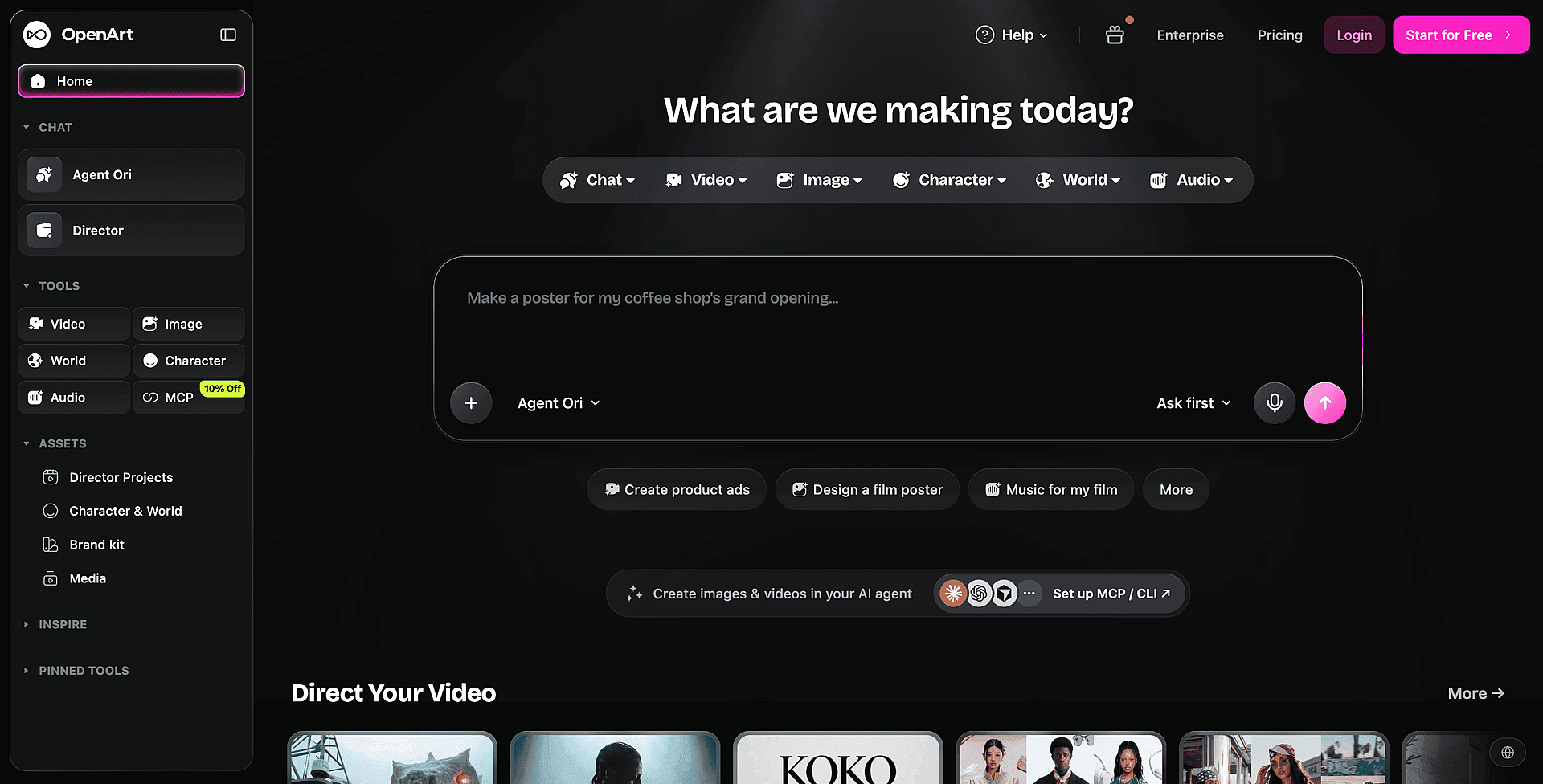
For teams that already work inside Claude, ChatGPT, or Cursor, OpenArt's MCP integration brings image and video generation into that same chat window, with access to OpenArt's full model catalog and your existing project library, so a marketer can generate or reuse assets without switching tools mid-task. Generations through MCP use the same credits as generating directly on openart.ai.
Put together, this is the part that's easy to miss if you only evaluate OpenArt as an image generator: the brand controls, ad-specific generation, and chat-based iteration are built around a marketing team's actual production cadence, not just single-image quality. That's the gap between a tool that makes a nice picture and one that can carry a weekly ad testing cycle.
Pros
- Multiple image models let you test different treatments of the same product without moving between separate tools.
- Saved references and brand fields reduce visual drift across email graphics, social ads, and website banners.
- Built-in editing (in-paint, remove, face, and a conversational chat-to-edit mode) covers common follow-up requests without a separate design tool.
- Image-to-video turns an approved product photo into a short campaign video, a capability the other tools in this comparison weren't evaluated for.
- Ad Creative AI and the Product Ads Generator turn a single approved photo into a running set of video and static ad angles, with brand rules applied automatically, instead of one image you have to repurpose by hand.
- Image generation can fit into supported agent workflows through OpenArt MCP.
Cons
- Free access has a credit ceiling: 40 trial credits, no credit card required, so you can test the workflow but can't keep generating indefinitely without a paid plan.
- Model choice can require more experimentation than a template-led tool such as Canva.
- OpenArt does not target automated, catalog-scale product image production for very large SKU counts.
Pricing
OpenArt prices access through credit-based plans, starting with Starter. New accounts get 40 free trial credits, no credit card required, to test the workflow above. Commercial use rights start at the Plus plan and above; Starter is a paid tier but does not include commercial use rights on its own. Check the live pricing page before publishing for current credit allocations and plan prices, since figures change over time.
Canva Magic Media
Best for: Canva Magic Media gives you the fastest route to on-brand social posts and blog graphics when you already build campaigns in Canva.
What it is: Magic Media generates four image options from a text prompt, then places your choice inside Canva's template editor. You can add your logo, brand colors, and readable overlay text without moving files between tools. Magic Media cannot restyle an uploaded product photo directly, but Canva offers separate editing tools for existing images.
Pros: Canva's template library makes layout work easy for non-designers. The free tier reportedly supports images up to 1024 by 1024 pixels, which suits most social and web graphics. Generation usually takes about 10 to 20 seconds, according to a third-party Canva review.
Cons: Sources disagree on whether Canva Free includes 50 generations each month or 50 generations for the account's lifetime, so verify the current limit before publishing. Another third-party test scored Magic Media 3.0 out of 10 for text rendering and 5.0 out of 10 for product shots. You can avoid generated lettering by adding text in Canva, but realistic studio photography remains a weaker use case. The free-tier watermark policy also needs confirmation.
Pricing: Canva Free provides limited Magic Media access. Reported Canva Pro pricing falls around $13 to $15 per month and includes 500 monthly generations, but current pricing and commercial-use terms require a quick check on Canva's official pages.
Adobe Firefly
Best for: Adobe Firefly suits brand teams that prioritize clear training-data policies and content provenance.
What it is: Firefly is Adobe's AI marketing image generator for campaign graphics, social posts, and concept work. You can adjust composition, lighting, color, and style, then move images into Adobe Express or other Creative Cloud apps.
Pros: Adobe trains its Firefly models on licensed Adobe Stock material and public-domain content, which gives IP-conscious brands a clearer sourcing policy than many generators provide. Adobe also adds Content Credentials to every output. These embedded records disclose AI involvement but do not function as a visible branded watermark.
Firefly provides more than 20 creative controls and supports partner models alongside Adobe's own models. That selection gives you room to test different visual styles without leaving Adobe's workspace.
Cons: Adobe describes the free plan as offering "free daily generations," but it does not publish a specific daily allowance on the cited product page. You should check the live terms before planning regular campaign production. Adobe's published material also does not clearly confirm whether free exports carry a visible watermark or whether identical commercial protections apply across free and paid plans.
Pricing: You can try Firefly through its free daily generation allowance. Paid subscriptions use monthly generative credits, but Adobe's accessible plans page did not provide verifiable prices or credit totals for this comparison.
Freepik
Best for Freepik suits you when you want a broad model roster and a large stock library as a fallback when generated images miss the brief.
What it is Freepik combines AI generation and editing tools with more than 200 million stock assets. A recent review counted more than 41 generative AI models, though free accounts cannot choose most of them directly.
Pros Paid access lets you choose models such as Flux and Mystic, while Seedream is another available option. The platform also includes background removal and upscaling. Paid-model testing found strong results on straightforward prompts, with Flux.2 Pro producing the best instruction fidelity among the models reviewed.
Cons Free accounts receive 20 generations per day through Freepik's Auto model. You cannot directly select Flux or Mystic, and Seedream also remains unavailable as a direct choice. Paid-model results do not establish the quality ceiling of the free Auto setting.
Generated typography can contain gibberish, so Freepik works better for image assets than finished banners with embedded copy. Free commercial rights also remain unclear. Free users may need attribution and could face usage restrictions, so verify the current license before publishing an ad. The available research does not confirm whether free exports carry a watermark.
Pricing The Essential plan starts at $7.50 per month when billed annually, or about $10 with monthly billing. Credit use varies by model and prompt, credits expire each billing cycle, and Essential does not include unlimited generation.
Fotor
Best for Fotor suits solo sellers who want product shots and static ads in one editor instead of moving images between separate tools.
Fotor combines a guided Product Shot workflow with an Ad Maker. You upload an existing product image, choose a generated background, and then place the result into promotional creative. Its model menu includes GPT Image 2, Nano Banana Pro, and Seedream models, although access depends on your credits and plan.
Pros
- The guided workflow makes product photography easier for non-designers.
- Fotor also provides standalone tools for background removal, enhancement, and upscaling.
Cons
- Fotor gives new free accounts six starter credits, but one Product Shot generation costs 15 credits. The starter balance cannot cover that workflow, according to a 2026 review of Fotor's plans and tools.
- Every free-tier export carries a watermark. Fotor also leaves its ongoing free-credit allowance undocumented, so you cannot assume that credits reset monthly.
- Batch background removal requires Pro+, which limits Fotor's usefulness for larger product catalogs.
Pricing Fotor Basic includes the starter credits and watermarked exports. Reported paid pricing starts near £2.33 per month for Pro when billed annually, while Pro+ starts near £4.66 per month and adds batch features. Fotor's pricing varies by billing term and product page, so verify current local rates before publishing or subscribing.
Image types that actually convert, and how to brief a tool for each
Picking a tool is only half the decision. What you generate with it matters just as much. These patterns show up repeatedly in high-converting product images across marketplaces, DTC stores, and social ads, and each one translates directly into a short, specific prompt. Baymard Institute's product page UX research identifies several of these as recurring, testable categories rather than stylistic preferences, which is worth knowing before you dismiss any of them as optional.
Lead with the contrasting feature, not the spec. If your water bottle holds both hot and cold liquids for hours, show it doing that, rather than captioning a number nobody searches for. A shopper is far more likely to register "keeps drinks cold for 24 hours, shown in use" than a spec like "20 KPA suction power" that means nothing without context.
Make it scannable, not readable. You have a few seconds to hold attention. Short text paired with simple graphics beats a paragraph every time. If you're prioritizing which features to visualize, ask two questions: do people actually care about this, and how fast will they understand it if you show it?
Use props and lifestyle context carefully on marketplaces with strict image rules. Amazon's main-image policy, for example, requires your product to fill at least 85% of the canvas, which puts heavily staged lifestyle shots at risk of suppression or account review. A well-designed packaging shot is usually the safer alternative when you want to hint at use case or elevate perceived quality without breaking a marketplace's rules.
Show everything that's included. If your product ships with multiple pieces, put them all in frame. Shoppers perceive more value when they can see the full contents at a glance, and it saves them from digging through your other images to confirm what they're getting.
Surface your other variations. If a shopper searching a broad term is actually looking for a specific color or size you carry, showing your range (or the top 8 to 10, if you have many) in the main image can still catch their attention even if a different variant is displayed by default.
Add color and life to anything transparent. Clear glass or plastic tends to photograph flat. A styled scene with color reads as considerably more premium for the same product.
Zoom in on the detail that backs up your claim. If you're telling shoppers a product is durable, show the hardware. If you're claiming waterproof, show the seal. This also quietly distinguishes you from competitors who only show the whole product from a distance.
Address the sticking point before they have to ask. Every product has a weak spot shoppers worry about. Mining your own review section (or a competitor's, or a category-wide view if you have access to aggregated review data) for the most common complaint tells you exactly what to answer visually, rather than guessing.
Give a size reference instead of just listing dimensions. Comparing your product to a familiar object, or a person, helps shoppers judge actual scale and meaningfully reduces returns driven by wrong assumptions about size. Baymard's research on "in scale" product images treats this as a best practice most product pages still skip, not a nice-to-have.
Show, don't tell. If it's waterproof, show it being rinsed off. If it's extra-long, show it being used somewhere that length matters. This is the same instinct behind a before/after image: concrete visual proof reads as more credible than a claim in text.
Lead with the benefit, not the feature, especially for technical products. Nobody buys a supplement because of a specific ingredient name; they buy it for what that ingredient does for them. Emotional, relatable benefits consistently outperform rational, spec-driven language.
Match your models to your actual customer. A model who resembles your target buyer's age, background, or lifestyle helps shoppers picture themselves using the product; Baymard's research on human-model product images finds this especially relevant for apparel, accessories, and cosmetics. Brand Analytics-style demographic data (age, gender, and similar) is useful for identifying your primary customer, but still aim to represent a reasonable range within your audience rather than a single narrow look.
Every one of these translates into a short prompt: describe the scene, the contrast you want to highlight, and the mood, then let a tool with a reference-locking setting (see the OpenArt workflow above) keep your actual product consistent while it builds the shot around it.
How to choose based on the job you actually have
For a campaign set built around one product photo, choose OpenArt. Image-guided generation lets you keep the product as the visual anchor while changing backgrounds, lighting, and campaign styling. Generate separate compositions for email, social posts, and web placements rather than stretching one image across every format. Credit limits still matter, so approve the visual direction before producing multiple variations.
If your real bottleneck is ad fatigue, the job isn't "generate an image," it's "keep a testing cadence going." Approve one direction, then use the reference-locking workflow to produce the next batch of variations before the current set's click-through rate starts to slip, rather than waiting until performance has already dropped to start on the next round.
For a promotional banner built with a logo and product image, Canva offers the easiest workflow. Upload both assets, place them in a template, and use Magic Media for supporting imagery. Keeping your logo and promotional text inside Canva's editor also avoids asking an image model to reproduce them accurately. Adobe Firefly makes sense when you already assemble campaign materials in Adobe apps.
For studio-style product shots without a photoshoot, OpenArt gives you more control over the visual treatment. Start with a clean product cutout, use it as an image reference, and test models or prompts until reflections and proportions look credible. Fotor offers a more guided Product Shot workflow, but its free starting balance may not cover that specific tool.
For social ads that should not resemble stock photography, choose OpenArt or Freepik. OpenArt suits campaigns that need a recognizable style across several original scenes. Freepik gives you broad visual variety and a stock library for backup, although its free Auto model removes direct model choice. Adobe Firefly fits better when commercial provenance carries more weight than stylistic range.
If you need both stills and a video ad from the same shoot, OpenArt is the one to try first here. Turning an approved product photo into motion, rather than starting a second production for video, is a capability specific to OpenArt among the tools in this comparison.
Side-by-side scorecard
| Tool | Free-tier generosity | Product photo input | Image-to-video output | Quality ceiling |
|---|---|---|---|---|
| OpenArt | ✅ 40 free trial credits, no credit card required | ✅ Supported, with reference-locking for consistency | ✅ Turns an approved photo into a short video or ad | ✅ Strong multi-model options across styles and formats |
| Adobe Firefly | 🟡 Unspecified daily generations | 🟡 Capability needs checking | 🟡 Not evaluated in this comparison | ✅ Strong controls and model choice |
| Freepik | ✅ 20 daily with Auto model | 🟡 Free access unverified | 🟡 Not evaluated in this comparison | 🟡 Best models require paid access |
| Canva Magic Media | 🟡 50 lifetime or monthly, unverified | ❌ Magic Media is text-only | 🟡 Not evaluated in this comparison | 🟡 1024 by 1024 free output |
| Fotor | ❌ Six starter credits | ✅ Product Shot workflow | 🟡 Not evaluated in this comparison | 🟡 Strong models, tight free access |
Which tool fits your situation
- Solo marketer running paid social. Choose OpenArt when ad fatigue means you need a steady stream of fresh, on-brand variations, not just one hero shot. The reference-locking workflow and chat-to-edit re-briefing above are what let one person cover a testing cadence that would otherwise need a designer on call.
- Lean team covering every channel from one asset. Choose OpenArt when the same product photo has to become an email header, a square feed post, a vertical story, and a landscape banner without a separate production for each. Its model options, including Seedream 4.5, GPT Image 2, and Nano Banana Pro, give you more control over backgrounds and visual styles, and image-to-video covers the placements that need motion.
- Solo ecommerce seller. Choose Fotor when you want a product-shot and ad-making workflow in one place. Free exports carry a watermark, and the initial credit balance may not cover its Product Shot workflow.
- Non-designer needing a banner fast. Choose Canva when you already have a logo, product image, and brand colors. Magic Media fits directly into Canva's templates, so you can generate an image and place it into a finished banner without learning a separate design tool.
- Brand team concerned about IP risk. Choose Adobe Firefly when training sources and content provenance guide your approval process. Adobe's commercially focused positioning and Content Credentials make Firefly easier to assess under stricter brand policies, though you should confirm current free-tier rights before publishing.
Frequently asked questions
Is there a truly free AI marketing image tool? A truly free tool lets you generate and export images without paying, although usage caps still apply. OpenArt provides 40 free trial credits with no credit card required rather than unlimited free generation. Canva, Freepik, and Adobe Firefly also offer capped free access, so you may need a paid plan for regular campaign production.
Can AI turn a product photo into an ad? An AI product photo generator can place an uploaded item into new scenes and create campaign variations. OpenArt can reuse your source image and brand assets across styled backgrounds and ad concepts. You can produce related visuals for social, email, and web without arranging another photoshoot.
Why do AI product photos sometimes look obviously fake? Three things usually cause it: using a general-purpose tool that wasn't built for image creation, writing an overcomplicated prompt that confuses the model instead of guiding it, and leaving in AI-typical artifacts like overly smooth textures or slightly wrong label text. A purpose-built image tool, a short and specific prompt, and a setting that locks onto your actual product all help avoid this.
Can I get a video, not just a still image, from these tools? Most free image generators in this comparison stop at stills. OpenArt extends the same uploaded product photo into a short video using image-to-video generation, which is worth checking if your campaign needs a moving asset alongside static images.
How do I keep ad creative fresh without a design team? The practical fix is to stop treating each new ad as a new production. Approve one hero image, then re-brief it (new background, new crop, a different callout) instead of starting from a blank prompt every time. That's the workflow OpenArt's chat-to-edit tool is built around, and it's closer to how a performance marketer actually needs to work than a one-shot generator is.
Can I get the same image in different aspect ratios for different placements? Not automatically in most of these tools. OpenArt's chat-style editor can re-brief an approved image into a new crop or composition (square, vertical, landscape) by keeping the product and background instructions the same and changing the framing request, which covers a handful of formats without a second design tool. None of the other four tools in this comparison were evaluated for this specifically, so confirm it fits your placement list before relying on it for a full campaign.
What is the easiest tool for non-designers? Canva offers the easiest route to a finished banner because its templates handle layout and text placement. OpenArt fits better when you want custom product scenes and less stock-like campaign imagery. Your choice depends on whether you need fast layout work or more control over the generated image.
Do free-tier images have watermarks and commercial rights? Watermark and licensing rules differ across free plans, so free access does not guarantee ad-ready exports. OpenArt confirms commercial use for Plus plans and above; its free-trial watermark status remains unverified. Fotor watermarks free exports, and Canva, Freepik, and Adobe policies need a live license check before publication or commercial use.
The bottom line
Choose a free AI image generator by the work you need to finish. Credit totals show how long you can experiment, but image-to-image control, watermark rules, and commercial rights determine whether you can publish the result. Most AI product photos that look fake aren't a tool problem: they come from the wrong tool, an overcomplicated prompt, or an uncorrected AI artifact, all of which are avoidable once you know to look for them.
If you want to turn one product photo into a coordinated set of styled campaign visuals, stills and video, try OpenArt. Its multi-model workflow lets you test backgrounds and campaign variations while keeping the source product consistent. Start with the available credits, confirm commercial-use terms for your plan, and upgrade when you need more output.