
 ChatGPT
 Perplexity
 Claude
 Gemini
We typed "ice-cold soda can on a summer picnic table" into an AI image generator. We never named a brand, and the copyright scan still matched the Coca-Cola logo and can design at 100%.
So can you use AI-generated images commercially? In most cases, yes. You can use AI-generated images commercially when your plan allows it, the image doesn't copy someone else's IP, and the place you post or sell accepts AI content.
This guide covers each of those checks, with real scan results, platform terms checked this month and rules for ads, Etsy, stock sites, and client work.
Key takeaways
- Most paid AI plans let you use AI-generated images commercially, and some free plans do too.
- In our test, 6 of 7 brand-free prompts came back with a real brand's logo, product design or character.
- A commercial license lets you use an image, and copyright lets you stop others from copying it. Prompt-only AI images usually don't get copyright in the U.S.
- Etsy and Adobe Stock accept AI images with disclosure, and Shutterstock doesn't accept AI uploads from contributors.
- A pre-publication IP review catches logos, designs and characters before you spend money on a campaign.
Disclosure: OpenArt makes an AI image generator and the IP Safety Check used in our test. Platform terms were checked on November 5, 2026. This article is general information and isn't legal advice.
The Short Answer: When You Can Use AI-Generated Images Commercially
You can use AI-generated images commercially when all four of these checks pass:
- Your plan allows it. Read the AI tool's terms for commercial rights, ownership and any free-plan limits.
- The image is clear of other people's IP. It shows no real logo, iconic product design, famous character or real person.
- Your destination accepts it. The ad platform, marketplace, or stock site allows AI-generated images, and you follow its labeling rules.
- You have the rights the job needs. If a client needs to own the image outright, you know what rights you can actually hand over.
Check 2 is the one most people skip. Our test shows why it matters.
We Asked for 7 Brand-Free Product Photos. 6 Came Back With Someone Else's IP.
Most advice on AI image generation says the same thing: to avoid copyright, trademark or likeness claims, don’t type brand names, celebrity names or character names into your prompt. We wanted to know if that's enough, so we tested what happens when you follow the advice and write a plain, brand-free prompt.
We created 7 everyday products and scenes that brands use in ads using OpenArt AI image generator. Then we scanned every result for IP. Here's how we ran it:
- Model: GPT Image 2.5 Sunburst on OpenArt, 2K, prompt enhancement off
- Prompts: typed word for word, with no "no logo" instruction
- Images: the first result from each prompt, with no rerolls
- Scan: OpenArt IP Safety Check, November 5, 2026
| Prompt (shortened) | Result | What the scan matched |
|---|---|---|
| White wireless earbuds in a charging case | Detected | AirPods Pro design (Apple), 98% |
| Runner's shoes on a red track | Detected | Nike Swoosh 90%, Nike running shoe design 85% |
| Soda can on a picnic table | Detected | Coca-Cola logo 100%, Coca-Cola can design 100% |
| Takeaway coffee cup with a croissant | Undetected | No matches |
| Red sports car on a coastal road | Detected | Ferrari 488 Pista design 100%, Prancing Horse logo 100% |
| Kid in a superhero costume at a party | Detected | Spider-Man 98%, Wonder Woman 95%, Batman 85% |
| Laptop on a wooden desk | Detected | MacBook Pro design (Apple), 95% |
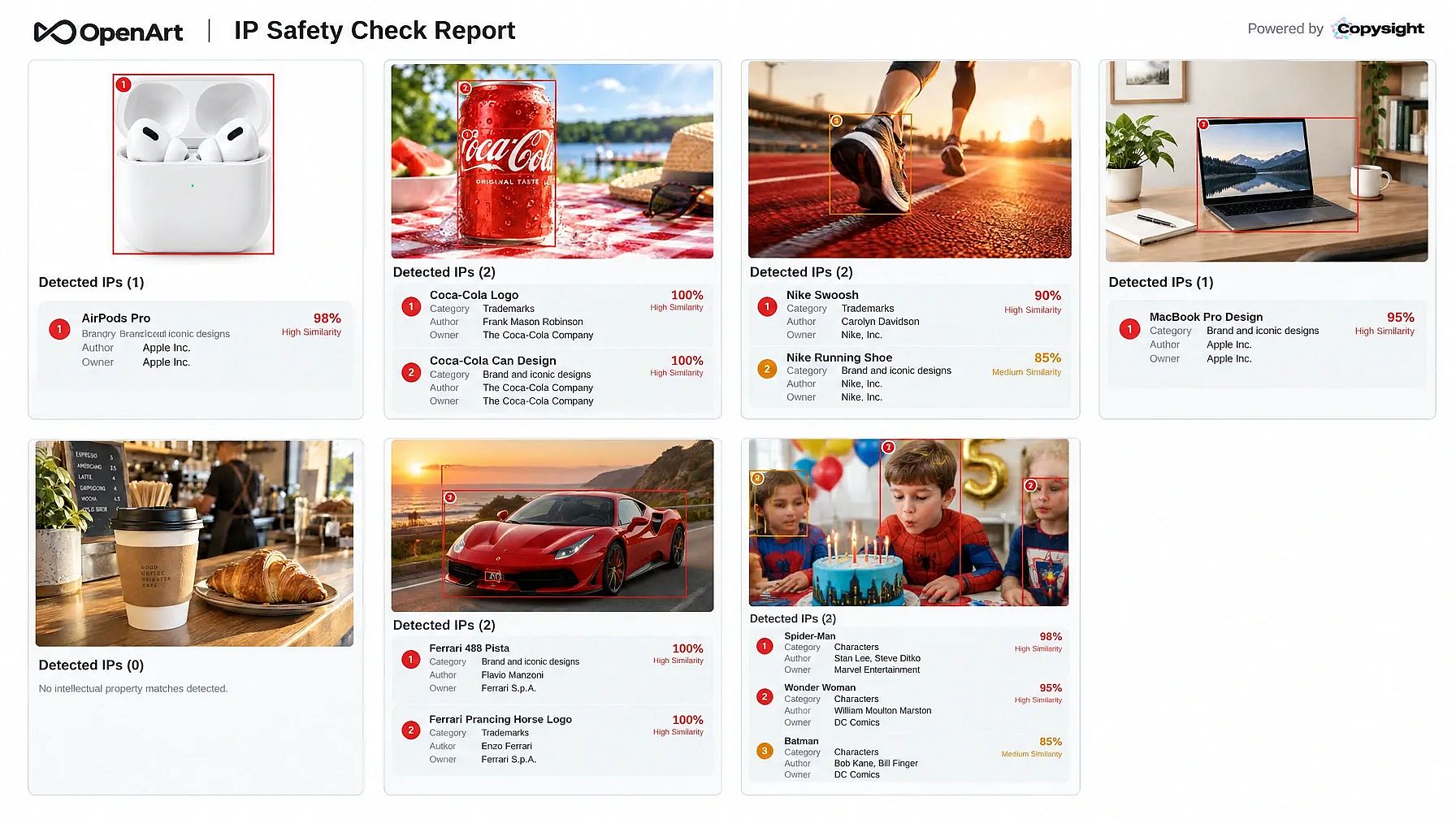
What the results show:
- A shape can be enough. The earbuds and the laptop had no visible logo, and the scan still matched Apple's product designs at 98% and 95%.
- One prompt can bring several characters. We asked for one kid in a generic superhero costume. The image also showed two other kids dressed as Wonder Woman and Batman.
- Plain scenes can come back clean. The coffee cup had a blank sleeve, so the scan found nothing.
In total, the scan found 11 matches owned by Apple, Nike, Coca-Cola, Ferrari, Marvel, and DC. If you planned to use AI-generated images commercially in an ad or on merch, any of the 6 flagged images could invite a trademark or copyright claim.
What this means for you:
- A clean prompt doesn't guarantee a clean image. AI models learn from millions of real photos, so they fill gaps with the most familiar version of a product, and that's often a famous brand.
- Iconic products need the most care when you use AI-generated images commercially. Earbuds, sneakers, soda cans, sports cars and laptops all have one look that a single brand made famous.
- Specific details lower the risk. Describe your own colors, shapes and packaging, such as "matte green earbuds with a square case," so the model has less room to borrow.
- Scan every image before you use AI-generated images commercially. Our scans took seconds and cost 30 credits per image, which is far less than pulling an ad or a product listing later.
The rest of this guide covers the other three checks: your plan, where you publish and the rights you can hand over. The pre-publication IP review section shows how to run the same scan on your own images.
Which Uses of AI Images Count as Commercial?
Commercial use means using an image to make money or promote a business. Personal use covers things you keep for yourself or share without any business purpose.
| Commercial use | Personal use |
|---|---|
| Ads, sponsored posts and product listings | A phone wallpaper or a personal art print |
| T-shirts, mugs and other merch you sell | A birthday card for a friend |
| Client projects and agency work | A mood board for a hobby project |
| Stock photo sales | Practice images while learning a tool |
| A business website, blog or newsletter | A post on your personal account with no promotion |
| Thumbnails on a monetized channel | Thumbnails on a hobby channel with no ads or sponsors |
If an image helps you earn money, even indirectly, you're planning to use AI-generated images commercially, and the rules below apply.
How Your AI Image License and Copyright Work Together
Your AI tool's terms give you a license, which is the permission you need to use AI-generated images commercially. Copyright is a separate right that lets the owner stop others from copying a work.
In the U.S., copyright needs human authorship. The U.S. Copyright Office's January 2025 report says prompts alone usually aren't enough, and the Supreme Court declined to hear Thaler v. Perlmutter in March 2026, which left that rule in place.
Human work can still earn protection. In Zarya of the Dawn (2023), the Copyright Office protected the author's text and the way she arranged the comic, while refusing protection for the Midjourney images themselves. Our guide on whether AI-generated images can be copyrighted covers this in more detail.
What It Means for Your Business If You Can't Copyright an AI Image
You can still use AI-generated images commercially without copyright, including selling and printing them. What you lose is the power to stop a competitor who copies it.
That matters most for assets you want to own long term, like a mascot, a logo or a signature product shot. Editing the image yourself, adding your own text and combining it with photos you took all add human authorship you can protect.
Other countries handle this differently. UK law has a rule for computer-generated works, the EU looks for a person's free and creative choices, while the status of AI-generated images remains uncertain in India and Canada.
China shows how much your records matter. In Li v. Liu (2023), the Beijing Internet Court protected an AI image because the creator worked through more than 150 prompts and then edited the result. Two years later, a court in Zhangjiagang went the other way in Feng v. Kuashi Plastic (March 2025). A designer used Midjourney to create images of a butterfly-shaped children’s chair, and a company sold the design without permission.
The court dismissed her case. She had no record of her creative choices and couldn’t recreate the images, so the court found that Midjourney had made the key design decisions and that her prompts were only ideas.
The lesson applies everywhere: if you use AI-generated images commercially, save your prompts, versions and edits. If someone copies your AI-assisted design, that record is your best proof of human authorship.
AI Images Commercial Use Rules by Platform
Every AI image generation tool has its own rules for using AI-generated images commercially. Here's what five popular platforms say, based on their terms and help pages as of November 2026.
| Platform | Free plan | Paid plan | Who owns the output | Notes |
|---|---|---|---|---|
| OpenArt | Personal use only. Images may carry a watermark. | Plus plans and higher allow commercial use. | OpenArt claims no ownership of your output. | Paid plans include IP Safety Check. Enterprise plan includes single broad indemnification agreement |
| Midjourney | No free plan | Commercial use allowed. | You own your images. | Companies earning over $1 million a year need a Pro or Mega plan to own their images. |
| Leonardo.Ai | Commercial use allowed, but images are public, and Leonardo owns them. | Commercial use allowed. | You own your images. | Paid users can keep images private, and Leonardo won't train on private content without consent. |
| ChatGPT (OpenAI) | You own the output | You own the output. | You do, to the extent the law allows. OpenAI also assigns you any rights it has in the output. | Output may not be unique, and your ownership doesn’t cover similar images other users get. OpenAI may use your content to improve its models unless you opt out. You must not use output related to a person for any purpose. |
| Adobe Firefly | Watermarked outputs | Commercial use allowed. | You can use your outputs commercially. | Trained on Adobe Stock, public domain and openly licensed content. Offers IP indemnity for enterprise customers . |
| Google (Gemini app and Gemini API) | Images in the Gemini app carry a visible watermark. On the free Gemini API, Google may use your prompts and images to improve its products. | On the paid Gemini API, Google doesn’t use your prompts or outputs to improve its products. Google’s top Gemini app plan removes the visible watermark. | Google won’t claim ownership of your images, and you’re responsible for how you use them. | Google may generate the same or similar images for other users. Every image carries an invisible SynthID watermark. |
Terms change often, so save a dated copy of the terms page each time you use AI-generated images commercially on a new project.
Can You Use AI-Generated Images Commercially on a Free Plan?
Whether you can use AI-generated images commercially on a free plan depends on the tool. OpenArt's free plan covers personal use, while Leonardo's free plan allows commercial use with a catch: your images are public, Leonardo owns them, and other users can reuse them.
Free plans also tend to add watermarks or show your work in a public gallery. If you need free images for marketing, compare the options in our list of free AI image generators for marketing.
Which AI Platforms Offer Indemnity?
Indemnity means the platform agrees to help cover certain legal costs if its output gets you sued. Adobe offers it for Firefly business customers, and OpenArt's enterprise plans include an indemnification agreement.
Indemnity usually comes with conditions. Coverage applies when you follow the platform's terms, so prompting for a celebrity or a competitor's logo can leave you without it.
Can You Use AI Images in Ads, Merch and Client Work?
When you use AI-generated images commercially, risk depends on where the image goes and how much money rides on it. Use this table as a starting point.
| Use | Risk level | What to check |
|---|---|---|
| Blog headers, website backgrounds, thumbnails | Low | Plan terms and a quick IP scan |
| Social posts and organic content | Low to medium | Platform AI labels |
| Paid ads | Medium to high | IP scan, ad claims, AI labels |
| Merch and print-on-demand | High | IP scan and marketplace rules |
| Stock photo sales | High | Stock site rules and labels |
| Logos and brand assets | High | Copyright and trademark advice |
| Client deliverables | High | Contract terms and disclosure |
AI Images in Ads and Social Media
You can use AI-generated images commercially in ads once the image passes an IP scan and the ad makes honest claims. Avoid fake customer photos, fake before-and-after results and any image that suggests a real person or brand endorses you.
Platforms also ask for labels. YouTube asks creators to label realistic AI-made or altered content, Meta shows an "AI info" label on content it identifies as AI-made, and the EU AI Act's transparency rules have required clear labels on deepfakes since August 2, 2026. To make the ads themselves, you can start with the AI commercial generator.
Selling AI Art on Etsy and Print-on-Demand Sites
Yes, you can sell AI art on Etsy if you play a clear creative role and say you used AI. Etsy’s October 2026 policy update allows AI art made from your own prompts or inputs and lists it under “Designed by a seller.”
Here’s what Etsy requires now:
- Disclose AI use. Say in your listing that the item was created with AI. Never describe AI work as handmade or as entirely your own creation.
- Show the real item. Every listing needs at least one unedited photo of the actual product against a real background, such as the printed poster on a wall or the mug on a table.
- Keep every photo accurate. You can use AI to fix lighting, crop or change the background, as long as the item looks the same as what the buyer receives. If it doesn’t, you may have to refund the buyer.
- Stay involved. Etsy removes listings created by bots with no human involvement, and it can close the shop. AI-written patterns, recipes and instructions are no longer allowed.
California adds one more rule. Etsy notes that from January 1, 2027, listing images or videos that prominently feature an AI-generated synthetic performer, such as an AI model wearing your shirt, may need a clear disclosure under California’s SB 1050.
Etsy’s AI rules focus on disclosure and honest photos, so when you use AI-generated images commercially on merch, checking for logos and characters is still your job. Print-on-demand sites remove designs that copy brands or characters, and our superhero result showed a “generic” design coming back with three famous characters.
Selling AI Images on Stock Photo Sites
To use AI-generated images commercially on Adobe Stock, check "Created using generative AI tools" and mark people and property as fictional. Its rules also ban artist names, real people and fictional characters in your prompts, titles and keywords.
Shutterstock takes a different approach. It doesn't accept AI-generated content from contributors, and it sells images from its own AI generator instead.
AI Images in Client Work and Agency Projects
When you use AI-generated images commercially for a client, expect them to want ownership, and know that you may not have full copyright to hand over. Tell clients when you use AI, and agree on contract wording that transfers your rights "to the extent they exist".
Keep a record of the tool, plan, prompt, edits and scan report for every deliverable. Records like these are evidence that an image wasn't copied from someone else's work. See how one team handled a large brand project in our AI fashion ad campaign case study without any copyright issues.
Using AI Images for Logos and Brand Assets
A logo needs protection, so treat AI as a starting point here. Generate ideas with the AI logo generator, then redraw or edit the final version yourself to add human authorship.
Trademark and copyright work differently. Trademark rights come from using a mark to identify your business, so search the USPTO database before you commit, and ask a trademark lawyer before you register an AI-assisted logo. Once you have a final logo, store it in your AI Brand Kit so new images use the real version.
Thumbnails, Websites and Blog Images
These are some of the safest ways to use AI-generated images commercially, since the image supports your content and isn't the product itself. A quick scan still helps, because a famous logo in a thumbnail can trigger a complaint.
For a full walkthrough, see our guide to check if an AI image is copyrighted.
Where AI Images Commercial Use Gets Risky
Most legal trouble when people use AI-generated images commercially comes from a few patterns. Our test hit four of them without trying.
- Logos and iconic product designs: Trademark and trade dress protect brands, including how a product looks. In Canada and the UK, this can also count as "passing off".
- Famous characters: Spider-Man, Batman and Wonder Woman all appeared from one generic prompt. Characters are protected even in a new pose.
- Real people and lookalikes: Using a face that looks like a celebrity can break personality or publicity rights.
- A living artist's style: Prompting "in the style of" a working artist can lead to backlash and legal risk.
- Fake endorsements: Never suggest that a real person or brand approves of your product.
- Training-data disputes: In the UK, Getty Images lost its copyright claims against Stability AI in November 2025 and won only a narrow trademark claim.
The stakes are real. In the U.S., statutory damages for copyright infringement run from $750 to $30,000 per work, and up to $150,000 if a court finds the copying was willful.
How to Run a Pre-Publication IP Review
A pre-publication IP review takes a few minutes per image and is the simplest safeguard before you use AI-generated images commercially. Run it before an image goes into an ad, onto a product or to a client:
- Save your plan terms. Screenshot or download the AI tool's current terms and note the date.
- Scan the image for IP. Run a pre-publication IP review with OpenArt's IP Safety Check, which flags logos, brand designs, characters and famous faces. In our test, each 2K image cost 30 credits to scan.
- Reverse search any reference. If you started from a stock photo or a found image, trace its source with Google Lens or TinEye.
- Search brand names. Check the USPTO trademark database for any name or symbol in the image.
- Fix and scan again. Remove a flagged logo, regenerate with a more specific prompt, or redesign the product. Then scan again and save the clean report.
For other tools that check music, video and writing, see our guide to the best AI copyright checkers.
AI Images Commercial Use Checklist
Before you use AI-generated images commercially, confirm each item:
- My plan allows commercial use, and I saved a dated copy of the terms.
- I didn't upload logos, artwork or photos I don't own as references.
- An IP scan found no logos, product designs, characters or famous faces, or I fixed them.
- The image makes no fake claims or endorsements.
- The marketplace or ad platform accepts AI images, and I added any required label.
- My client knows I used AI, and our contract covers rights.
- I kept records of the tool, prompt, edits and scan report.
- A lawyer reviewed anything high stakes, like a logo or a national campaign.
Final Thoughts
You can use AI-generated images commercially in most cases, as long as the plan, the image and the destination all check out. Our test showed that the image itself is where most of the risk hides, even when the prompt names no brand.
Make your images in the AI image generator, run a pre-publication IP review on each one, and keep the report with your files.
Frequently Asked Questions
Can you use AI-generated images commercially from a free plan?
Sometimes. Leonardo's free plan allows commercial use, but the images are public and Leonardo owns them. OpenArt's free plan covers personal use, and commercial use starts with the Plus plan.
Can I sell AI art on Etsy?
Yes. Etsy treats AI art as "Designed by a seller" and requires you to disclose AI use in the listing description. Scan designs first, since Etsy and print-on-demand sites remove items that copy brands or characters.
Who owns AI-generated images?
Usually you do under the tool's terms, though rules vary by platform and plan. Owning an image under a platform's terms is different from holding copyright, which prompt-only images usually lack in the U.S.
Can I use Midjourney or ChatGPT images commercially?
Yes. Midjourney says you own your images, though companies earning over $1 million a year need a Pro or Mega plan. OpenAI assigns you its rights in ChatGPT images, and you're still responsible for checking them for IP.
Do I need to label AI images in ads?
Often, yes. YouTube and Meta both use AI labels, and the EU AI Act now requires clear labels on deepfakes. Check each ad platform's rules before your campaign goes live.
Can I trademark an AI-generated logo?
Trademark rights come from using a mark to identify your business, so an AI-assisted logo may qualify. Edit the final design yourself, search the USPTO database, and ask a trademark lawyer before you file.
Can you use AI-generated images commercially for client work?
Yes, if your plan allows it and you tell the client. Put the rights transfer in writing, keep your records, and scan every deliverable before you send it. For AI video, see the AI video generators for commercial use and [how to check a video for copyright].
Can I sell AI images on stock photo sites?
Yes, on some. Adobe Stock accepts labeled AI images that meet its rules, and Shutterstock doesn't accept AI uploads from contributors.
Does a paid plan protect me if an AI image infringes?
A paid plan lets you use AI-generated images commercially, and it usually leaves the IP risk with you. Some platforms offer indemnity on business or enterprise plans, and an IP scan before publishing is still your best protection.