
 ChatGPT
 Perplexity
 Claude
 Gemini
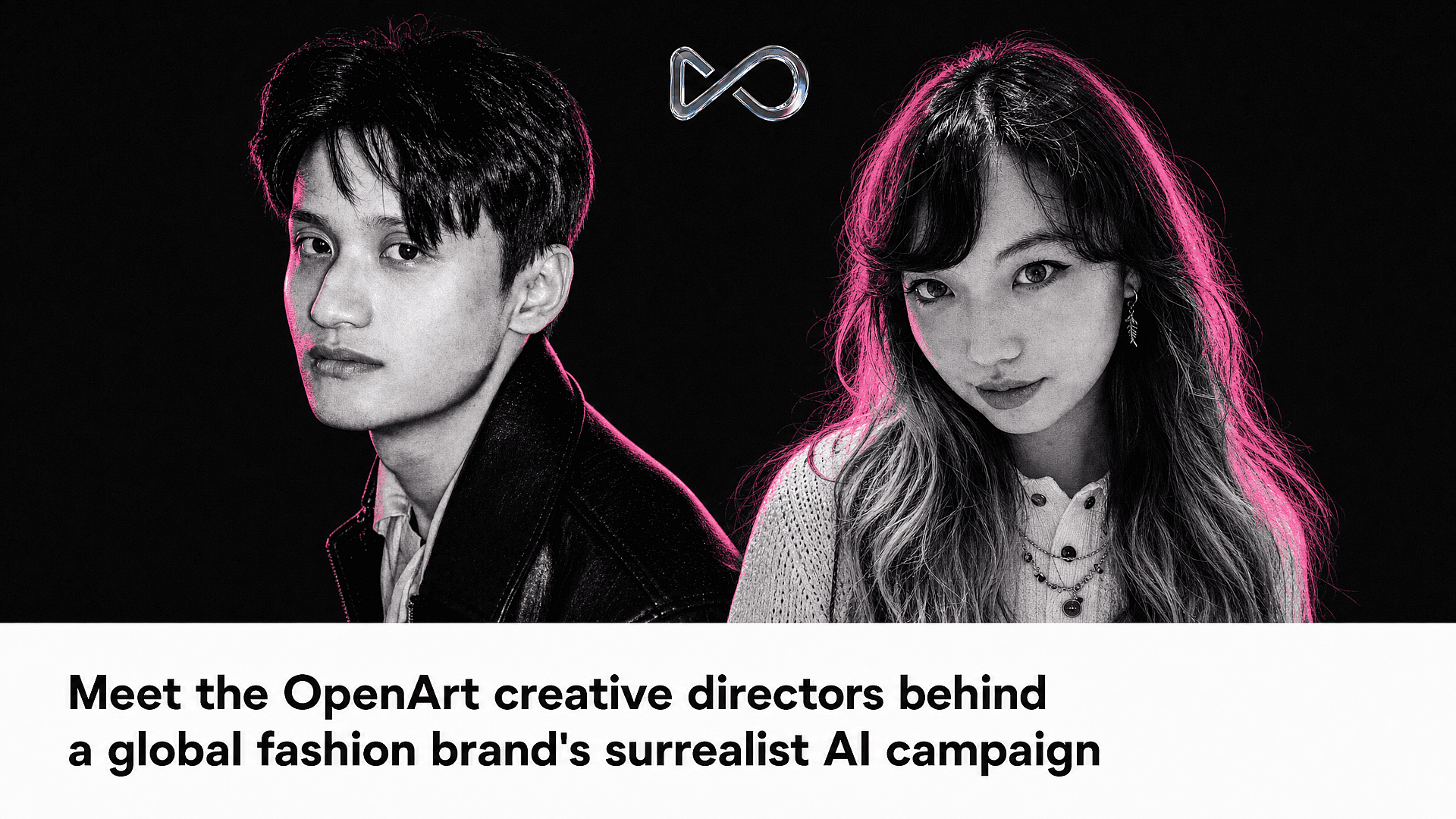
For its 2026 fall/winter collection, Shein worked with OpenArt on a campaign of six fully AI-generated social ads, one for each of the season's trends: dark romance, folk revival, power dressing, regal maximalism, retro remix and soft glam. Ash He and Minyu Chen, two of OpenArt's creative directors, helped shape and deliver all six.
Both are part of OpenArt's Studios team, a group of storytellers and creative producers who are making some of the best work in film, music and advertising today, and the Shein campaign was a chance to show a brand at that scale what the team can do. Ash came to AI from CGI commercials, Minyu from producing across film, TV and advertising. They're two of the most talented storytellers and creative technologists I've known, and after working with them, I'm nearly certain there's nothing they couldn't make if they set their minds to it.
The brief gave them room. Shein told the team to be as creative as possible, and with AI they weren't held back by real locations, travel, weather or set budgets. "They wanted something they can't do in reality," Ash says. "That's why we use AI." Minyu describes the target as "something very wild that only AI can do, or something that would be very difficult or cost a lot for a real production," which pushed the work toward the surreal.
It was the brand's first time working with an AI creative team, and they didn't arrive with a fixed idea of what the process should look like. Ash's read is that, to the brand, AI was just another production method, much like CGI, which left room for him and Minyu to help define the workflow with Shein instead of inheriting one. In July, Shein sent over the trend names and the pieces from the collection, and the two creative directors styled them into looks for the screen. Some trends came with outfits already assembled, and when Minyu, building the dark romance spot, saw a way to push the looks closer to the world she was imagining, she proposed changes and asked. "They are very open to it," she says.
That openness didn't mean the creative directors said yes to everything, and it didn't mean they were attached to their first ideas. "We're not like, this is so good, I don't want to change it. We are not like that," Minyu says. "We definitely don't accept everything. We definitely fight for it a little bit." That balance is a large part of what makes the two of them good at this work. They push creative boundaries without making it about themselves: the goal is to keep peeling back layers until the best idea is what's left, not to hang one person's vision on a wall, and that matters even more when the work belongs to a client. Their curiosity and humility, as much as their passion for the craft, are what make them such an asset to OpenArt and, as this project shows, to the creative vision of a global fashion brand.
AI also changed how many jobs a single creative can step into. On a traditional shoot, that work is split across specialists. The director shapes the vision, and the director of photography decides how every shot is framed, lit and moved. A costume department chooses and fits the wardrobe, a stylist pulls it into looks, and hair and makeup artists finish each one, while a production designer builds the world the story takes place in. Each of those is its own department, and the people in them rarely touch one another's decisions. "If I'm the DP, normally I'm not touching the costume, that's a whole different department," Minyu says. "But right now we're doing all of it ourselves: directing, camera movement and framing, costume, hair and makeup, figuring out what should even be in the shot. We're doing the production designer's job too."
For Ash and Minyu, that meant stepping into roles they would never have held on a traditional production, building new skills as they went and getting a level of control over each ad that a director rarely has. None of it took work away from the specialists who do those jobs on a live shoot. Shein ran both lanes, its traditional human-made campaigns and an AI campaign built to push the limits of what's possible, and nobody lost anything along the way. For creatives wary of what AI means for their work, it's a useful picture of what the technology can open up instead of close off.
A third person kept the arrangement workable. Sissi Lei, from OpenArt's business development team, worked as producer, sitting between the two creative directors and Shein and running the relationship, communications and PR so neither of them had to. "Sissi gave us the space to be totally creative," Minyu says, "so when it came to feedback, we were able to communicate directly with the Shein team."
Two ways to prompt
So how did two creative directors turn six trends into six finished ads in about a month? They shared a process, and each worked inside it in their own way. Every trend started with a character sheet: a close-up, a side shot, a hero shot and a full-body shot of the model in each outfit, much like the costume and makeup test on a traditional production. Minyu built hers in GPT Image 2, which she found held the product and the model's likeness most faithfully. Concept stills came next, so the client could approve a look before any motion got generated, and OpenArt's Multi-view feature then pulled several angles out of a single approved location image, a kind of virtual location scouting that didn't need a new prompt for each one.
Minyu's prompts read like shooting scripts: long, moment by moment, built on very few reference images. Ash's are short and carried by reference images, and he says he had little experience writing a long prompt like a script. He builds high-fidelity stills first, and once he has those, "I feel like, okay, I can control this video." They brainstormed each trend together, then split the six ads three apiece and worked separately, since their timelines differed, checking in along the way. "Somehow Ash uses some of my prompts, and I use some of Ash's way of doing it," Minyu says. "We help each other."
Both of them are firm that the tool isn't the hard part. "The idea is the most important part," Minyu says. "The rest is just how well you master the AI." For Ash it comes down to judgment: which clips you choose and what you want the visual to be all live in your head, and so does your aesthetic. Minyu writes about eighty percent of each prompt herself, then hands it to GPT to expand and tighten, because "there's a specific way you talk to AI." Her view is that "AI creators should save their time and energy for the idea."
Real models, rights cleared
The models in the campaign were real people. Their likenesses were rights-cleared and paid through a licensed AI model partner, and the team built each trend's look from the models' photos instead of from generated faces. Sissi framed it in the webinar as a way for real models to keep participating in fashion advertising, a version of the technology OpenArt wants to be known for. Minyu has a practical reason too. "There are so many people in the world, you never know," she says. "The AI could end up generating someone who looks like a celebrity, or even a small YouTuber."
It also meant a model dropping out was a real problem. Partway through the power dressing video, after Shein had approved the final cut, one of the licensed models quit. Replacing a face in a finished AI video is harder than it sounds. "Everybody knows AI can't generate a hundred percent the same thing," Minyu says. "And one video isn't one generation. It's so many generations added together. So at that point it was really risky."
With the cut approved and the schedule fixed, Minyu went to her own contacts to find a replacement model. "I really value my work, and I didn't want this to destroy it," she says. Within about half a day she had found someone who looked very close to the original.
The harder problem was the face itself. The video model accepts a video as a reference, but when she fed in the original footage along with the new model's photo, it blended the two faces. "The face information in the old video is kind of noise for the AI," she says, "so it's very hard for it to get rid of that part." They tried several workarounds, and none of them held.
Then Ash suggested a depth map. Minyu had seen the technique online but hadn't thought to use it this way. "I was like, wait, that's a genius idea," she says. She had little experience with vibe coding, so she used Codex to generate the depth-map video from the approved cut, which took her longer than it would have taken Ash. "But my time was only two hours," she says. "Two hours is not a lot."
Once it worked, the recipe was this: the depth map became the reference for camera movement and composition, the new model's photo supplied the face, and a long prompt described the location, the product and what should happen second by second. Minyu likens a depth map to a gray-box render with the camera baked in, so the blocking and movement stay put while everything on top gets reskinned. "We successfully changed the model's face," she says, "and our clients didn't notice." By then Seedance 2.5 had been released, and the new version even came out with better lighting.
The fix has outlived the project. Ash later built a simple web tool that outputs a depth map from any uploaded video, and the technique became Ad Remake, a feature in OpenArt where you upload a finished video and the platform builds the depth map behind the scenes. From there you can swap the model, the product or even the language, which Minyu pointed to as a natural fit for localization and global marketing. It has a limit worth knowing about: a depth map mostly captures outlines, so it works best when the hairstyle stays the same, and a different hairstyle calls for a different approach.
What one month made room for
The schedule shows what the workflow changed. Ash laid out the math in the webinar for his retro remix spot. A live-action green screen version would mean a crew of eight to twelve, one to two weeks of pre-production, and an estimated $15,000 to $40,000 on location before model fees, plus a CGI team of more than ten people working for over a month. He finished the spot in about five days, with one or two people. Ash knows the other version of that timeline from his CGI work: the same work would have taken three to four months at least, and a single revision could take a week. Here, a major change of direction took twenty-four hours.
The more telling point is about the brief itself. Asked what a fully human production of these ads would have taken, Ash didn't give a longer timeline. He said he wouldn't have proposed the ideas at all. "It would cost a lot in CGI," he says, "so at the beginning, I wouldn't have proposed this." A brief this surreal is only possible with AI, because the human alternative is too expensive to justify it: ideas like these mean elaborate rigging on a live set, and anything involving a horse brings animal-handling concerns with it. Minyu, thinking like the producer she used to be, says she'd never have said yes to this kind of concept before, and that if someone had pitched her these ideas back then, her answer would have been to ask for a budget of more than a hundred thousand dollars.
A live shoot also locks everything early. "You cannot do any change after the shooting," Minyu says, which is why traditional productions hold so many meetings before the camera rolls: a reshoot is that costly. Here nothing had to be final. Partway through one spot the team swapped the animal in the shot for a horse, an idea that only came up after the client had seen a first cut. In the summary Chloe Fang, OpenArt's Head of Enterprise Go-to-Market, wrote afterward, that's the first shift she lists: "The visual became the communication medium, not just the final output."
Ash's retro remix spot shows how that played out. His first version blended Y2K nostalgia with early-computer imagery: a Windows XP sky, CRT monitors, a model riding a surfboard through a digital portal. The client had pictured American nostalgia instead, with motels, diners and vintage cars. His second version moved an American highway into space, and the client found it a little too rigid and wanted something softer, sweeter and more girlish. That was when Ash realized the cars and diners were never the point. "They were actually trying to describe a certain feeling," he says, and the props didn't all have to appear. The final cut opens briefly in a digital space, moves into a wood-paneled bedroom with a floating bed and gadgets built into the furniture, and ends on an upside-down Los Angeles sunset where the model sails a speedboat across a sea of clouds. The client was extremely satisfied, and that last round of iteration took about twenty-four hours.
It's also Ash's favorite shot in the campaign. "It's like the sky is the ocean," he says. He describes the work as fun in a way CGI rarely was: he could finish a spot in a few days, test an idea, and if it hit a problem, look for another creative route. Before AI, he'd spend a month in Unreal or Cinema 4D, "which aren't really for humans to use," and then wait days for a render with nothing to do in the meantime.
For Minyu, the proudest moment wasn't a single shot. It was watching the client's reaction each time she showed new work. "They were like, wow, I feel like this is good," she says, and when she asked for feedback, the answer was: "I think it's great." She has worked across variety shows, TV dramas, feature films and ads, and says that after all of it, "right now I see a new possibility, which is AI production."
Ash and Minyu walked through this campaign in an OpenArt webinar, from the creative brief to the final campaign. Watch the recording, and join us for the next one: we host webinars every two weeks.