


 ChatGPT
 Perplexity
 Claude
 Gemini
In The Princess Diaries, it takes a full montage and one very painful eyebrow scene to turn Mia into a princess. But your makeover can happen in about a minute with a selfie and an AI makeup prompt, and none of Mia's dread.
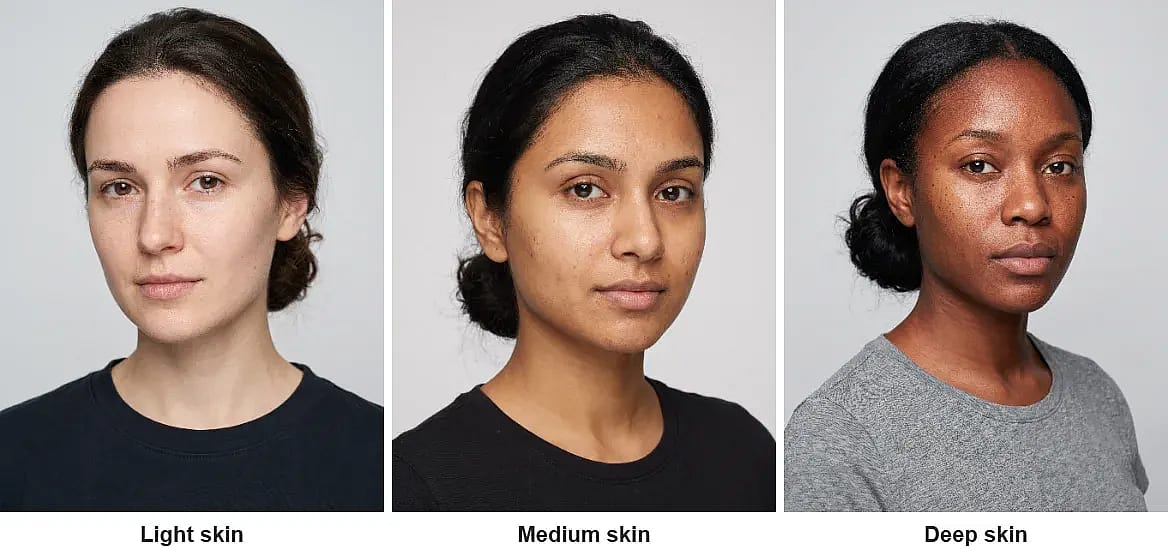
The catch is how you write the prompt, so we tested it. We wrote one makeup prompt and ran it on three faces with light, medium and deep skin.
The light and medium faces came back looking like themselves with fresh makeup. The deep face came back a shade lighter, and the blush almost disappeared.
This guide has 30 AI makeup prompts, from no-makeup makeup to Indian bridal and gothic Halloween glam. Ten of them come from our test, with what went wrong and the line that fixed it.
Key takeaways
- GPT Image 2.6 put on the most accurate makeup in our test and kept freckles and pores.
- Name the finish. Dewy, satin and matte gave three different results from the same prompt.
- Write the skin tone into the prompt. Our deep-skin result kept its true shade once we named it.
- Start every photo prompt with a face lock line, then list the makeup from skin to lips.
- To copy a makeup look, upload the look as a second photo and say which photo holds the face.
What we learned testing AI makeup prompts
The model you pick and the words you use change the makeup more than anything else. We made 20 images on OpenArt on November 26, 2026, and every result below is a first try with no rerolls. OpenArt hosts all three models we compared.
How we tested: We made three base portraits with light, medium and deep skin. Then we added makeup to them with image-to-image edits at a 3:4 ratio and 2K resolution. We judged each result on two things: did the face stay the same, and did the makeup match the prompt?
Which AI model applies makeup best?
GPT Image 2.6 gave the best result. We ran the same soft glam prompt (prompt 4 below) on the medium-skin face with three models.
| Model | Face kept the same? | Makeup matched the prompt? | What we saw |
|---|---|---|---|
| GPT Image 2.6 | Yes | Yes | Freckles and pores stayed. Bronze shadow, matching liner, peach blush and nude-pink lips all showed up. |
| Nano Banana Pro | Yes | Partly | The face stayed perfect, but the makeup was so light it was hard to see. |
| Seedream 5.0 Pro | Partly | Yes | It gave the boldest makeup. It also smoothed the skin and lightened the skin tone. The cheeks changed shape a little. |
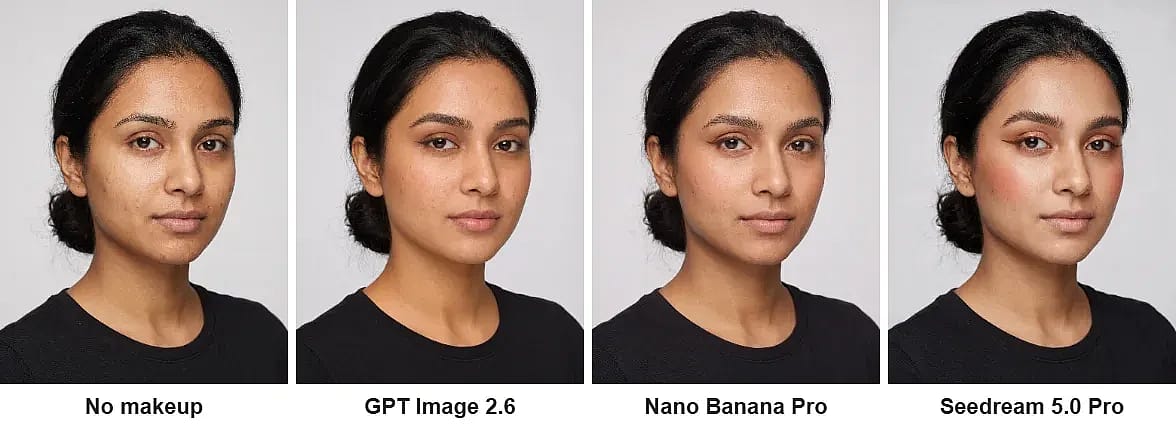
Nano Banana Pro is Google's Gemini image model, so this result matters if you use a makeup prompt for Gemini. Ask for "medium coverage" and "clearly visible" makeup to push it harder.
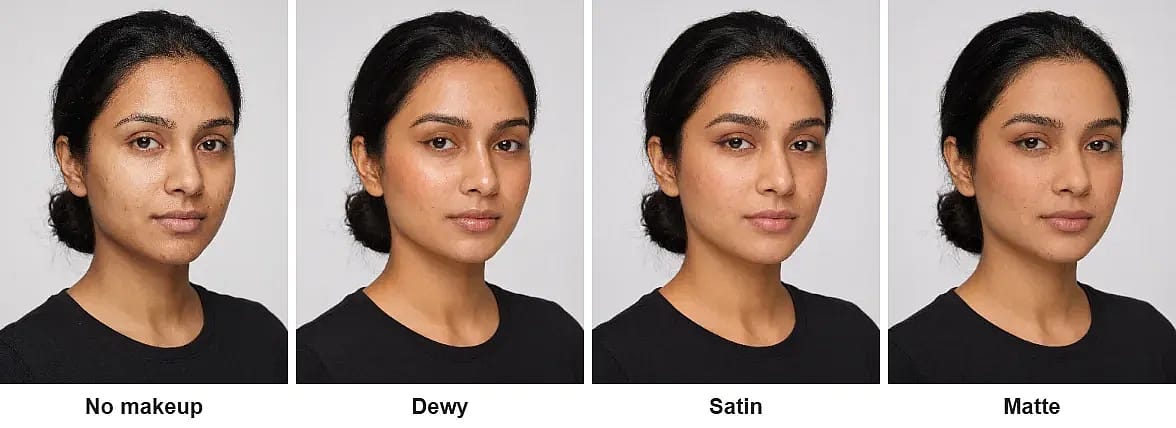
Do words like dewy, satin and matte change the result?
Yes, one word changes the whole skin finish. We swapped only the finish word in the soft glam prompt.
Dewy put a wet-looking glow on the cheekbones and the bridge of the nose. Matte took away all the shine but still showed pores.
Satin landed in between, with a soft sheen that looked the most like real skin. If you leave the finish out, the model picks one for you.
Does the same makeup prompt work on every skin tone?
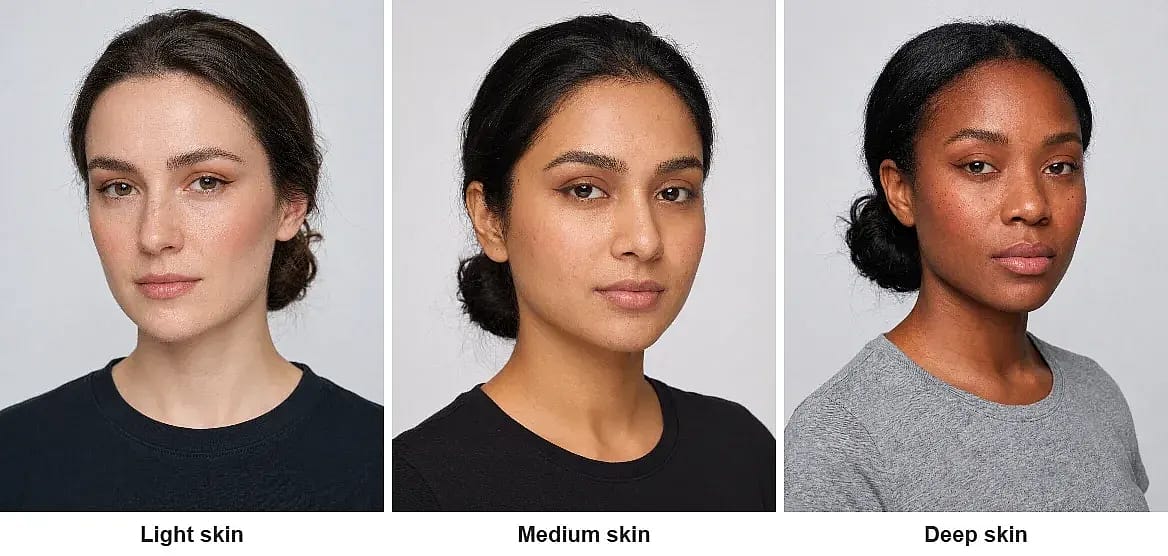
Not always. The light and medium faces came back clean, but the deep face did not.
On the deep-skin face, the skin turned about one shade lighter and a little orange. The freckles faded, and the peach blush almost vanished.
This is a known problem with AI image tools. A 2025 study in the Journal of the European Academy of Dermatology and Venereology looked at 4,000 AI images of people from four popular generators, and 89.8% of them showed light skin.
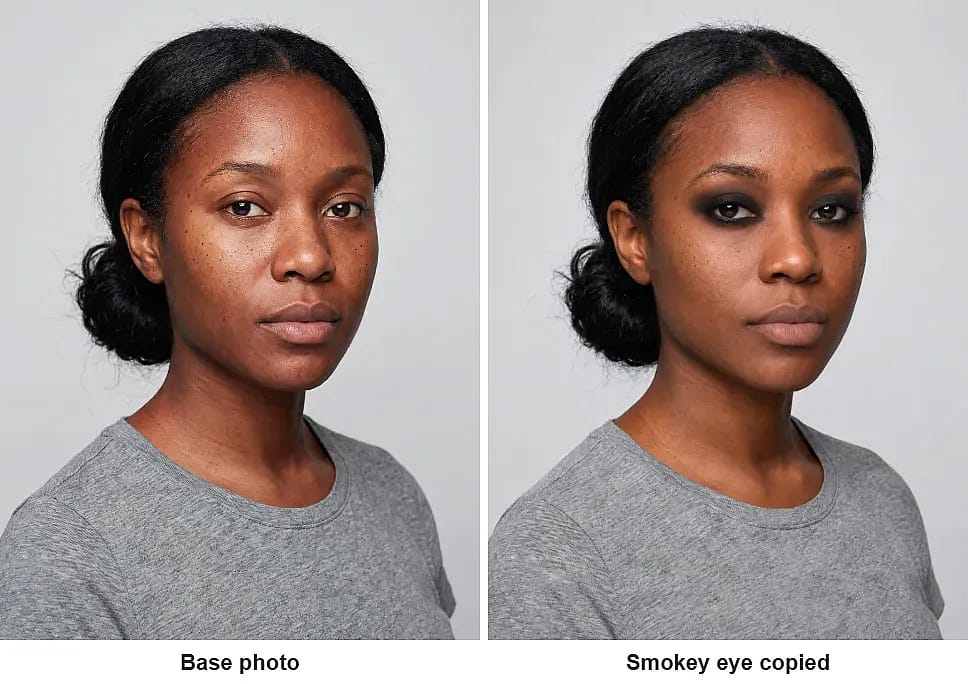
The fix was simple. When we copied the smokey eye onto the deep-skin face (prompt 29), we wrote "keep her deep skin tone" into the prompt, and the shade and freckles stayed true.
Shade matching is hard outside AI too. In a 2026 survey of more than 4,300 US beauty shoppers, 41% said finding their foundation match is difficult, and that rose to 56% for people with deeper skin tones.
How to write a makeup prompt for AI
A good face makeup prompt locks the face first, then describes the makeup from skin to lips. Use these four parts in this order.
- Lock the face. Tell the AI what must stay the same. Paste this line first in every photo prompt: "Use the uploaded photo. Keep the same person exactly the same: face shape, skin tone, eyes, nose, lips, hair, outfit and expression."
- Name the finish and coverage. Pick dewy, satin or matte, and say how much coverage you want. "Light coverage so pores still show" keeps the skin looking real.
- Describe the makeup from top to bottom. Go brows, eyes, cheeks, then lips. Give each one a color and a place on the face, such as "warm bronze matte eyeshadow blended into the crease."
- Set the light and backdrop. Say what the light looks like, such as "soft front light" or "warm window light." Keep the same backdrop if you only want the makeup to change.
For skin that is very light or very deep, add the skin tone to the face lock. "Keep her deep skin tone and visible skin texture" did the job in our test.
Text prompts vs photo prompts
A text prompt makes a brand new face, and a photo prompt adds makeup to a face you upload. Use text prompts for mood boards and makeup ideas. Use photo prompts to try a look on yourself or a client.
To turn any photo prompt below into a text prompt, swap the face lock for a short description of the person. For example: "Close-up beauty portrait of a woman in her 20s with medium brown skin and dark hair in a low bun."
Makeup prompts for Gemini, ChatGPT and Claude
Every prompt here works as a makeup prompt for Gemini or ChatGPT, as long as the tool can edit an uploaded photo. Gemini makes images with Google's Nano Banana models, and ChatGPT uses OpenAI's GPT Image models.
In our test, Nano Banana Pro kept the face very well but went light on makeup. Add "medium coverage" and "clearly visible" when you use Gemini. For more Gemini ideas, see our list of the best Gemini AI photo prompts.
Claude is great at reading a photo and writing the makeup prompt for you. Prompt 28 is built for that. With the OpenArt MCP connector, Claude can also send that prompt to an OpenArt image model.
30 AI makeup prompts to copy
Every photo prompt below starts with the face lock line from the formula above. Paste that line first, then the prompt. Prompts marked Tested come from our test run.
Natural and no-makeup makeup prompts
1. No-makeup makeup (Tested)
Apply a no-makeup makeup look: a sheer skin tint that evens tone but leaves freckles and pores visible, a little concealer under the eyes only, brushed-up brows with clear gel, one coat of brown mascara, a soft rosy cream blush, tinted lip balm. Same light gray backdrop and soft front light, photorealistic beauty portrait.
Where it can go wrong: The change was so soft that it looked almost like the bare photo. If you want people to notice, name one thing that should stand out, like "rosy blush clearly visible on the cheeks."
2. Clean girl glow
Apply a clean girl makeup look: a sheer skin tint with real skin texture, brushed-up laminated brows, cream highlighter on the top of the cheekbones, soft pink cream blush, clear lip gloss over a light pink balm. Soft window light from the side.
Tip: Ask for cream highlighter and say where it goes. "Top of the cheekbones" gives a soft glow in the right spot.
3. Sun-kissed bronze
Apply sun-kissed makeup: warm cream bronzer across the forehead, cheeks and bridge of the nose, a few soft painted-on freckles, golden shimmer on the eyelids, brown mascara, a peachy tinted lip balm. Warm late-afternoon light.
Tip: Say "a few" and "soft" when you ask for painted freckles. Those two words keep them light and natural.
Soft glam and everyday makeup prompts
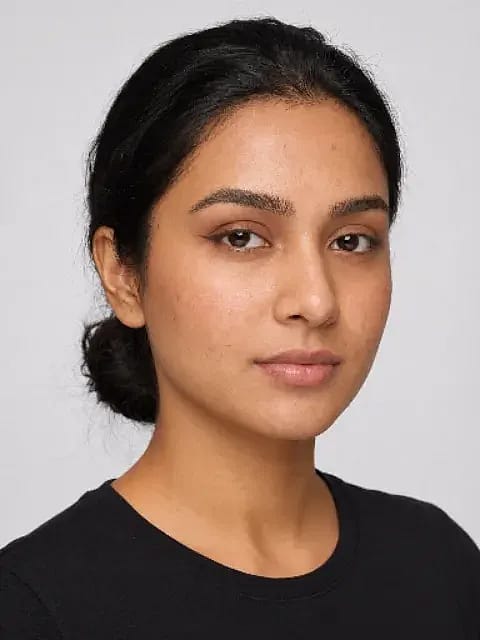
4. Soft glam (Tested)
Apply soft glam makeup: satin skin finish with light coverage so pores still show, warm bronze matte eyeshadow blended into the crease, a thin brown winged liner the same length on both eyes, fluffy brushed-up brows, soft peach blush on the cheeks, nude-pink satin lips. Same light gray backdrop and soft front light, photorealistic beauty portrait.
Where it can go wrong: On the deep-skin face, the skin went a shade lighter and the peach blush almost vanished. Add "keep her deep skin tone and visible skin texture" to the face lock, and swap peach for a berry or brick-red blush.
5. Everyday office makeup
Apply everyday office makeup: light satin foundation, concealer under the eyes, taupe matte eyeshadow in the crease, one coat of black mascara, filled-in brows, a mauve-nude lipstick. Neutral daylight.
Tip: "One coat" of mascara tells the AI to keep the lashes natural. Ask for "false lashes" only when you want drama.
6. Full glam night out
Apply full glam evening makeup: full-coverage matte base, a warm brown cut crease with gold shimmer in the center of the lid, black winged liner the same on both eyes, wispy false lashes, sculpted contour, rose-gold highlighter, a deep rose matte lip with lip liner one shade darker.
Tip: Full coverage can erase skin texture. Add "skin texture still visible" if the face starts to look plastic.
Bridal makeup prompts
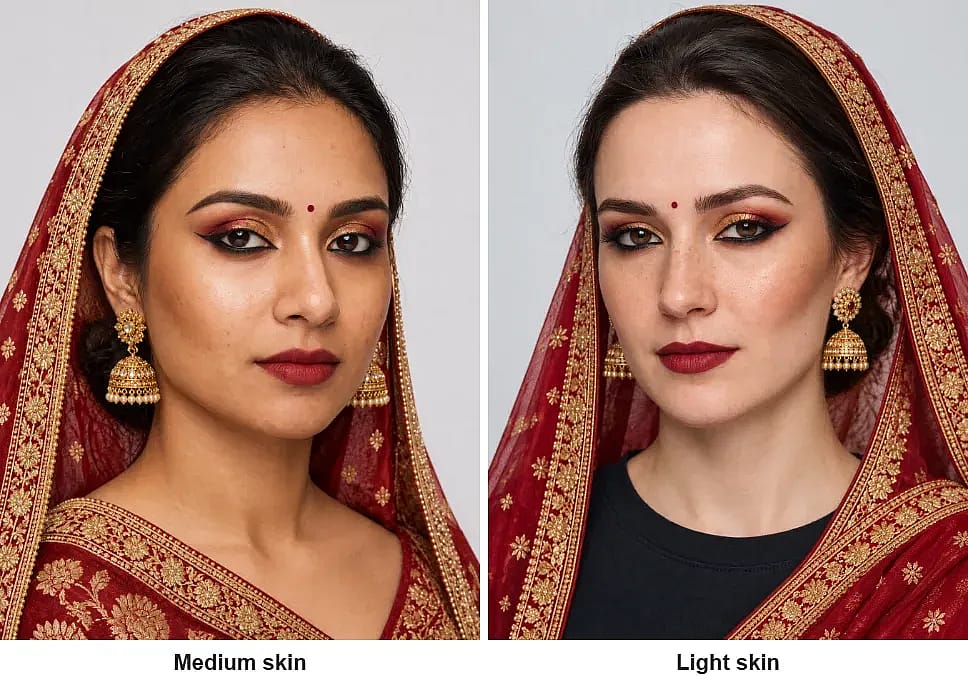
7. Indian bridal makeup (Tested)
Apply Indian bridal makeup: warm gold and deep red shimmer eyeshadow, bold black kohl lining both eyes with a matching wing, full defined brows, soft bronze contour, a satin glowing base, deep red matte lips, a small red bindi between the brows. Add a red silk bridal dupatta with a gold border over her hair and gold jhumka earrings. Same light gray backdrop and soft front light, photorealistic bridal portrait.
Where it can go wrong: This one worked on both faces we tried, light and medium. The dupatta, jhumkas and bindi all showed up, and the faces stayed the same. Check that both wings match, and add "the same wing length on both eyes" if they don't.
8. Soft white-wedding bridal
Apply soft bridal makeup: long-wear satin base, champagne shimmer on the lids, soft brown liner smudged at the outer corners, individual false lashes, rosy pink blush, a dusty rose satin lip. Add a sheer white veil pinned behind her hair. Bright, soft window light.
Tip: Bridal makeup should look good in close-ups. Ask for "long-wear" and "satin" so the skin doesn't look greasy under bright light.
9. Arabic bridal glam
Apply Arabic bridal makeup: bronze and gold smokey eyes with a sharp black wing, bold arched brows, wispy lashes, sculpted contour, a soft gold highlight on the cheekbones, a nude-brown matte lip. Add a delicate gold headpiece along the hairline.
Tip: Name the headpiece's position, such as "along the hairline," or the AI may place it on top of the head.
Eye makeup prompts
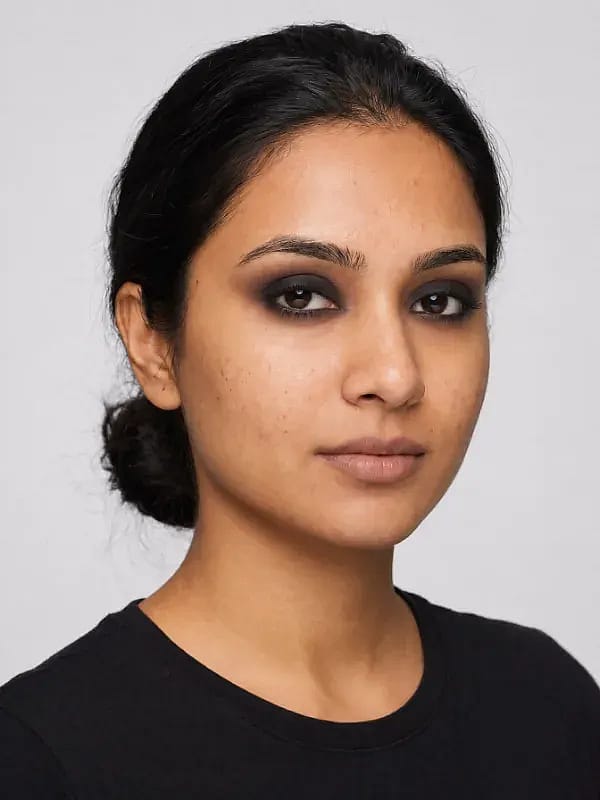
10. Classic smokey eye (Tested)
Apply a classic smokey eye: charcoal and black eyeshadow packed on the lids and smudged softly into the crease and along the lower lash line, the same shape and darkness on both eyes, black mascara, soft matte skin, nude matte lips. Same light gray backdrop and soft front light, photorealistic beauty portrait.
Where it can go wrong: Nothing broke here. Both eyes came out even because the prompt says "the same shape and darkness on both eyes." Keep that line in every eye makeup prompt.
11. Graphic floating liner
Apply a graphic liner look: a floating cobalt blue line just above the eye crease and a thin black wing, both shapes matching on each eye, bare lids, clean skin, nude lips.
Tip: Say "just above the crease" so the line floats. If you only say "graphic liner," you usually get a regular wing.
12. Halo eyeshadow
Apply a halo eyeshadow look: bronze matte shadow at the inner and outer corners of the lid, gold foil shimmer in the center, blended together with no hard edge, brown pencil on the lower lash line, lots of black mascara.
Tip: An eyeshadow prompt works best when it names each color and where it sits on the lid. For close-up eye shots, see our AI eye photo prompts.
13. Siren eyes
Apply siren eyes: black liner that dips down at the inner corner and stretches out into a straight, lifted wing, brown shadow smudged along the lower lash line, lifted brows, a glossy nude lip.
Tip: Siren eyes change how the eye shape looks. Keep "eyes" in the face lock so the AI changes the liner and leaves the eye itself alone.
Lip makeup prompts
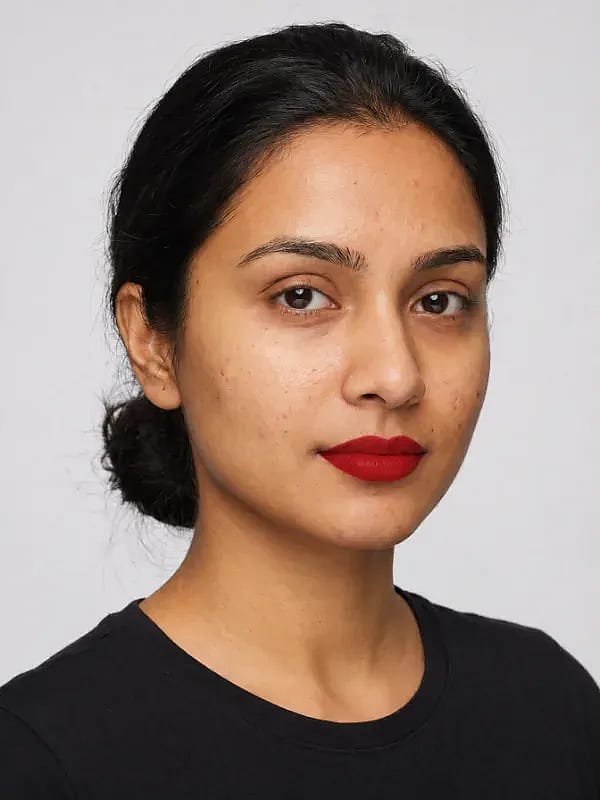
14. Red lip, nothing else (Tested)
Keep the same woman exactly the same: face shape, skin tone, eyes, nose, hair, outfit, expression and bare skin. Only change the lips: apply a bold classic red matte lipstick with a sharp, clean lip line that follows her natural lip shape. No other makeup. Same light gray backdrop and soft front light, photorealistic beauty portrait.
Where it can go wrong: This one passed cleanly. The words "only change the lips" and "bare skin" left the rest of the face alone. Use the same wording for any single-feature edit.
15. 90s lip combo
Only change the lips: a 90s brown lip liner with a lighter nude-pink gloss in the center of the lips, the liner blended softly into the gloss. Leave the rest of the face bare.
Tip: Name both colors and where each one goes. "Brown liner, nude gloss in the center" gives a much clearer result than "90s lip."
Korean and glass skin makeup prompts
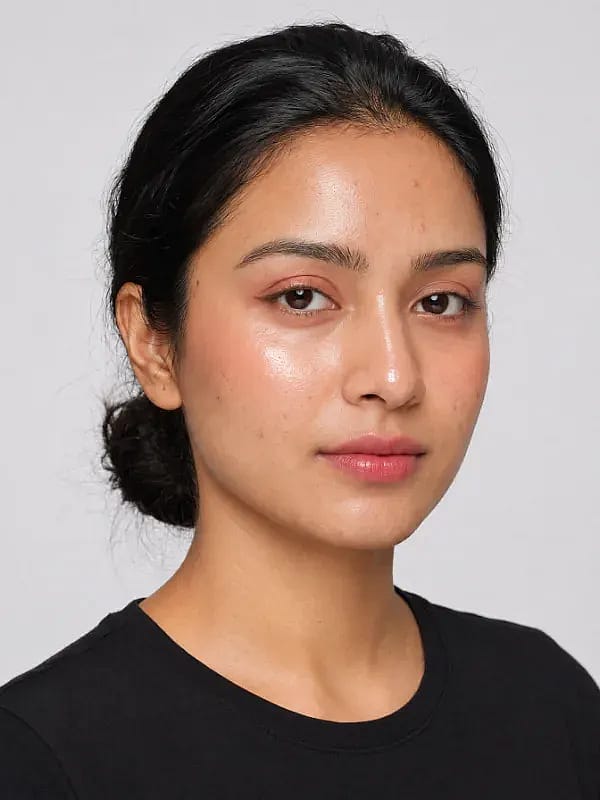
16. Korean glass skin (Tested)
Apply Korean glass skin makeup: a dewy, luminous base with a clear glossy sheen on the cheeks and nose but real skin texture still visible, straight soft brows, a light peachy-pink eyeshadow wash, a thin brown liner, soft coral blush high on the cheeks, a gradient tinted lip that is deeper in the center. Same light gray backdrop and soft front light, photorealistic beauty portrait.
Where it can go wrong: The glow worked, but the shine spread onto the forehead and started to look oily. Add "glow only on the cheekbones and nose bridge, soft matte forehead." For more on real skin texture, see our AI skin prompts.
17. Douyin makeup
Apply Douyin makeup: a smooth base that still shows skin texture, pink blush across the cheeks and over the nose, glittery pink shadow on the lower lid, a soft brown shadow under the eye to make it look fuller, curled lower lashes, a few soft faux freckles, a glossy pink gradient lip.
Tip: The fuller under-eye look is called aegyo sal. Describe it as "a soft shadow under the eye" because the AI may not know the term.
18. Strawberry makeup
Apply strawberry makeup: pink-red cream blush high on the cheeks and over the nose, soft faux freckles, a berry lip stain blurred at the edges, a pink wash on the lids, a glossy finish on the cheekbones.
Tip: "Blurred at the edges" gives the soft, just-bitten lip. A sharp lip line changes the whole look.
Editorial and creative makeup prompts
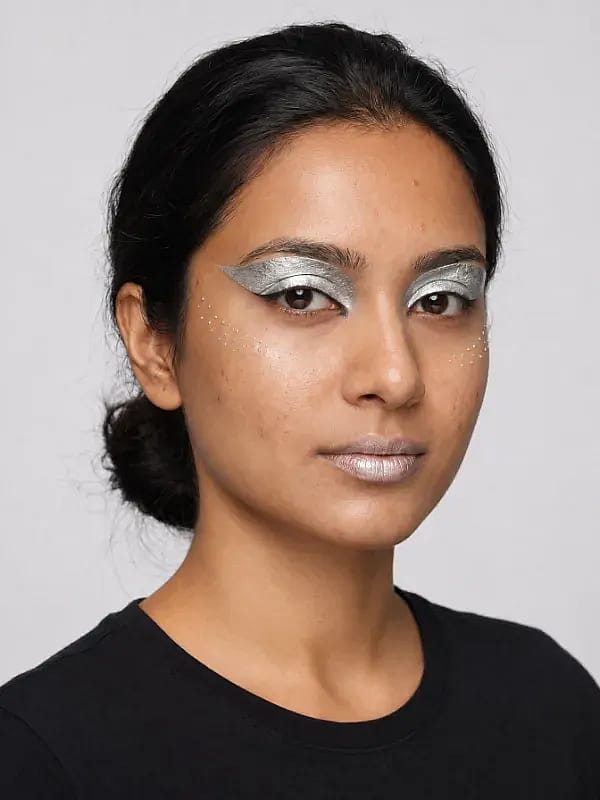
19. Futuristic silver editorial (Tested)
Apply futuristic editorial makeup: metallic silver foil eyeshadow from lid to brow bone with a sharp graphic edge, the same shape on both eyes, tiny silver dots along the cheekbones, a satin base, pale metallic lips. Same light gray backdrop and soft front light, photorealistic high-fashion beauty portrait.
Where it can go wrong: This passed. The foil shapes matched on both eyes, and the face stayed the same under a heavy look. "The same shape on both eyes" did the work again.
20. 1980s color pop
Apply 1980s makeup: bright fuchsia blush swept up toward the temples, electric blue and purple eyeshadow up to the brow bone, thick defined brows, a bold fuchsia lip. Keep the hairstyle the same.
Tip: Add "keep the hairstyle the same." Era prompts like this often pull the hair into the look too.
21. Festival face gems
Apply festival makeup: small clear and iridescent face gems along the brow bone and the outer corners of the eyes, lilac shimmer on the lids, fine glitter on the cheekbones, glossy clear lips.
Tip: Give the gems a size and a place. "Small" and "along the brow bone" keep them neat.
Halloween and gothic makeup prompts
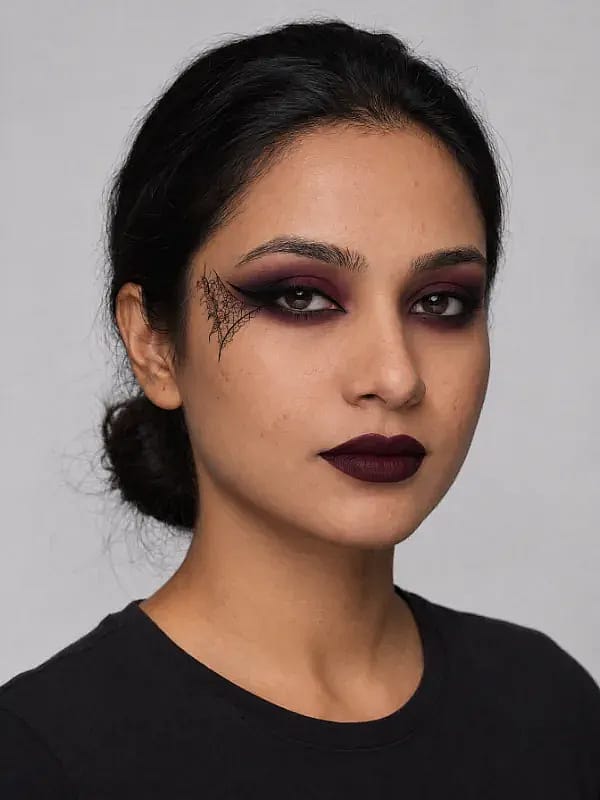
22. Gothic Halloween glam (Tested)
Apply gothic Halloween glam makeup: a matte base, deep plum and black smoked-out eyeshadow, sharp black winged liner the same on both eyes, dark berry-black matte lips, a thin black floral lace pattern like a doily painted at the outer corner of one eye. Same light gray backdrop, moody soft light, photorealistic beauty portrait.
Where it can go wrong: Our first version only said "lace pattern," and the AI painted a spiderweb. The Halloween theme likely pulled it toward a web. The prompt above already has the fix: "floral lace like a doily."
23. Half-face skeleton
Apply half-face skeleton makeup on the left side of her face only: matte white base, a black eye socket, drawn-on teeth over the lips and cheek, black shading under the cheekbone. The right side stays bare. Dark gray backdrop, moody light.
Tip: Say which side gets the makeup and which side stays bare. Half-face looks need both halves described.
24. Vampire glam
Apply vampire glam makeup: a matte base one shade paler than her skin, red-brown shadow around the eyes, sharp black liner, deep red glossy lips with one thin drop of fake blood at the corner of the mouth.
Tip: "One shade paler" gives a spooky look while keeping her face recognizable. A bigger change can make her look like someone else.
Makeup artist, Instagram and cosmetics ad prompts
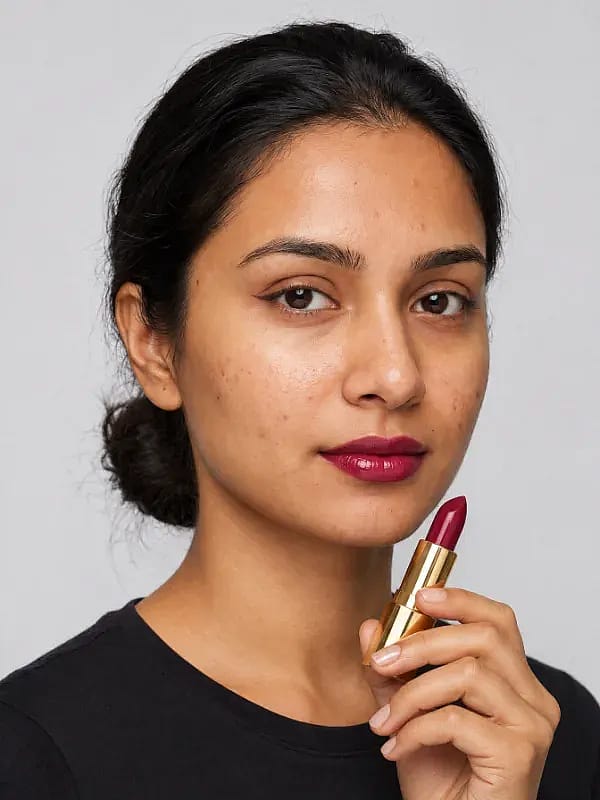
25. Lipstick ad with real skin (Tested)
Keep the same woman exactly the same: face shape, skin tone, freckles, eyes, nose, hair and expression, with real skin texture and visible pores. Turn it into a lipstick ad: she wears a glossy berry-red lip and holds an open gold lipstick in the same berry shade near her chin, fingers relaxed, short nude nails. Light satin skin, soft brown liner. Clean light gray backdrop, soft front beauty light, photorealistic cosmetics campaign photo, no text or logos.
Where it can go wrong: The lip and the lipstick came out the same berry shade, and the freckles and pores stayed. We also asked for a "tight beauty crop," and the framing stayed at head and shoulders. Crop the image afterward or set the frame in a second edit.
26. Before-and-after post for a makeup artist
Use the uploaded photo. Make a side-by-side before-and-after image for a makeup artist's Instagram. Left half: the woman with bare skin. Right half: the same woman with soft glam makeup, warm bronze eyeshadow, thin brown wing, peach blush and a nude-pink lip. The same face, hair and outfit on both sides, 4:5 frame, soft front light, no text.
Tip: Use the client's real photo for the "before" side and only edit the "after." Show it as an AI preview so your followers know which side is real.
27. Makeup kit flat lay (text prompt)
Top-down flat lay of a makeup artist's kit on a white marble table: an open eyeshadow palette in warm browns, three foundation bottles in light, medium and deep shades, a fan of clean brushes, a beauty sponge and one lipstick, soft daylight, 4:5 frame for Instagram.
Tip: For captions, ask ChatGPT or Claude to "write three short Instagram captions for a soft glam bridal trial, friendly tone, two hashtags each." More ideas for posts like this are in our list of the best AI image generator prompts.
Prompts to analyze and copy a makeup look
28. Makeup analysis prompt (for ChatGPT, Gemini or Claude)
Look at this photo and describe only the makeup, in this order: skin finish and coverage, brows, eyeshadow colors and where each one sits, liner shape, lashes, blush and contour placement, lip color and finish. Use plain color names like "warm bronze" or "berry red." End with one prompt I can paste into an AI image generator to recreate this makeup on a different face.
Tip: Paste the prompt it writes after your face lock line. This is the fastest way to copy a makeup style from a celebrity photo, a magazine or a makeup artist's post.
29. Copy a look from one photo to another (Tested)
Copy the exact makeup look from the smokey eye reference onto the woman in the base photo. Keep the base photo woman exactly the same: face shape, deep skin tone, eyes, nose, lips, hair, outfit and expression. Match the makeup only: charcoal and black eyeshadow packed on the lids and smudged into the crease and lower lash line, same shape and darkness on both eyes, black mascara, soft matte skin, nude matte lips picked for her deeper skin tone. Same light gray backdrop and soft front light, photorealistic beauty portrait.
Where it can go wrong: The smokey eye moved over cleanly, and her skin tone and freckles stayed true. Upload two photos and label them, such as "base photo" and "makeup reference." Then say which one holds the face.
30. Shade-matched makeup for your skin tone
Use the uploaded photo. Keep her face and her exact skin tone. Apply the soft glam look from prompt 4 with colors chosen for her skin: a blush deep enough to show, a lip color that stands out on her skin, and a golden highlighter that looks like a soft glow.
Tip: Run this after prompt 4 if the first result washed out. It asks the AI to pick shades for the skin, which can help on very light and very deep skin.
How to try AI makeup on your own photo with OpenArt
Upload your photo to the OpenArt AI image generator, pick a model and paste a makeup prompt. This is the same setup we used for every test above.
- Upload a clear photo. Open the AI image generator and add your selfie as a reference image. Use a front-facing photo with even light and no filters.
- Pick the model and size. Choose GPT Image 2.6 for the closest match to your prompt. Set the aspect ratio to 3:4 or 4:5 for portraits.
- Paste the prompt and generate. Start with the face lock line, then add one prompt from this list. The cost shows before you click Generate.
- Fix one thing at a time. To change only the lips or eyes, use Edit Image in Area Edit mode and highlight that part of the face.
If the skin looks soft after a few edits, run the photo through the AI image upscaler to bring back detail. Want the same face across a whole set of looks? Build it once with OpenArt Characters.
You can also describe the look in plain words in Chat Mode. Chat Mode writes the prompt and picks the model for you, then generates the image. Upload your selfie from your computer or your OpenArt assets. Chatting is free, credits apply when you generate, and the cost shows first.
What photo works best for AI makeup?
A sharp, front-facing photo with soft, even light gives the most accurate makeup. Use these checks before you upload.
- Your face fills at least a third of the frame.
- Your eyes are open and looking near the camera.
- Your hair is pulled back from your brows and cheeks.
- The photo has no beauty filter or heavy edits.
Common AI makeup prompt mistakes
Most bad results come from a prompt that leaves the AI guessing. Here are the most common mistakes, with the fix for each.
- No face lock. Without it, the AI can change the shape of your nose or jaw. Paste the face lock line first, every time.
- Vague makeup words. "Glam makeup" lets the AI choose everything. Name the color and the spot, like "warm bronze shadow in the crease."
- No finish word. Dewy, satin and matte gave three different faces in our test. Pick one.
- Skin tone left out. Our deep-skin result went a shade lighter until we named the skin tone. Add it to the face lock for very light or very deep skin.
- One eye at a time. Liner and shadow can come out uneven. Add "the same shape on both eyes."
- Too many changes in one edit. Changing makeup, hair and outfit together makes the face drift. Change the makeup first, then the rest.
AI makeup prompt FAQs
What is the best AI makeup prompt?
The best AI makeup prompt locks your face first, then names the finish and lists the makeup from brows to lips. Prompt 4, the soft glam prompt, is a good place to start because it gave a clean result on light and medium skin in our test.
How do I keep my face the same in an AI makeup edit?
Start the prompt with a face lock line that lists what must stay: face shape, skin tone, eyes, nose, lips, hair and expression. Then use a model that follows edit instructions closely. In our test, GPT Image 2.6 and Nano Banana Pro kept the face the best.
What is a good makeup prompt for Gemini or ChatGPT?
Any photo prompt in this list works in Gemini or ChatGPT when you upload a photo with it. For Gemini, add "medium coverage" and "clearly visible," because Google's Nano Banana Pro kept the makeup very light in our test.
Do AI makeup prompts work on every skin tone?
They work best when you name the skin tone in the prompt. Our same prompt lightened deep skin by about one shade, and adding "keep her deep skin tone" fixed it in the next test.
How do I copy a makeup look from a photo?
Upload the makeup photo as a second reference and say which photo holds the face, like prompt 29. You can also ask ChatGPT, Gemini or Claude to describe the makeup with prompt 28, then paste the result into your image prompt.
How do I make AI makeup look like real makeup?
Ask for light or medium coverage with visible skin texture and pores. Name a finish, and keep the light soft and from the front. Heavy full-coverage prompts are the ones most likely to make skin look plastic.
Can makeup artists use AI makeup prompts?
Yes, makeup artists can use them to show clients a look before a trial and to make posts for Instagram. Prompts 25 to 27 cover cosmetics ads and Instagram posts. Label AI previews so clients know what was made with AI.
Do these prompts work in Midjourney or Stable Diffusion?
The text prompts work in most image generators, including Midjourney and Stable Diffusion. The photo prompts need a model that can edit an uploaded photo and follow written edit instructions, like GPT Image 2.6.