 ChatGPT
 Perplexity
 Claude
 Gemini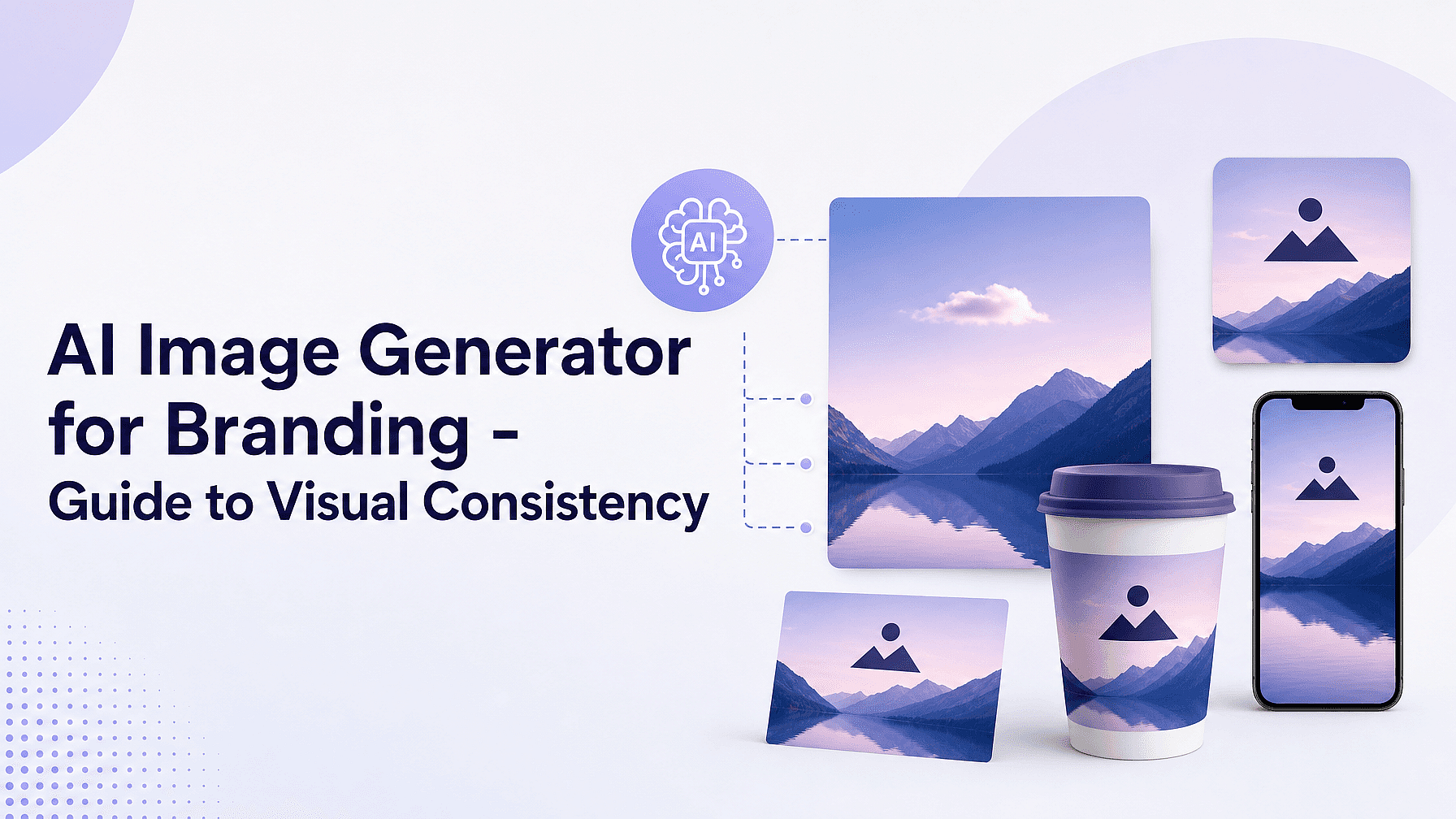
Brand teams do not have an AI image problem, they have a consistency problem. How an AI Brand Kit holds your logo, palette, and rules across every generation.
Brand teams do not have a generic-AI-image problem. They have a consistency problem.
One teammate's prompt nails the palette. The next one washes it out. By the tenth asset the color, the mood, and the logo placement have all drifted from the first nine.
An AI image generator built for branding fixes that at the source. You store your logo, palette, and style once in a Brand Kit, then that identity applies to every generation, instead of being re-explained in every prompt.
Key takeaways
- The failure mode is not one fake-looking image, it is ten images that do not look like they came from the same company.
- A Brand Kit stores six things, not just a logo, and color, type, and rules apply even on models with no image-reference slot.
- Kits are project-scoped, so an agency running five clients keeps five identities separate.
- Saving a good generation back into the kit means it improves with use instead of freezing on day one.
- A palette fixes half the drift. Anything with a face needs a saved character too.
Why a generic AI image generator breaks brand consistency
Ask a typical AI image generator for a matching set of ten social posts, a pitch deck slide, and an ad. By the last asset the fonts have moved, the colors have shifted, and nothing lines up with the first one.
The same drift shows up in smaller ways. A logo sits a shade off between the hero banner and the email header. A product shot needs a full re-brief every week because nobody saved last week's settings.
None of that is a quality problem. Every individual image might be fine. The set is what fails.
What an AI Brand Kit stores, and how it applies
Brand Kit holds six things, not just a logo: your logo, a color palette down to exact hex codes, typography, specific brand assets like packaging or product shots, style references for the overall look, and brand rules that spell out what to avoid.
It works in two layers, and that split is the useful part. Color, typography, and brand rules live in the text layer, so they apply even on models that have no slot for an image reference. Your logo, brand assets, and style references share the model's image reference slots.
That matters because most brand teams are not using one model. They send product shots to one engine and stylized social content to another, and the text layer follows both.
Kits are set at the project level, not the prompt level. An agency running five client accounts keeps each identity in its own project instead of one kit bleeding into another.
The kit also gets better with use. Save a generation that nails the look back into the kit as a new brand asset or style reference, and it stops being frozen at whatever you uploaded on day one.
Two smaller controls matter in practice. When a campaign needs a one-off visual that should not become permanent, add it at generation time without touching the saved kit. When reference slots run tight, set a reference focus and Brand Kit protects that first, then tells you what it dropped instead of silently swapping something out.
The same saved kit drives both still images in Create Image and motion content in Text to Video, so a campaign holds together across formats.
Consistency beyond color: characters and mascots
A palette and a logo solve half the drift problem. The other half is anything with a face: a mascot with specific proportions, a spokesperson, a recurring character across an ad series.
OpenArt Characters saves a character from a prompt, a reference image, or a set of presets. You tag that saved character into any new generation instead of re-uploading a reference and hoping the model holds the likeness.
The difference is structural. A reference image asks the model to work out the face again every time. A saved character gives it the same starting point every time, so the mascot in week ten still matches the mascot in week one.
For a whole visual signature rather than one character, you can train a custom model on your own reference images and keep it in your library. Check OpenArt's own guidance for current image counts and training times, since those change as the feature develops.
Generation quality still has to survive a brand review
None of this matters if the output looks like a stock AI image the moment somebody zooms in. Brand work gets scrutinized in agency reviews, legal sign-off, and print proofs.
OpenArt's answer is to give you the right engine per asset instead of one house look stretched across everything. The image lineup includes GPT Image 2, Nano Banana Pro, Nano Banana 2, Nano Banana 2 Lite, Seedream 5.0 Pro, Seedream 5.0 Lite, Seedream 4.5, Recraft V4, Kling 3.0, and Grok Imagine, all on one credit pool.
Match the model to the job. GPT Image 2 currently leads the Arena.ai text-to-image leaderboard at 1,381, and it is the safe pick for anything with small text or a tight instruction. Recraft V4 is tuned around design taste and treats type as part of the composition, which suits posters, logos, and icon work. Nano Banana Pro handles photoreal work and writes text in many languages. Seedream 4.5 is the pick for flat illustration.
For print and broadcast sizing, the image upscaler runs in Precise, Refined, or Creative mode, and the Vellum Skin Enhancer reaches 8K when a person is in the shot. GPT Image 2 can generate up to 3,840 by 2,160, though OpenAI marks anything above 2,560 by 1,440 as experimental, so treat those sizes as worth checking rather than guaranteed.
Two habits are worth keeping whatever you generate with. Convert to CMYK before anything goes to press, since these tools output RGB. And look at an upscaled file at 100% before you deliver it, because an upscaler can invent detail that was never in the original.
Editing without drifting off the kit
The first generation is a draft. On OpenArt the fixes happen on the same canvas, inside the same Brand Kit context, so an edit does not quietly wander off the palette the original was locked to.
- Region edits. Edit Image's Area Edit mode lets you highlight one spot and change only that, like a background prop or a hand.
- Fill and removal. Generative AI Fill fills a gap, removes a distraction, or extends the frame.
- Reframing. Expand Image stretches a square product shot into a 16:9 banner without re-generating it.
- Backgrounds. The AI Background Remover gives a clean cutout, and the AI Background Changer drops the product into a new seasonal scene.
Before anything ships wide, run the IP Safety Check. It scans for brand similarity, famous faces, and likeness risk, then labels the result safe or unsafe with a warning tier for borderline cases.
That matters more for brand work than for most AI image use. A campaign that accidentally echoes a competitor's mascot or a public figure's likeness is a legal problem, not just an aesthetic one. OpenArt states the results are informational, so treat a clean result as a screen rather than legal clearance.
Who this is for
Agencies running several client accounts use project-scoped kits so one client's palette never leaks into another's deliverable.
In-house marketing and brand teams use a shared kit so a request that goes to five different teammates comes back looking like it came from one design system rather than five.
DTC and e-commerce brands rotating a catalog every week use it to skip re-briefing the background, the lighting, and the angle on every new product.
None of this needs a design background, because the kit holds the identity instead of one person checking every asset by eye.
Setting it up in three steps
- Build the kit once. Upload your logo, enter your palette's hex codes, set your typography, add a few brand assets or style references, and write down the rules that actually matter, like no busy backgrounds or no warm color casts.
- Generate with the kit on. Pick the model that suits the asset, tag a saved character if a face or mascot has to appear, and let the stored identity carry through instead of pasting your brand guidelines into every prompt.
- Edit, check, and export. Fix what needs fixing with Area Edit or Generative AI Fill, run the IP Safety Check before wide distribution, upscale for the final placement, and export without a watermark.
Example prompt
Product hero shot, ceramic mug on a walnut desk, soft window light from the left,
  blurred background, 45-degree angle, brand color accents from the active
  Brand Kit in the background props, photorealistic, commercial product
  photography style
Turn the Brand Kit on before you generate so the palette and the rules apply on their own, instead of typing hex codes into the prompt by hand every time.
How this compares to other ways of staying on brand
| Standalone brand or logo kit generator | Re-uploading a reference each time | OpenArt Brand Kit | |
|---|---|---|---|
| Model choice | Usually locked to the tool's own engine | Whatever model you are prompting | The whole lineup, one kit |
| Applies to models with no image slot | No | No | Yes, through the text layer |
| Video support | Rarely | No | Yes, in Text to Video |
| Team and client separation | Usually one workspace | Manual, per person | Project-scoped kits |
| Learns from your best outputs | No | No | Save generations back into the kit |
A dedicated brand-kit generator is often faster for producing a starter logo and palette from a blank page. What it is not built for is carrying that identity into ongoing image and video production across a changing set of models, which is the part that breaks once a team is generating weekly rather than once at launch.
FAQ
Will AI-generated images actually match my brand's exact colors and fonts?
Yes, when the palette and typography are stored as hex codes and font names in a Brand Kit rather than described in a prompt. Asking for "our blue" in a prompt drifts between generations. A stored hex code does not.
Do I need a designer to set this up?
No. Uploading a logo, entering hex codes, and writing a few brand rules takes about as long as filling in a short form. Generating afterwards does not need design skill either, because the kit holds the constraints for you.
Can different teammates generate on-brand content without redoing the setup?
Yes, as long as they generate inside the same project. That is the real fix for the problem where everyone's prompts drift differently, because the identity lives in the kit instead of in each person's prompt-writing habits.
Can I keep a mascot or spokesperson consistent across images and video?
Yes, through OpenArt Characters, which works alongside Brand Kit rather than replacing it. Save the character once and tag it into any generation, still or motion.
What is the difference between a Brand Kit and just re-uploading a reference image?
A reference image controls one generation. A Brand Kit carries across every generation in the project, applies even on models with no image-reference slot, and improves when you save a good result back into it.
Can I keep separate brand kits for different clients?
Yes. Kits stay isolated to their own project by default, so five client accounts mean five kits with no bleed between them. Switching clients is a project switch, not a fresh setup.
What do I need for client-facing brand work?
You own what you generate, with no royalties and no credit line required, and commercial rights apply on eligible paid plans. Paid plans start at $14 a month billed monthly, and annual billing brings that down. Check the current plans before you commit a client budget.
Related features
- Brand Kit: the feature this article is built around.
- OpenArt Characters: saved mascots and recurring spokespeople.
- AI Ads Generator: running the kit across a set of ad creatives.
Further reading
- What Is a Brand Kit?: a plainer walkthrough of what belongs in one and why.