


 ChatGPT
 Perplexity
 Claude
 Gemini
AI filmmaking gives creators a faster way to build scenes, storyboards, and visual effects without a full production crew. Studios and indie filmmakers already use AI tools to plan shots, test ideas, and finish post-production work in hours.
OpenArt CEO Coco Mao sat down with The Hollywood Reporter in September 2026 to explain where generative AI tools fit in film production. AI works as a production partner that handles pre-production planning and post-production finishing, so filmmakers can focus on the creative work that requires a human touch.
Key takeaways
- AI filmmaking works best in pre-production (storyboards, concept art) and post-production (VFX, scene cleanup), cutting weeks from the schedule
- Live-action quality still requires real cameras and real actors, especially for human performance and dialogue
- Indie and first-time filmmakers benefit most because AI removes the budget barriers to getting started
- Marketing and advertising teams already use AI video at scale, while film and TV studios adopt it more slowly
- Studios can start small by testing AI in storyboarding and post-production cleanup before scaling to full workflows
Why won't AI filmmaking replace live production yet?
AI-generated video produces strong results for animation, motion graphics, and stylized content. For photorealistic live-action scenes, the technology still needs more development time before it matches what a camera captures on a physical set.
Human facial expressions, natural body movement, and dialogue delivery are the hardest elements for AI to reproduce. Audiences notice when something looks slightly off, even if they cannot explain why.
Coco Mao told The Hollywood Reporter that AI tools will keep improving, but the gap between AI-generated and camera-captured live action is still significant.
Two areas show the gap most clearly:
- Sustained character consistency. AI-generated faces can shift between cuts in a long scene. A real actor stays the same person from shot to shot.
- Lip sync and dialogue timing. Matching spoken words to natural mouth movements still takes dedicated tools and manual adjustment for professional results.
For studio-level work, real actors and real cameras remain the standard for live-action production. AI fills in the stages around that core.
Where does AI fit in film production today?
AI fits best in the stages that happen before and after the cameras roll. Pre-production and post-production both involve repetitive, time-heavy work that AI handles well without changing the core creative process.
| Production stage | AI application | What it saves |
|---|---|---|
| Pre-production | Storyboards, concept art, shot planning | Days of manual sketching and revision |
| Post-production | VFX, background replacement, upscaling | Weeks of rendering and compositing |
| Pre-production | Location scouting references | Hours of photo research and reference gathering |
| Post-production | Scene cleanup, relighting | Frame-by-frame manual touch-ups |
Pre-production
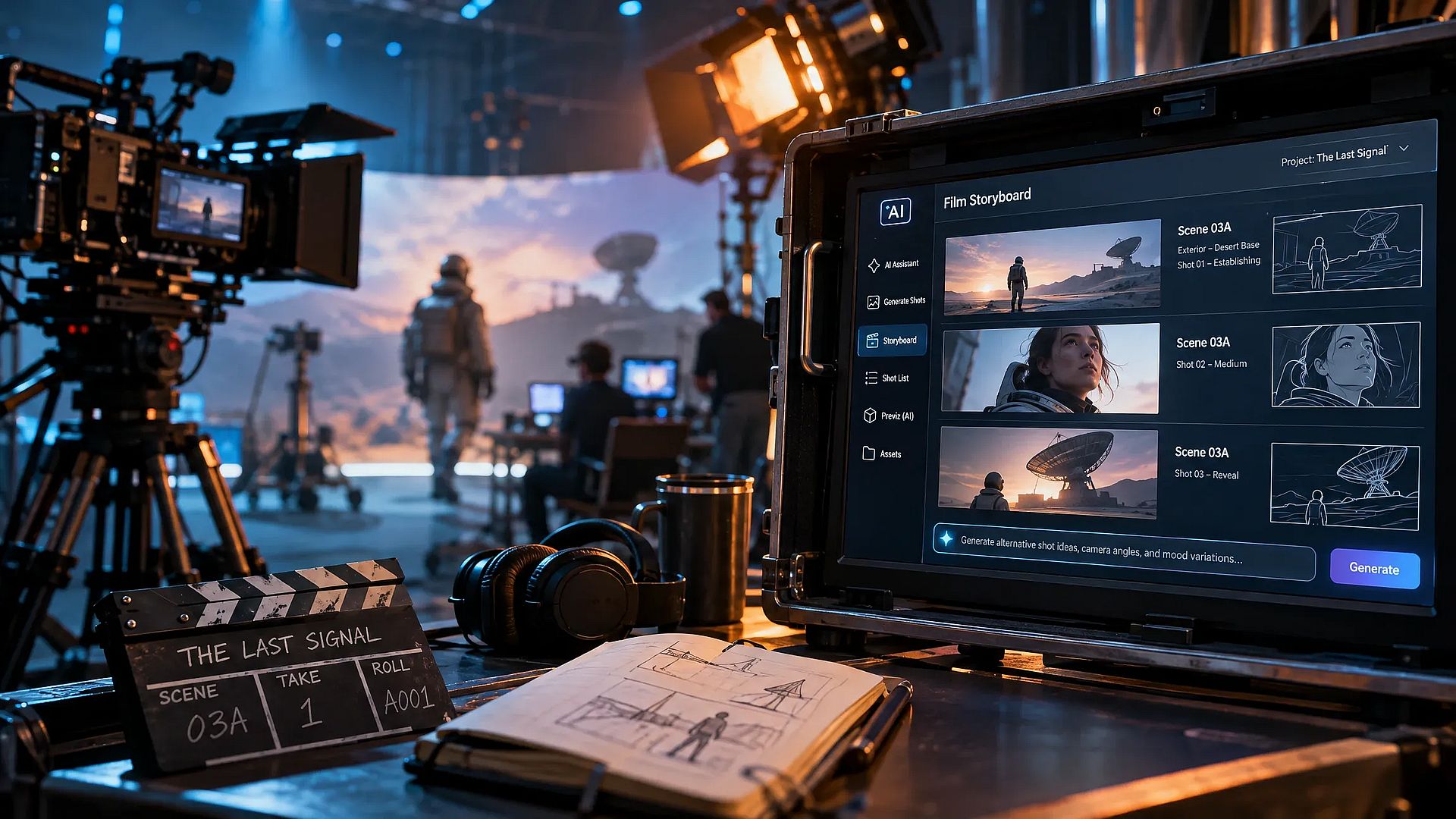
Concept art, storyboards, and shot planning are where most film teams start with AI. A director describes a scene in plain language and gets a visual reference in seconds.
OpenArt's ai storyboard generator turns text descriptions into frame-by-frame boards. Teams can plan camera angles, lighting, and composition before spending money on set construction.
Ideation and concepting work that used to take days with a dedicated artist now finishes in hours. That means more time for creative exploration and revisions before production begins.
Post-production
After filming wraps, AI speeds up the finishing process. Background replacement, color correction, and visual effects cleanup all run faster through AI-assisted workflows.
Teams looking for ai vfx tools can use OpenArt VFX to add or adjust effects without building every element from scratch.
Enhancement and editing tools handle tasks like upscaling footage to 4K, relighting scenes, and removing unwanted objects from the frame. Work that used to take a VFX house weeks now finishes in a fraction of the time, with fewer revision rounds.
Are indie and first-time filmmakers moving first?
Yes. Smaller productions and first-time creators have adopted AI filmmaking faster than major studios. The reason is budget. A traditional short film with sets, crew, and post-production can cost tens of thousands of dollars. AI tools cut most of that cost.
An indie filmmaker with a laptop can build a storyboard, generate concept art, animate scenes, and produce a polished short using tools like OpenArt's ai movie maker.
Director mode lets a single creator build a multi-scene video up to five minutes long through a conversation. OpenArt handles scene transitions, visual consistency, and pacing.
The cost barrier has dropped. First-time filmmakers who would have needed a crew of ten can now produce work that looks professional enough to submit to festivals, pitch to investors, or publish online. The creative decisions stay with the filmmaker. AI handles the production labor.
Will AI replace filmmakers?
No. AI changes the tools filmmakers use, but creative judgment stays with the person directing the project. Shot selection, story structure, performance direction, and emotional pacing are human skills that AI tools cannot handle on their own.
What is happening is a split in adoption speed. Marketing and advertising teams adopted AI video first because their work favors volume, speed, and variation.
A marketing team can produce dozens of ad variations in the time it used to take to finish one, then test them all at once.
Film and television production moves slower because the quality bar is higher and the creative process involves more people. A feature film relies on hundreds of coordinated decisions over months. AI fits into specific parts of that process, but the overall creative direction stays human.
What can studios learn from the VFX parallel?
The closest comparison to AI's current moment in film is how VFX emerged in the 1990s and 2000s. When computer-generated imagery first reached theaters, the industry debated whether it would replace practical effects, stunt work, and even actors.
Practical effects stayed. They became one option alongside digital tools, and the best films used both. Studios that adopted VFX early built skills and infrastructure that gave them an edge for years afterward.
AI filmmaking is following the same path. Studios experimenting with AI in pre-production and post today are building knowledge that will pay off as the tools improve.
VFX took roughly a decade to move from novelty to standard practice. AI tools are moving faster because the software is easier to access, but adoption across a full production pipeline still takes time.
How can studios start with AI filmmaking?
Studios do not need to change their entire workflow to begin using AI. The lowest-risk entry points are pre-production planning and post-production finishing, both areas where AI produces clear time savings without affecting the creative process.
A practical starting path:
- Start with storyboards and concept art. Use AI to generate visual references during pre-production. This saves time without affecting the footage you shoot.
- Test AI in post-production cleanup. Background replacement, upscaling, and effects touch-ups are low-risk applications where AI proves its value quickly.
- Review IP and licensing. Before using AI-generated content in a release, have your legal team review the output for intellectual property considerations.
- Train one team, then expand. Start with one project or one department. Build confidence before bringing AI into broader production workflows.
OpenArt's enterprise tools are built for teams working in content creation at scale. Talk to the enterprise team to find the right starting point for your production pipeline.
FAQ
What is AI filmmaking?
AI filmmaking is the use of artificial intelligence tools in the filmmaking process, from storyboarding and concept art to editing and post-production VFX. AI handles repetitive production tasks so filmmakers can spend more time on creative decisions.
The technology works as a production assistant, taking on the labor-heavy steps while the filmmaker directs the creative vision.
Will AI replace filmmakers?
No. AI changes the tools available to filmmakers, but creative judgment (story, performance, pacing, emotion) stays with the person directing the project.
Marketing teams use AI to produce video at high volume. Feature films still rely on human direction because audiences expect emotional depth and visual precision that current AI models cannot deliver alone.
Where is AI used in film production?
AI is used most in pre-production and post-production. In pre-production, filmmakers use AI for storyboards, concept art, and shot planning.
In post-production, AI handles visual effects, background replacement, upscaling, and scene cleanup. Some studios also use AI for script analysis and scheduling during the planning phase.
What is hybrid filmmaking?
Hybrid filmmaking combines traditional production methods (real cameras, physical sets, human actors) with AI-generated elements (digital backgrounds, generated visual effects, AI-created storyboards). Most studio AI adoption follows this hybrid model.
AI handles specific production tasks while the core creative process stays traditional. Teams save time and budget on labor-heavy steps without giving up creative control.
Can studios use AI without IP risk?
Studios can reduce IP risk by choosing AI tools built for commercial production. OpenArt's enterprise platform is designed for teams that need commercial-grade output with clear licensing terms.
Legal review of AI-generated content before release is recommended, especially for projects heading to theatrical distribution or broadcast.