
 ChatGPT
 Perplexity
 Claude
 Gemini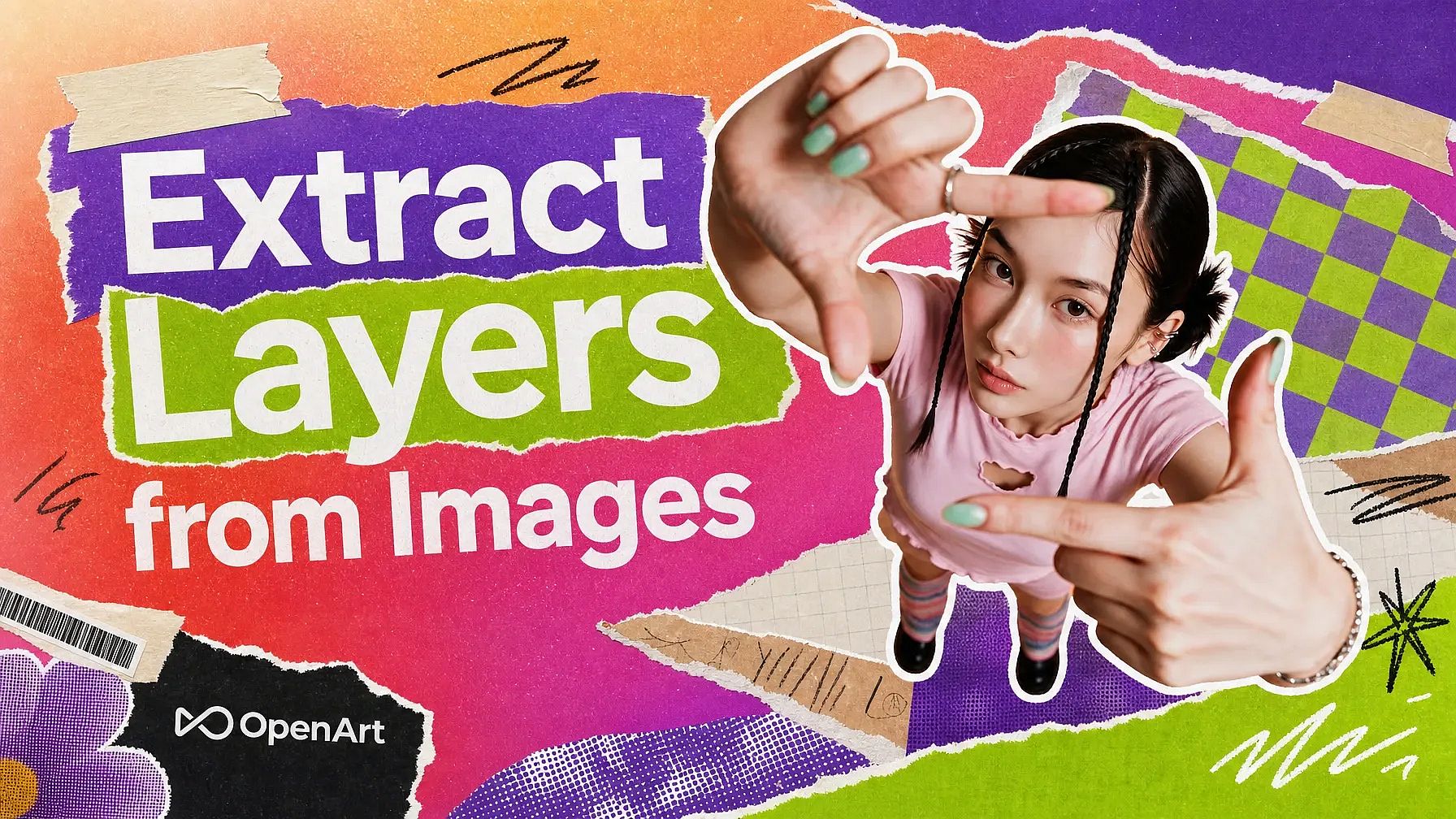
You have a finished image you like, and you only want to change one part of it. Maybe the background needs to go, or the product needs to show up in a different ad.
Separating the image into layers puts each part of the picture on its own see-through layer. OpenArt's Extract Layers does that from a single upload, and this guide walks through every step.
Key takeaways
- OpenArt's Extract Layers splits one image into separate transparent PNG layers using Seedream 5.0 Pro AI image model.
- You can split the whole image, or draw a free-hand loop around just the part you need.
- You set the most layers you want, from 2 to 16, and Extract Layers may return fewer.
- Every layer saves to your Asset Library automatically, and your last split reopens when you come back.
- One layer that looks wrong can be regenerated on its own while the rest stay the same.
What does it mean to separate an image into layers?
Separating an image into layers means putting each part of a flat picture on its own sheet. Each sheet holds one thing, like a person, a product, a block of text, or the background.
A layer from OpenArt's Extract Layers is a PNG file with a transparent background. Transparent means everything around the object is see-through, so you can set that object on top of any other picture.
Text comes out of Extract Layers as a picture of the words. To change the wording itself, type the new text in your design app and place it where the old text sat.
What can you do with an image split into layers?
An image split into layers lets you change one part and leave the rest exactly as it was. That covers most everyday design fixes.
- Swap the background. Keep the product layer from Extract Layers and set it on a fresh background.
- Take out an element. Hide the layer you no longer want, like a sticker or a price tag, and check the picture without it.
- Reuse a product or person. Drop the same see-through product layer into a listing photo, a banner, and a social post.
- Update a poster. Pull the headline, the logo, and the artwork apart so you can refresh one piece for a new campaign.
Marketing teams, online sellers, designers, and agencies use Extract Layers for these jobs because the split takes one step.
How to separate an image into layers in OpenArt
OpenArt's Extract Layers tool turns one image into layers in five steps.
- Open Extract Layers and upload your image. Find Extract Layers in OpenArt's Image tool list, right after Edit Image. Upload one picture.
- Choose Whole Image or Select Area. Whole Image splits the full picture. Select Area lets you draw a free-hand loop around one part, and Extract Layers splits only what is inside the closed loop.
- Set the most layers you want. Pick any number from 2 to 16, then generate.
- Check and arrange your layers. Your layers appear as a list of cards, with the front layer at the top and the back layer at the bottom. Drag a card up or down to change which layer sits in front, hide a layer to see the picture without it, or regenerate one layer that looks off.
- Find your layers in the Asset Library. Extract Layers saves every layer to your Asset Library as a transparent PNG as soon as the split finishes. Saving happens on its own, with no button to press.
Extract Layers runs on Seedream 5.0 Pro for every split. That keeps the setup the same each time, with no model to choose.
Which images split into the cleanest layers?
Images with clear edges between objects give Extract Layers the easiest job. A product on a plain table, a portrait against a wall, or a poster with space around its text usually splits cleanly.
Busy images take more care. Objects that overlap, blend into the background in color, or sit under heavy blur can come out joined together or with rough edges.
A quick check helps before you upload. Look at the image at normal size and ask whether you could trace around each object with your finger. If the edges look fuzzy, start with the sharpest, largest copy of the image you have.
How many layers should you ask for?
The layer number in Extract Layers is a limit, so Extract Layers may return fewer layers than you set. Pick a number close to how many separate things you see in the picture.
A photo of a person holding a mug against a wall has about 3 parts: the person, the mug, and the wall. A poster with a headline, a logo, a product, and a few stickers can use 8 or more.
Extract Layers takes any number from 2 to 16. Start near your count, check the result, and run a new split with a different number if the parts come out grouped together.
How to fix a layer that comes out wrong
Regenerate the one layer. Extract Layers lets you regenerate a single layer and keep every other layer as it is. Try this first when one piece has rough edges or a missing detail.
Split just the problem area. Start a new task in Extract Layers, choose Select Area, and draw your loop around only the object you need. A smaller area gives the tool fewer objects to sort out.
Change the layer count. When two objects come out joined together, run a new split with a higher number. When one object comes out in pieces, try a lower number.
Upscale a small image first. Run a low-quality picture through OpenArt's image upscaler before you split it. Precise mode keeps what is already in the photo and makes the edges larger and sharper for Extract Layers to work with.
How to use your layers after the split
Every layer from Extract Layers waits in your OpenArt Asset Library as a transparent PNG. Photoshop, Canva, and Figma all open PNG files, so you can stack the layers in your design app in the same order as the card list.
A fresh background is easy to make in OpenArt's AI image generator. Type what you want, like "a sunny marble kitchen counter, soft morning light," then place your product layer on top.
Brand Kit keeps that new background on brand. Turn on Brand Kit in Create Image so the new background comes out in your brand colors.
A finished design can also become a short video. Upload the final picture to OpenArt's AI video generator, describe the motion, and generate a clip for social media.
How are AI layers different from a layered design file?
A layered design file, like a Photoshop PSD, holds the layers a designer built by hand. It keeps live text, effects, and every setting the designer used.
OpenArt's Extract Layers builds layers from the finished picture itself. It finds each object and gives it its own transparent PNG, which is what you need to swap a background, remove an element, or reuse a product.
Keep the layered design file when you need to retype text in its original font or hand the project to another designer. Use Extract Layers when all you have is the flat image and you need its parts.
FAQ
How do I separate an image into layers with AI?
Upload the image to OpenArt's Extract Layers and choose Whole Image or Select Area. Set the most layers you want, from 2 to 16, and generate. Extract Layers puts each part of the picture on its own transparent layer and saves every layer to your Asset Library.
Does Extract Layers make a PSD file?
No. OpenArt's Extract Layers saves each layer as its own transparent PNG in your Asset Library. You can stack those PNG files in Photoshop, Canva, or Figma to rebuild the layered picture.
How many layers can I get from one image?
OpenArt's Extract Layers lets you set a maximum anywhere from 2 to 16 layers. Extract Layers may return fewer layers than your maximum when the picture has fewer separate parts.
Can I split only one part of an image?
Yes. Choose Select Area in OpenArt's Extract Layers and draw a free-hand loop around the part you want. Once you close and confirm the loop, Extract Layers splits only what is inside it.
Will text stay editable after the split?
Text comes out of OpenArt's Extract Layers as a picture of the words, on its own layer. To change the wording, type new text in your design app and place it where the old text layer sat.
Which AI model does Extract Layers use?
OpenArt's Extract Layers uses Seedream 5.0 Pro for every split. The model is built in, so you can upload an image and start right away.
Can I come back to my layers later?
Yes. Every layer from OpenArt's Extract Layers stays in your Asset Library. When you open Extract Layers again, your most recent split reopens so you can keep working or start a new task.
Can I split several images at once?
OpenArt's Extract Layers works on one image per task. Finish one split, then start a new task for the next image.
Is Extract Layers free to try?
OpenArt's free trial gives you 40 credits over 7 days, with no credit card needed.