

 ChatGPT
 Perplexity
 Claude
 Gemini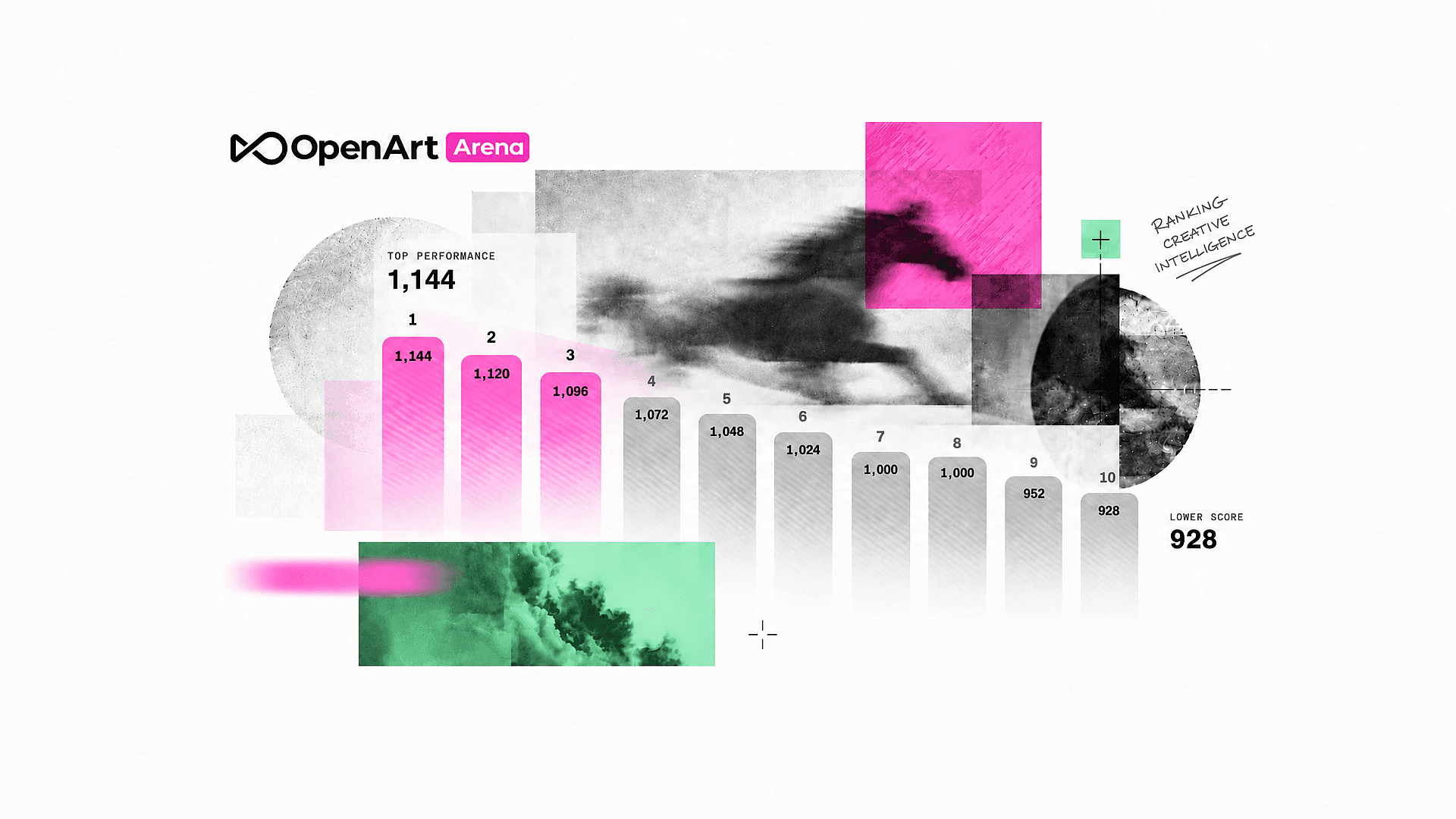
TL;DR
- OpenArt Arena is now live: an expert-led AI image and video model leaderboard built around creative work.
- Explore overall rankings alongside boards for advertising, film, animation, motion design, product imagery, graphic design, editing, and lip sync.
- The published judging panel includes 28 expert judges and 1,003 Tastemakers, with results based on blind comparisons of model outputs.
- Use the rankings to build a shortlist, then review the criteria, sample generations, and production requirements that matter to your project.
Why “best AI model” needs a creative brief
A model can produce a beautiful image and still get the product wrong. A video can look cinematic while ignoring the camera direction. A convincing talking character can lose its identity between shots.
For creative professionals, those are practical differences. The question is rarely just “Which AI model ranks highest?” It is “Which model should I try for the work I need to deliver?”
OpenArt Arena is built around that question. It brings AI image and video model rankings together with evaluations organized by creative task and industry. An overall leaderboard offers a starting point; the more specific boards help you narrow the choice.
OpenArt Arena’s vision for creative AI model rankings is to make comparisons more useful to the people making ads, films, animations, product visuals, and other creative work.
What Is OpenArt Arena?
OpenArt Arena is OpenArt's public leaderboard for AI image and video generation models. It's built for creative production work, not general-purpose AI comparisons. Instead of one all-purpose score, it ranks models across boards organized by creative industry and task. Those include advertising, film, animation, motion design, product imagery, graphic design, editing, and lip sync. A shortlist built this way reflects the kind of work you actually need to deliver.
Rankings come from blind, expert-led evaluation, not open public voting. A judging panel of 28 expert judges and 1,003 Tastemakers compares unlabeled model outputs against criteria specific to each task. Results are calculated using a Bradley–Terry model with published confidence intervals. OpenArt Arena launched on September 15, 2026 and is operated by OpenArt, the AI creative platform that also lets creators run the ranked models directly.
How OpenArt Arena fits alongside other AI leaderboards
Existing leaderboards offer useful perspectives. Arena.ai, for example, provides image-to-video rankings based on preference votes. Artificial Analysis covers intelligence, speed, and cost, alongside dedicated image and video evaluations.
Hugging Face also hosts individual leaderboard projects, including image and video leaderboards published by Artificial Analysis. Each project has its own scope and methodology, so it helps to check who runs it and what it measures.
OpenArt Arena adds a focused perspective: expert-led evaluation of image and video models through the requirements of creative production. Its industry and capability boards help creators connect a model’s strengths to a particular brief.
What you can explore on the live leaderboard
The AI model leaderboard has separate Video and Image views. Within each, you can switch between an overall ranking and boards for specific types of work.
AI video model rankings
- Overall: a starting point for comparing general video capabilities.
- Ads: for commercial and branded video work.
- Film: for cinematic storytelling and filmmaking.
- Animation: for animated characters and sequences.
- Motion Design: for design-led motion work.
- Video Editing: for modifying existing video.
- Lip Sync: for matching visible speech or singing to audio.
AI image model rankings
- Overall: a starting point for comparing general image capabilities.
- Product / E-commerce: for product-focused imagery.
- Film: for film-oriented still imagery.
- Graphic Design: for visual communication and design work.
- Image Editing: for transforming or refining existing images.
To find the most relevant comparison, choose Video or Image, then select the board closest to your project.
Why the criteria change depending on the job
An advertising team and a filmmaker can look at the same output and notice different problems. A brand team may reject an otherwise striking shot because the packaging is inaccurate. A filmmaker may care more about whether the camera direction, lighting, and performance support the scene.
That difference is central to OpenArt Arena. Its AI model evaluation criteria include product and brand consistency for commercial work, camera and lighting control for film, and layout and typography for graphic design.
Consider a product launch. You might start with Product / E-commerce to shortlist an image model for the product visuals, then use Ads to compare video models for the campaign. If the final asset includes a speaking presenter, Lip Sync becomes another relevant comparison.
The same approach applies to filmmaking. A model that works well for a concept image may not be your first choice for animating that image, editing the resulting clip, or creating a dialogue scene. Choosing by task gives you room to use different models where each is strongest.
How the ranking works
OpenArt Arena uses blind, paired comparisons. Judges do not see the model identities and assess one named criterion at a time. Models receive the same brief, and evaluation outputs are selected by a fixed rule rather than hand-picked.
Scores use a Bradley–Terry model and an Elo-like scale. Expert Council votes carry 3× weight and Tastemaker votes 1×. Published results include 95% confidence intervals; scores should be compared within the same board. The published AI model ranking methodology explains the criteria, weights, coverage requirements, and quality controls.
Who evaluates the models?
As of the September 15, 2026 update, OpenArt Arena’s AI model judging panel includes 28 expert judges and 1,003 Tastemakers whose votes contributed to published rankings.
The panel includes professionals from filmmaking, advertising, academia, and the creator economy. Tastemakers bring additional perspectives from creative practice, studios, schools, and AI creator communities.
For readers, the value is having identifiable creative experience behind the evaluation. You can review the panel and its professional backgrounds before deciding how much weight to give the results.
Which image and video models are included?
The published launch results include the following models. Coverage can differ by board, so check the selected leaderboard for its eligible model list.
Image models: Seedream 5.0 Pro, GPT Image 2, Nano Banana Pro, Grok Imagine 2.0, Nano Banana 2, Qwen Image 3.0, and Flux.2 Pro.
Video models: Seedance 2.5, Wan 3.0, Seedance 2.0, Seedance 2.0 Mini, Google Omni Flash, Flux 3 Video, MiniMax H3, Kling 3.0 Omni, HappyHorse 1.1, Grok Imagine 1.5, and PixVerse V6.
Refer to the live leaderboard for the current order, criterion scores, and available specifications. Model names and versions matter: a result for one version should not automatically be applied to a later release.
How to use the leaderboard for your next project
- Define the deliverable. Write down what you need to make: a product still, a cinematic sequence, a branded video, an edited image, or a lip-synced performance.
- Choose the relevant board. Start with Image or Video, then select the use case or capability that matches your brief.
- Look beyond the headline rank. Review the individual criteria that could make or break your output. Product accuracy may matter more than visual flair; precise editing may matter more than creative variation.
- Inspect the examples. The leaderboard includes sample prompts and generations. Use them to understand what the scores look like in practice.
- Check production constraints. Review the available specifications, such as resolution, reference inputs, video duration, generation time, and listed price. Confirm the settings you intend to use.
- Test a shortlist on your own brief. Try the most promising models with the same prompt and references before committing to a production workflow.
For example, if you are creating a product ad, test whether your shortlisted models preserve the exact packaging, label, and color. For a film scene, test the requested camera movement and whether the character remains consistent. These checks turn a leaderboard into a practical starting point for your own evaluation.
How to read the results responsibly
A ranking reflects the evaluated prompts, criteria, and model versions. It is useful evidence for choosing what to test, but it cannot guarantee the result of every new prompt.
When confidence intervals overlap, avoid treating a small numerical gap as a decisive advantage. Also keep quality and production requirements separate: the highest-scoring option may not be the one that fits your deadline, budget, or required output format.
OpenArt Arena is operated by OpenArt and covers models available on its platform. Its AI model benchmark disclosures explain the scope, commercial relationships, judge compensation, and data practices. OpenArt states that no model provider paid for inclusion, placement, ranking, or favorable treatment.
Who OpenArt Arena is built for
Creative professionals can use the boards to narrow their options before spending time testing models. A designer, filmmaker, and advertising producer can each start from a comparison that fits their work.
Creative teams and studios can use the criteria to make model selection more explicit. Instead of choosing a tool because one demo looked impressive, the team can agree on the capabilities the project requires and test against those requirements.
Model makers can examine where their models perform well and where they fall behind on the published evaluations.
Judges and Tastemakers contribute their experience to the evaluations. Creatives interested in becoming an AI model evaluator can follow the “Apply as a tastemaker” link on the judges page.
Keeping up with new results
Bookmark the leaderboard and check the published version and date when using a result in a recommendation or production decision.
Scoring runs preserve snapshots of scores and configuration. When comparing results over time, check which model versions and scoring rules apply to each snapshot. Refer to the published methodology and disclosures for the details behind each release.
FAQs
Is OpenArt Arena live?
Yes. OpenArt Arena is live, with published image and video rankings, task-specific boards, information about the judges, and documentation explaining how the evaluations work.
What is the best AI image model or AI video model right now?
Start with the live rankings for the task you need to complete. An overall leader is a useful starting point, but a model’s performance on editing, product imagery, film, or lip sync may be more relevant to your project. Check the current board and its uncertainty information before choosing a shortlist.
How is OpenArt Arena different from other AI leaderboards?
OpenArt Arena focuses on image and video models used in creative work, with expert-led judging and boards organized around specific production tasks and industries. Other leaderboards offer complementary perspectives, including broader preference rankings, technical benchmarks, and price or speed comparisons.
Can anyone vote on the rankings?
The published rankings come from the judging panel’s blind evaluations. Creatives interested in participating can apply through the Tastemaker application linked from the judges page.
Does OpenArt Arena cover every creative AI model?
No. It covers a defined set of models available on OpenArt, and model eligibility varies by board. Check the live rankings for current coverage rather than assuming every model is included.
Are price and speed part of the quality score?
No. Production specifications are separate from the quality score. Consider both when choosing a model for a real project.
How can I report an issue with a result?
The published contact for corrections is arena@openart.ai. Include the board, model version, and result you are referring to.
Where do I create images or videos after choosing a model?
Arena helps you compare models. You can then use OpenArt to test your shortlist and create images or videos with your own prompts and references.