 ChatGPT
 Perplexity
 Claude
 Gemini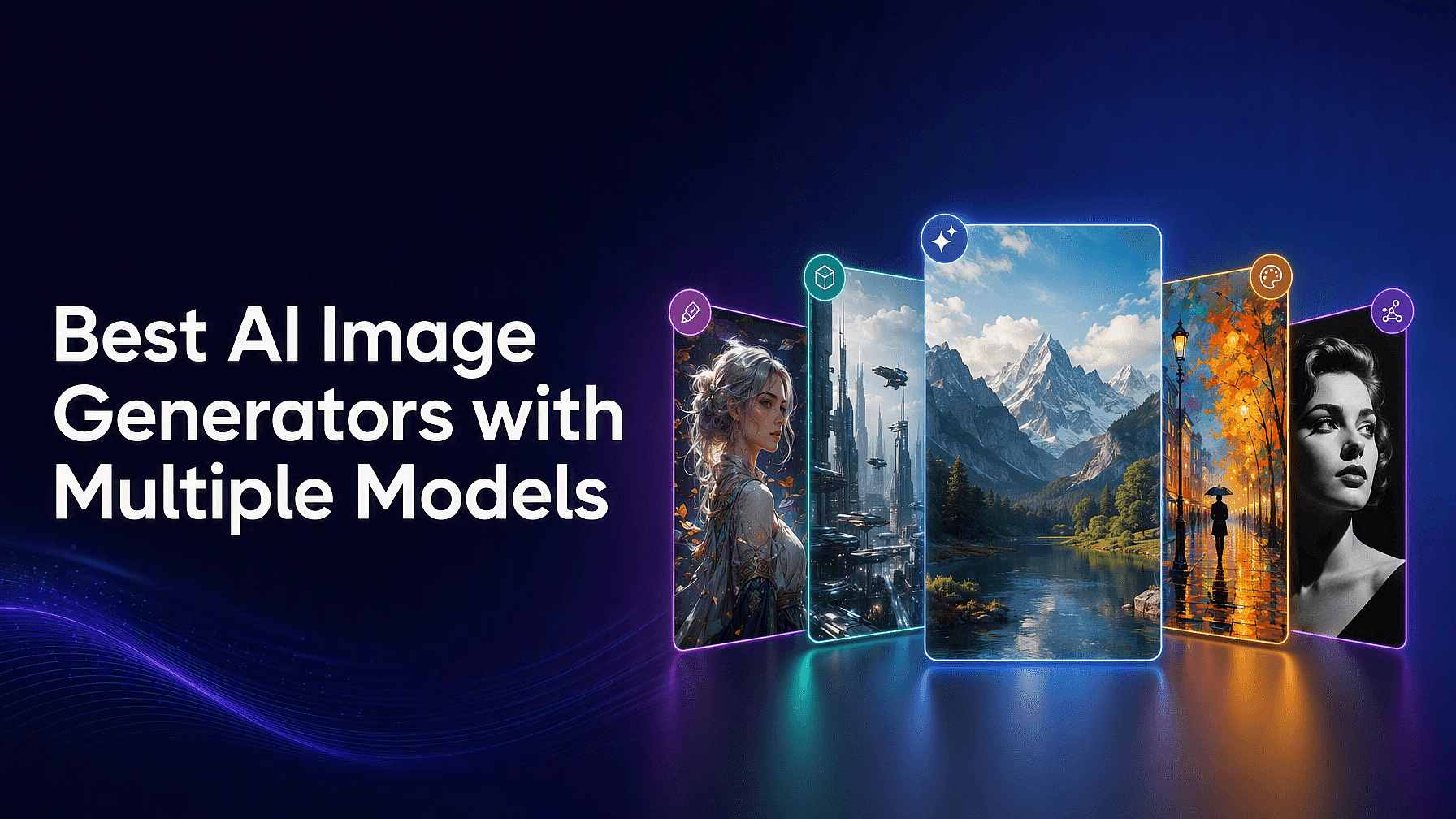
Run one prompt through Midjourney, then a FLUX host, then ChatGPT. Now you are paying for three subscriptions to answer one question: which image model draws the best result from the same brief or prompt?
An AI image generator with multiple models puts those engines behind one credit pool. You run the same prompt through a few of them, compare the pictures on one screen, and cancel the extra plans.
We compared the leading multi-model platforms on model count, side-by-side comparison, editing depth, reference-image input, pricing, and commercial use. Every price was checked against the company's own pricing page in August 2026.
Key takeaways
- OpenArt covers the most ground in one place, with premium image, video, and audio models, region edits, upscaling, saved characters, and image-to-video on one credit pool.
- Adobe Firefly is the one platform that openly markets a side-by-side compare view for multiple models.
- Krea is the cheapest paid way in, at $5.25 a month on annual billing with a commercial license included.
- Credit math beats sticker price, because one image can cost 5 credits on one model and over 180 on another.
- Free plans are where the rights get messy, so check who owns the picture before you use it for work.
How we evaluated
We scored each platform on six things, drawn from how marketers and creative teams actually use these tools.
- Number of models. How many image models one subscription covers, and how fast new releases like GPT Image 2 and Nano Banana Pro show up. We also checked which platforms carry Seedream 5.0 Pro.
- Side-by-side comparison. Whether one prompt can go to several models and come back on one screen, or you have to switch models and run it again.
- Editing. Whether you can fix a region, expand the frame, restyle, and upscale in the same place, so a near-miss picture becomes a finished asset.
- Reference-image input. Whether you can feed in a photo, a saved character, or a brand look and hold it across many pictures.
- Pricing. Entry price, credits per dollar, and whether unused credits carry over to next month.
- Commercial use. Which plan lets you use the picture for work, who owns the output, and whether the platform checks for copyright risk.
Best AI image generators with multiple models at a glance
| Tool | Best for | Price | Verdict |
|---|---|---|---|
| OpenArt | Range and built-in editing | From $14/mo | Premium image, video, and audio models on one credit pool, plus editing, saved characters, and an IP Safety Check in one place |
| Adobe Firefly | Side-by-side comparison | Sold inside Creative Cloud plans | Partner models from OpenAI, Black Forest Labs, and Google, with a compare view Adobe markets by name |
| Krea AI | Lowest paid entry | $5.25/mo Basic on annual billing | Big model list, real-time canvas, commercial license on every paid plan |
| NightCafe | Casual use | $7.49/mo AI Beginner | 50+ pro image models and image plus video, but very small credit counts |
| Leonardo AI | Credit rollover | Check current pricing | Multi-model in 2026, and unused tokens bank up to three months' worth |
| Magnific (formerly Freepik) | Credits that keep | $14.50/mo Premium on annual billing | 240,000 credits a year that stay valid for a full year instead of resetting monthly |
Our top picks
OpenArt leads on range and on finishing the picture without leaving the tab. Adobe Firefly is the pick if comparing models side by side is the whole reason you are shopping. Krea is the cheapest paid way to reach a lot of models.
Best for range and built-in editing: OpenArt
OpenArt is built around model choice. One plan covers its image, video, and audio models, and every tool draws from the same credit pool. It is one AI image generator account instead of five.
The image lineup includes GPT Image 2, Nano Banana Pro, Nano Banana 2, Nano Banana 2 Lite, Seedream 5.0 Pro, Seedream 5.0 Lite, Seedream 4.5, Recraft V4, Kling 3.0, and Grok Imagine. Pick a model per job, or run the same prompt through two or three and compare the results in one workspace.
Create Image gives you up to 4 pictures per run. If one is close, Image Variations makes up to 8 takes from it and a slider controls how far each one strays from the original.
The editing tools finish the job in the same place. Edit Image changes anything you can describe, and Area Edit mode lets you highlight one spot and change only that. Expand Image widens the frame to any aspect ratio or social preset. The image upscaler has Precise, Refined, and Creative modes, and the Vellum Skin Enhancer goes up to 8K when a face needs real skin texture.
For a look you need to repeat, build it once. OpenArt Characters saves a person from a single prompt, one reference photo, or a set of presets, then you tag them into any new picture. Brand Kit saves your logo, exact hex codes, fonts, and brand rules at the project level, so a whole batch comes out in your colors.
Paid plans run from $14 a month. Billed monthly, Starter is $14 for 4,000 credits, Plus is $34 for 12,000, Pro is $56 for 24,000, and Wonder is $240 for 106,000. Annual billing brings each of those down, saving up to 27%. Base credits reset each month, and the $15 Extra Credit Pack adds roughly 5,000 credits that do carry over.
You can try it first with 40 free credits over 7 days and no credit card. You own what you generate, with no royalties and no credit line required, and commercial rights apply on eligible paid plans.
Before you publish, run the IP Safety Check. It scans the finished picture for brand lookalikes, famous faces, and likeness risk, then labels the result safe or unsafe with a warning tier in between. It is a review step, not legal clearance.
Best for side-by-side comparison: Adobe Firefly
Firefly is the one platform on this list that markets model comparison by name. Adobe's own partner models page tells you to "compare the results side by side" and calls it one of the most intuitive tools for AI model comparison.
The partner lineup covers GPT Image from OpenAI, FLUX models from Black Forest Labs, and Gemini 3 with Nano Banana Pro from Google, plus Runway, Luma, Kling, ElevenLabs, and Topaz. You can reach them from Text to Image, Text to Video, Firefly Boards, Adobe Express, and Photoshop.
The catch is where it lives. Firefly is worth the most to people already working in Creative Cloud every day, and much less to anyone who is not.
One more thing worth knowing. Firefly attaches C2PA content credentials to pictures where every pixel came from Firefly, so the file carries a record of how it was made instead of a visible mark.
Lowest paid entry: Krea AI
Krea gives you a long model list for very little money. It carries FLUX, Ideogram 4.0, Google Imagen 4, GPT Image, Recraft V4, and Krea's own Krea 2 model, and its real-time canvas is a fast way to push an idea around before you commit.
On annual billing, Basic is $5.25 a month for 5,000 compute units, Pro is $21 for 20,000, and Max is $63 for 60,000. Yearly plans save 40%, and every paid plan includes a commercial license.
Watch the per-model costs, because they are not close. Krea's own docs price a FLUX image at 5 compute units, Imagen 4 and Nano Banana at 114 each, and a ChatGPT Image generation at 183. Your real monthly ceiling depends entirely on which model you live in.
The free tier gives 100 compute units a day and no commercial license, so treat it as a test drive rather than a plan.
Other options we considered
These platforms came up in our research and are worth a look for specific jobs.
- NightCafe: 50+ pro image models including the FLUX 2 family, Ideogram 3.0, GPT Image 2 and 1.5, and Stable Diffusion, plus video. Paid plans start at $7.49 a month for AI Beginner. Check the credit counts against your volume, because the top AI Artist plan includes 1,400 fast credits, where OpenArt's Pro plan carries 24,000 at a similar price.
- Leonardo AI: a real multi-model platform now, running FLUX 2 Pro, Nano Banana Pro, GPT Image 1.5, and Seedream 4.5 next to its own Phoenix and Lucid models. Its rollover is the best here: unused tokens bank up to three months' worth. Check the current price on Leonardo's own pricing page.
- Magnific (formerly Freepik): Premium is $14.50 a month on annual billing, and its credits are the friendliest on this list, because you get 240,000 a year that stay valid for a full year instead of resetting monthly. Custom Characters trains on 5 to 35 of your photos, and 12 or more is the recommendation.
- Midjourney: one proprietary model family, with V8.2 becoming the default on July 24, 2026. There is no free plan and no public API, automation is not allowed, and a company grossing over $1M needs the Pro plan at $60 a month or Mega at $120.
- ComfyUI: free, open source, and node-based, with every model download and update on you. There is now an official paid cloud version if you would rather not buy a GPU.
- Automatic1111: the classic local Stable Diffusion interface. Its last release, v1.10.1, shipped in February 2025, and it still has no FLUX support, so most of its community moved to ComfyUI and SD.Next.
How to choose
Six questions separate the right platform from an expensive mistake. Start with the models.
Which models are available, and what each one is good at
Artificial Analysis runs a text-to-image leaderboard scored in Elo, which is just a rating built from head-to-head votes. Higher is better.
As of August 2026, GPT Image 2 leads at 1,367, with Reve 2.1 at 1,321 and Nano Banana 2 at 1,319 right behind it. Seedream 5.0 Pro sits at 1,279, FLUX.2 [max] at 1,227, and Ideogram 4.0 at 1,217.
Treat the ranking as one input, not the answer, because each model is good at a different job.
- GPT Image 2: the strongest at following instructions, and the safe default for anything with words in it.
- Nano Banana Pro: writes text in many languages and can pull real facts in through Google Search.
- Seedream 5.0 Pro: the pick for anime, illustration, and poster layouts, and it blends up to 10 reference pictures.
- Ideogram 4.0: the typography favorite, covered further down.
- Recraft V4: the design-team pick for art direction and clean type. Its vector siblings export editable SVG, though that happens on Recraft's own platform rather than through a multi-model host.
- Stable Diffusion 3.5: the lowest-ranked of the models here, and its real draw is open weights and community LoRAs. Note the community license is free for commercial work only up to $1M in yearly revenue.
Comparing outputs with the same prompt
Some platforms send one prompt to several models at once. Others make you switch the model and run the prompt again, which costs time and tempts you to reword it between runs. Change the prompt and you have ruined the comparison.
Leonardo, Playground, and ImagineArt all work one model per request, so a real comparison there means running the prompt again by hand.
When you read a grid of results, check the boring stuff before the pretty stuff. Did every element you asked for actually appear, in the right relationship? OpenAI says GPT-4o can hold 10 to 20 objects with their traits attached, while other systems start slipping around 5 to 8. A gorgeous picture that dropped your second product is a failed picture.
Editing and reference images
Editing tools turn a 90% right picture into something you can ship. Look for region edits to fix a hand or swap an object, frame expansion for different formats, restyling for each channel, and upscaling for print. A platform missing those sends you back to Photoshop.
Reference images are how you keep a brand looking like itself. Image-to-image makes new versions that hold your product's shape and finish, and a saved character holds a face.
The setup cost varies a lot. OpenArt Characters builds from one prompt, one photo, or presets. Magnific's Custom Characters wants 5 to 35 photos, with 12 or more recommended. If you need a look for months, that upfront work is worth it. For one campaign, it is not.
Free versus paid, and how credits really work
Check the credit rules before you compare sticker prices. Rollover splits the field: Leonardo banks unused tokens up to three months' worth, Magnific keeps credits valid for a year, and OpenArt, Krea, and Playground reset each month.
Per-model costs inside one platform can differ by 30 times or more. Add up your real mix of models before you trust any headline credit number.
The single-subscription math is the whole reason these platforms work. One plan and one balance beats three bills for the same set of pictures.
Commercial use and copyright risk
Free plans are where people get burned. Recraft's terms say free-tier images belong to Recraft, and its ownership FAQ adds that upgrading later does not change that for pictures you already made. Leonardo's terms also say it owns free-plan pictures, though its help center says free users can still use their own generations for work.
Magnific's free tier allows commercial use but requires attribution, and paying removes that. Krea's free tier has no commercial license at all. Ideogram is the generous exception, claiming no ownership of your output and no restriction on commercial use.
The legal backdrop is worth knowing. The U.S. Copyright Office's January 2025 report concluded that "given current generally available technology, prompts alone do not provide sufficient human control to make users of an AI system the authors of the output."
Legal cover is thinner than it sounds. Adobe promises to defend you over Firefly pictures on eligible Creative Cloud team and enterprise plans, but that promise stops at US$10,000 per picture or per claim. Your real protection is the platform's terms plus a risk check before you publish.
Text and typography in pictures
Ad copy and packaging labels fail the second a model garbles a letter, and the gap between models here is huge.
On the STRICT academic benchmark, GPT-4o scored 0.05 on a 100-character string against FLUX 1.1 Pro's 0.76. That score measures how far the letters drift from what you asked for, so lower is better, and 0.76 is close to total failure at that length.
Newer models closed much of the gap. IMG.LY's 2026 benchmarks score typography by category, with FLUX.2 [pro] at 3.7 out of 5, GPT Image 1.5 at 3.4, and Nano Banana Pro at 3.0. All three hit a perfect 5.0 on individual typography prompts, and IMG.LY calls the dataset a pilot, so read it as direction rather than gospel.
Ideogram is still the designer favorite. In a blind ContraLabs test in June 2026, 10 professional designers picked Ideogram v4 first in 47.9% of typography matchups.
Segmind's June 2026 head-to-head went the other way on a finished poster: "For a one shot, ready to publish poster, GPT won this." Since both families sit on multi-model platforms, the practical answer is to run type-heavy prompts through both and keep the cleaner one.
FAQ
What is the best platform to compare AI image models side by side?
Adobe Firefly is the only platform here that markets a compare view by name, putting results from several models next to each other. OpenArt reaches the same outcome a different way, because its models all sit behind one credit pool, so you can run the same prompt through two or three and judge the results in one workspace. Krea, NightCafe, and Leonardo carry plenty of models too, and there you switch the model and run the prompt again.
Can I use Nano Banana without a separate subscription?
Yes. Nano Banana Pro, Nano Banana 2, and Nano Banana 2 Lite all run inside OpenArt on the same credits as every other model, so there is no second subscription to add. Krea, NightCafe, Leonardo, and Adobe Firefly carry Nano Banana Pro through their own plans as well.
Which model handles small text and logos best?
GPT Image 2 is the one to reach for when a picture has tiny lettering, UI icons, or a multilingual layout. Nano Banana Pro is the specialist for text inside the image, from a short tagline to a full paragraph, and it writes in many languages. Recraft V4 suits art-directed work with clean type. All three sit on OpenArt, so you can run the same headline through each and keep the cleanest one.
Is Nano Banana 2 Lite good enough, or do I need the full model?
Lite is Google's fastest and most cost-efficient Gemini image model, and it holds character and text detail well at 1K. Pick it when speed or cost matters more than maximum quality. Step up to Nano Banana 2 for native 4K detail and up to 14 reference pictures, or to Nano Banana Pro when text inside the image or multi-subject consistency is the whole job.
What should I compare before committing to a subscription?
Five things: how many models the plan covers, whether one prompt can reach several of them, whether editing and upscaling happen in the same place, whether unused credits carry over, and which plan grants commercial use. Then check the per-model credit cost, because one image can cost 5 credits on one model and over 180 on another.
Can I keep my brand look consistent across generations?
Yes, and you do not have to re-type your style guide into every prompt. OpenArt's Brand Kit saves your logo, exact hex codes, fonts, brand assets, style references, and brand rules at the project level, so a whole batch reads as one brand. OpenArt Characters does the same for a person, saving a face from one prompt, one photo, or a preset that you tag into later pictures.
Do free plans add watermarks?
Often, yes. Every image made with Gemini apps carries an invisible SynthID watermark, and the visible sparkle mark is now a setting you can turn off in most regions. Bing Image Creator stamps a mark in the bottom left corner. Adobe Firefly adds C2PA content credentials as metadata instead of a visible mark. On OpenArt, every paid plan exports without a watermark.
Which platforms offer API access?
OpenArt offers OpenArt MCP, a connector rather than a REST API. You sign in once and generate images straight from Claude, ChatGPT, or Cursor, drawing on your existing OpenArt credits, workspace, and library. Leonardo runs a pay-as-you-go REST API, and getimg.ai sells API access separately from its subscriptions at $0.06 for a 1K GPT Image 2 picture. Midjourney does not allow automation.
What sizes and resolutions can I get?
Nano Banana Pro generates up to 4K, and GPT Image 2 goes up to 3840 by 2160, though anything above 2560 by 1440 is still marked experimental. Upscalers raise the ceiling after the fact. Magnific reaches 10K, getimg.ai hits 16K on select models, and OpenArt's upscaler offers Precise, Refined, and Creative modes with the Vellum Skin Enhancer going to 8K.
Can I turn a picture into video on the same platform?
On OpenArt, yes. Image to Video animates a still image using models including Seedance 2.5, Veo 3.1, Kling Omni, and Grok Imagine, and OpenArt Director builds a multi-scene video that keeps the same characters in every shot. Krea, Magnific, and NightCafe also offer image-to-video. Google's Veo 3.1 takes up to 3 reference pictures and generates its own audio, including spoken lines and sound effects.