

 ChatGPT
 Perplexity
 Claude
 Gemini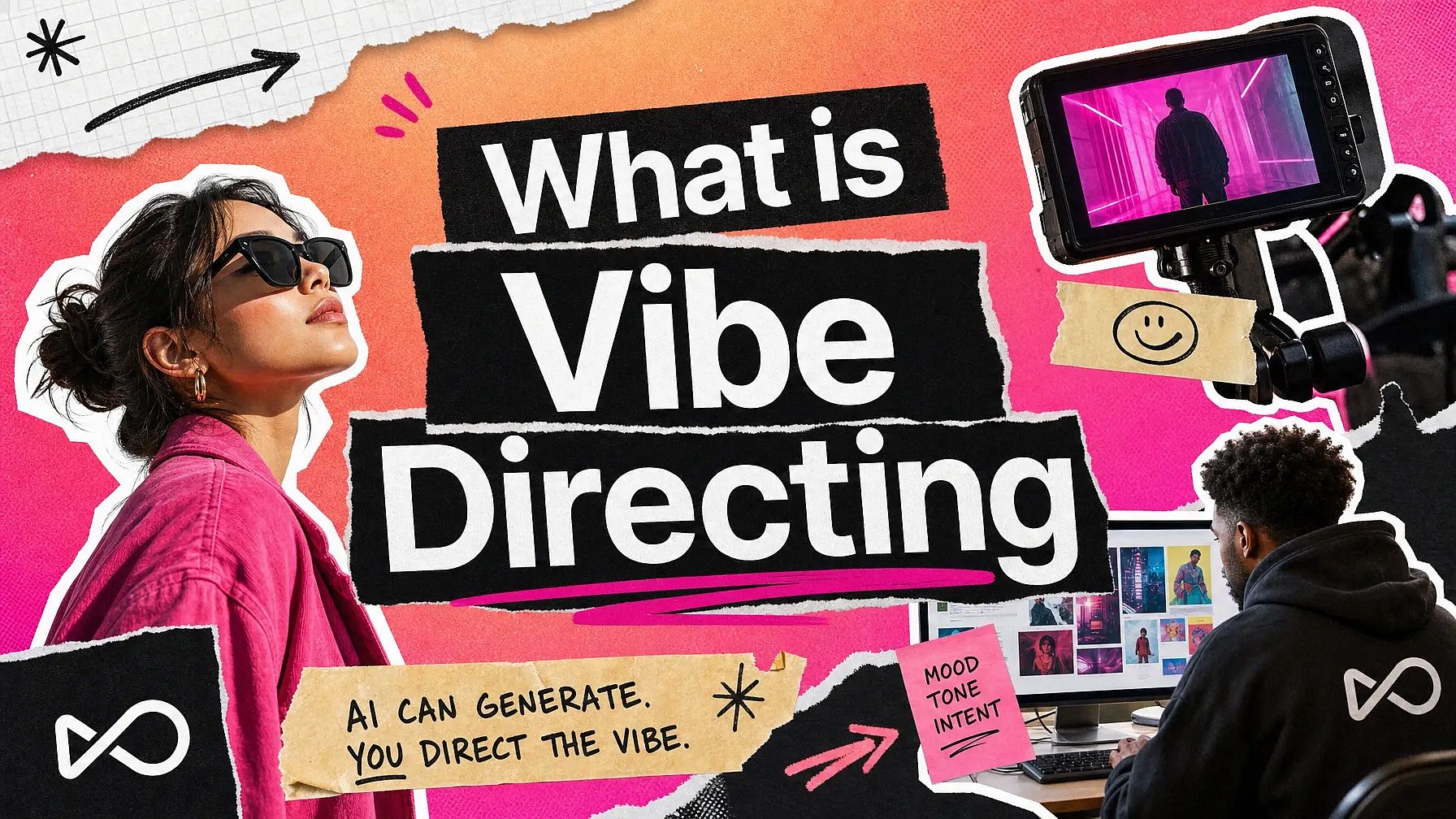
You have heard of vibe coding. Now the same shift is arriving for video, and we're calling it "vibe directing."
Vibe directing is making AI video by describing what you want and shaping it with notes, while every creative call stays yours. In this blog post we'll look at what the term means, how it differs from the 'vibe coding' concept that inspired it, and how it actually works in OpenArt Director.
Key takeaways
- Conventional AI video generation is about automation; vibe directing is about max creative control.
- Vibe directing brings the conversational workflow of vibe coding to video, with you making every creative call.
- You describe the film in your head, give notes on what comes back, and approve every shot.
- Unlike one-shot AI video generators, your notes change one thing without re-rolling everything else.
- You 'vibe direct' in OpenArt Director and leave with a finished film, voices and sound included.
- There is no timeline to learn and no prompt engineering, just direction.
What is vibe directing?
Vibe directing is directing a video into existence by talking. It's conversational. You describe the film in your head, the AI builds it, and you shape every shot and cut with your feedback in chat until it matches your vision.
The role split here is simple. The AI agent is your production crew, and you are the director, which means the story, the look, and the final cut are yours to call.
That last part is the point. Vibe directing is not for quicker automation, unlike conventional AI video generation, and it is definitely not a shortcut. It is supposed to give you maximum creative control without the usual technical hassle. That is why OpenArt has built Director as a separate suite from the conventional AI video generator.
How did we come up with vibe directing?
The name borrows from vibe coding, Andrej Karpathy's term for building software by describing it and, in his own words, letting yourself "forget that the code even exists." Vibe directing runs on the same idea: you describe the film in natural language and forget the technical hassle of making video.
The timeline, the cuts, the stitching, the editing software you were supposed to spend years learning. That whole layer disappears in vibe directing the way actual code disappears in vibe coding.
An AI assistant stays by your side the whole way, asking whenever your direction leaves room for doubt. Think of it as your all-knowing production sidekick.
The difference shows in the result, because you can tell when nobody was in charge of a video's details. Steady creative control is what separates a film that looks intended from a clip that was just a one-shot AI generation.
How is vibe directing different from AI video generation?
Most AI video generation works like a slot machine. You write a prompt, pull the lever, and hope.
When the result is 80 percent right, your only move is to re-roll, and the re-roll may lose the original 80 percent you liked while fixing the rest. Sure, newer AI video models like Seedance 2.5 have the ability to make highly precise edits, but it's still not perfect and the workflow is the same.
Vibe directing replaces that re-rolls workflow with feedback notes that persist: just say the ending should change, and only the ending changes.
The output is different too. Instead of a stack of short clips to stitch and fix in other software, you leave with a finished, coherent piece up to five minutes long, with scenes, voices, music, and sound included.
Under the hood, OpenArt Director combines leading language, image, and video models, including GPT Image 2 and Seedance 2.0. You bring the vision, and your AI crew handles the rendering.
A simple walkthrough: how to vibe direct
Vibe directing in OpenArt Director takes three steps. To make it concrete, follow one idea through: a short film about a kid who builds a rocket in her backyard.
1. Describe your idea
Start at the prompt box and type the film in your head, like "a short film about a kid who builds a rocket in her backyard, warm and hopeful." You can guide it further with a reference image, a music track, or a Character or World you already saved in OpenArt.
Then decide how collaborative you want the AI assistant to be. "Ask me first" has the AI check with you on calls like resolution, aspect ratio, and tone, while "Run automatically" proceeds with the best settings for your prompt.
2. Take the director's seat
Hit "Start Directing", and the AI works through your film step by step, showing its thinking steps as it goes (just like you would in Claude or any other AI agent). You refine the script, the characters, the world, and the look by chatting, the way you would give notes in a production meeting.
This is where the whole vibe directing happens. Maybe the kid in the video should be younger, and the backyard should feel like a summer memory, so you say exactly that and it keeps refining.
3. See it come to life
When the cut is ready, review it in two different tabs. Scenes shows your storyboard, and Timeline shows the finished video, the way a director watches dailies.
Then give notes on anything, from a single frame to the whole film. "End on hope, not on the launch" changes exactly that, and a few rounds later the film on screen matches the one in your head.
Who is vibe directing for?
Vibe directing is for people who care about how the final result looks and feels, not about rapid production and automation. It's for those who are open to sit with the idea and go through loops of iteration.
If you have never made a video, you have still been directing your whole life, every time you pictured how a moment would play out. OpenArt Director simply hands you the tools to make those moments a reality now.
Start vibe directing
So that is vibe directing. You describe, you give notes, you approve every shot, and you stay the director from the first idea to the final frame.
There's a director in all of us. Ready to take the chair? Start vibe directing at OpenArt.