

 ChatGPT
 Perplexity
 Claude
 Gemini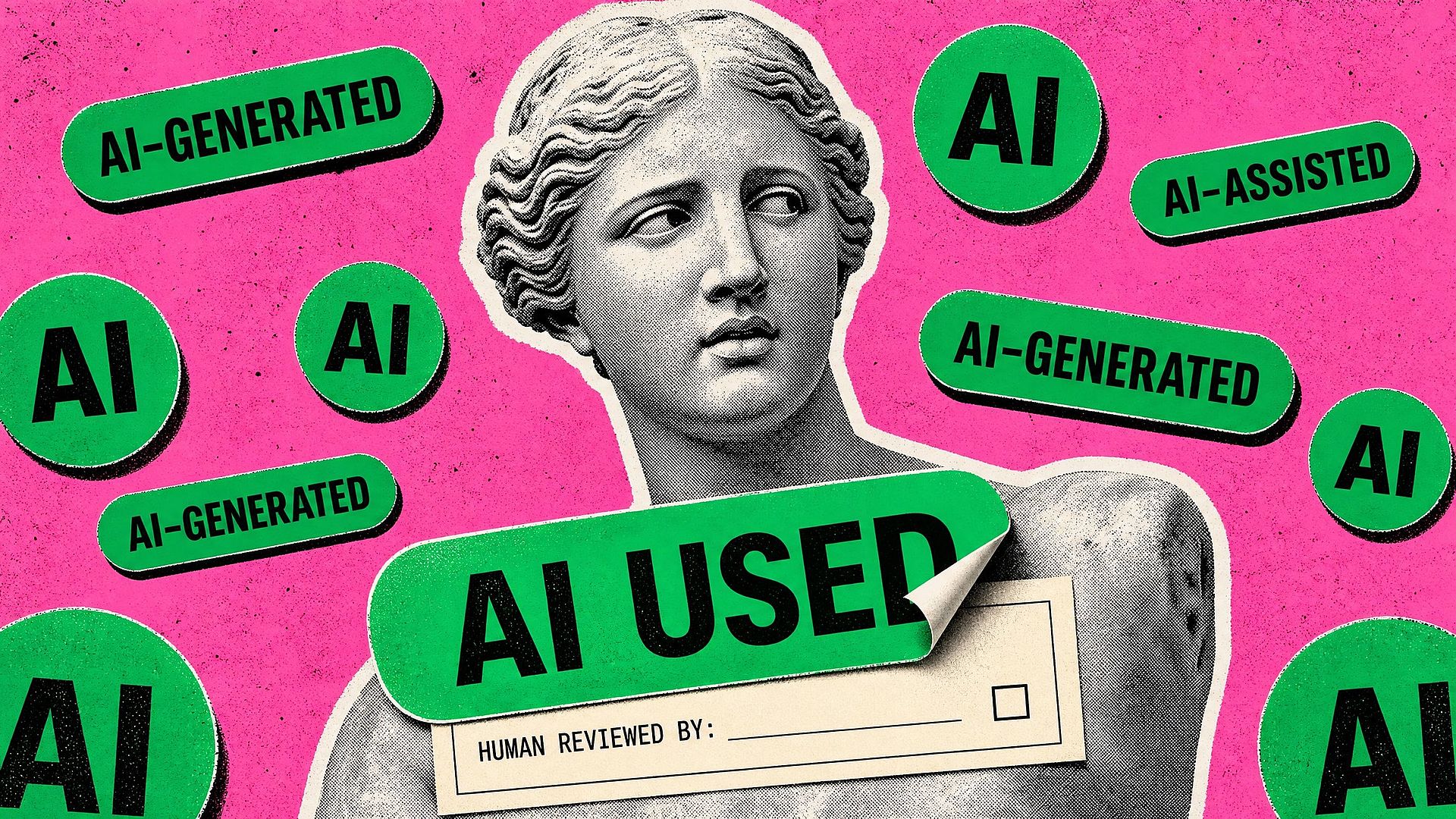
The demand side of this argument isn't close. Fractl's 2026 survey of more than a thousand consumers found that 84 percent want written AI content labeled, 91 percent want it on video, 90 percent on images, 87 percent on audio, with strongly-agree responses alone clearing half in every category. The supply side isn't close either, just in the other direction: only 20 percent of organizations say they always disclose AI use to their audience, and 33 percent say they never do. Framed that way, this looks like a straightforward compliance gap. Get more companies labeling their content, close the gap, problem solved.
Except a pair of 2026 studies published in the journal Digital Journalism suggests that gap isn't actually where the trust problem lives. One, a conjoint experiment with Chilean media consumers, had people compare outlet AI policies head to head and found that human oversight, not disclosure alone, was the single most influential factor in which outlet people found credible and chose to read. Whether an outlet used AI for menial tasks or personalizing formats barely moved the needle either way. What moved it was whether a person had reviewed what the AI produced. A label answers one question: was AI involved. It turns out that's rarely the question an audience is actually asking.
The second study, built on interviews rather than experiments, found something sharper: labels can actively backfire. One participant described their reaction to seeing an AI label as "I probably need to fact-check this and try and find another article," which is the opposite of what a disclosure label is supposed to accomplish. Others saw AI use itself as a kind of professional shortcut, with one interviewee putting it bluntly about a fully AI-written article: "You can do that as an 11-year-old. You don't need the training for that if you're going to use AI to generate your entire article." A vague, generic label doesn't resolve that instinct. It just confirms the suspicion without giving anyone a reason to set it aside.
What the same research found does help: specificity about degree, not just presence. Interview subjects drew a real line between an article labeled as fully AI-generated and one labeled as AI-assisted, treating those as different claims requiring different levels of scrutiny, and they wanted that distinction visible at the top of a piece rather than buried in a footer where it could look like it was trying not to be noticed. None of that is about whether to disclose. It's about whether the disclosure actually tells someone what happened and whether a person was accountable for it.
That's the distinction the compliance framing misses entirely. A law can mandate that a label exists. It can't mandate that the label does the actual job of rebuilding trust, because trust is a function of whether the audience believes a competent person was still in the loop, not of the label's presence on the page. Getting the 33 percent who never disclose to start doing it matters in its own right. But the harder, more useful question sitting underneath it is whether what gets disclosed actually tells anyone anything, or just checks a box that doesn't touch what people were actually worried about in the first place.