

 ChatGPT
 Perplexity
 Claude
 Gemini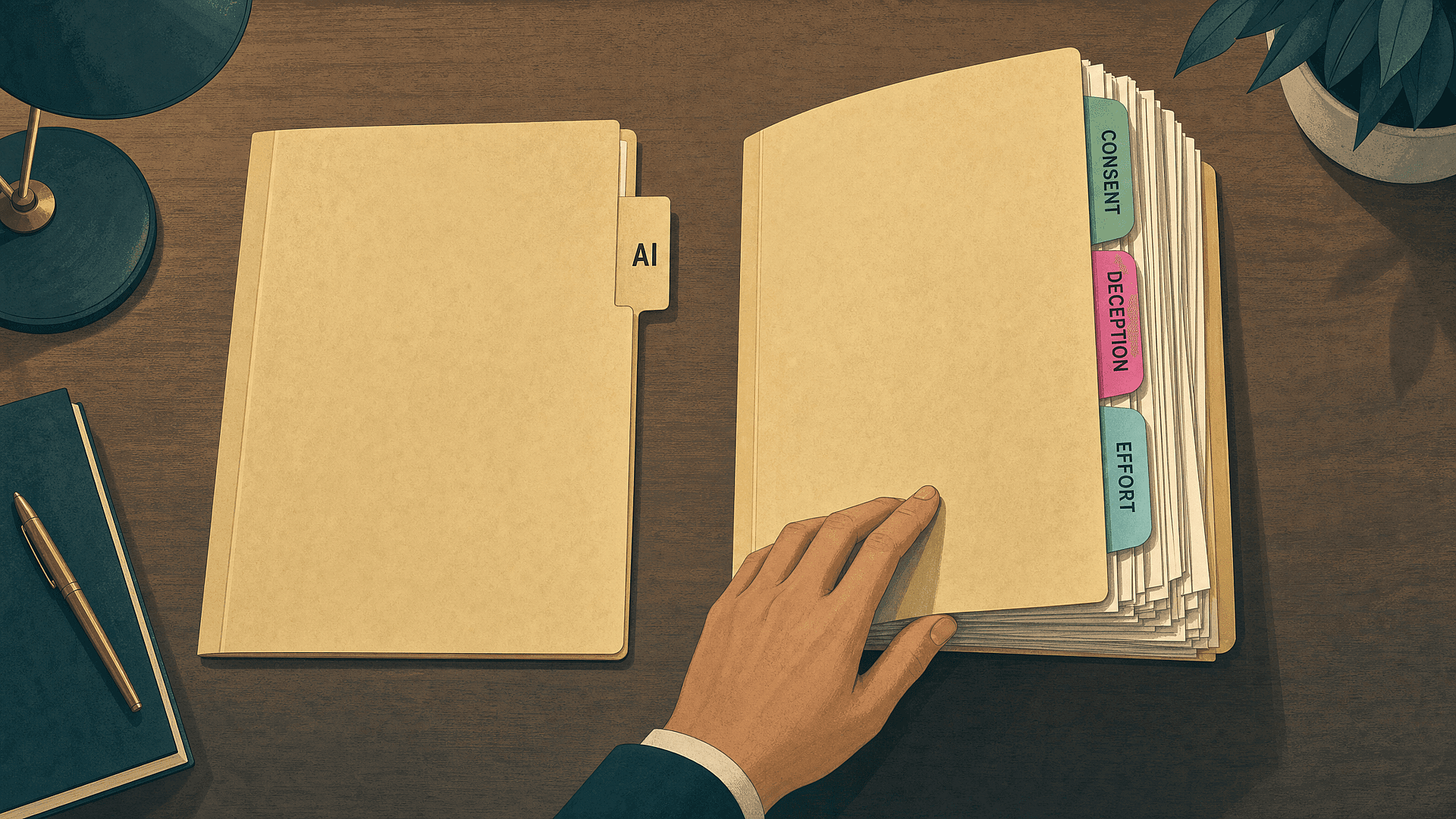
On August 2, the EU AI Act's transparency obligations hit full enforcement, requiring clear, perceivable labels on deepfakes and AI-generated content, with non-compliance carrying penalties of up to seven and a half million euros or 1.5 percent of a company's global turnover. A law can force a label onto a piece of work. It can't force an audience to agree on what that label means, and right now, almost nobody agrees.
The first wave of AI backlash treated "AI art" as one thing: a single category, deserving a single reaction. That couldn't hold for long. Nearly half of creative professionals now use generative AI daily on client work, and half say they're using it significantly more than they were just six months ago, according to Envato's newest industry survey. Once a tool is that embedded in ordinary production, a single verdict about it stops being useful, because it has to cover everything from a cleanup pass on a client logo to a fully synthetic character performing a scene that never happened. Those aren't the same thing, and treating them as the same thing is exactly what's breaking down.
What replaces a blanket verdict is specificity, not acceptance. A 2026 study presented at the ACM Conference on Fairness, Accountability, and Transparency found that granularity, being specific about how AI was used rather than slapping on a generic warning label, measurably reduces the stigma attached to disclosure. That flips the usual instinct to hide AI use to avoid judgment: the causality actually runs backward. A vague label reads as suspicious in a way a specific one, laying out exactly what happened, reads as accountable.
You can watch this play out in real time by comparing two things that happened weeks apart. Meta's Muse Image let people pull another user's public Instagram photos into AI generations without asking first, and the backlash was fast, organized, and specifically about consent: SAG-AFTRA called it out by name, and Meta pulled the feature within days. Compare that to the quieter, barely-remarked-on fact that a huge share of routine AI-assisted editing, color correction, background cleanup, format conversion, happens every day without anyone objecting to it at all. Both involve the same underlying technology. Nobody's confused about which one is the problem. The shame is attaching to consent, deception, and whether someone lost control of their own likeness, not to "AI" as a technology, and it's very precisely skipping over the boring, assistive uses that have quietly become normal.
That's the harder version of this to sit with if you're a creator: the judgment usually isn't really about effort, even though "they didn't even try" is the sentence people reach for. A creator who shows every layer, every reference, every editing pass, still gets read as suspicious if the underlying use case is the one people haven't made peace with yet, a fully synthetic performance standing in for a real one, a likeness used without permission, a scene staged to be mistaken for documentary. Showing your work resolves an effort objection but leaves a consent objection completely untouched, and a lot of what gets called "AI shame" is actually the second thing wearing the costume of the first.
None of this means the discomfort disappears once the categories get sorted out, it just means the discomfort gets easier to actually respond to. A creator can't win an argument with the entire internet about whether AI belongs in creative work, and trying to is a losing game. What a creator can do is make the specific thing they did, and didn't do, legible: what was generated, what was directed, whose likeness was or wasn't involved, whether anyone watching is being asked to believe something that isn't true. That's a smaller, more answerable question than "is this cheating," and it's the one that's actually being asked underneath all the noise.