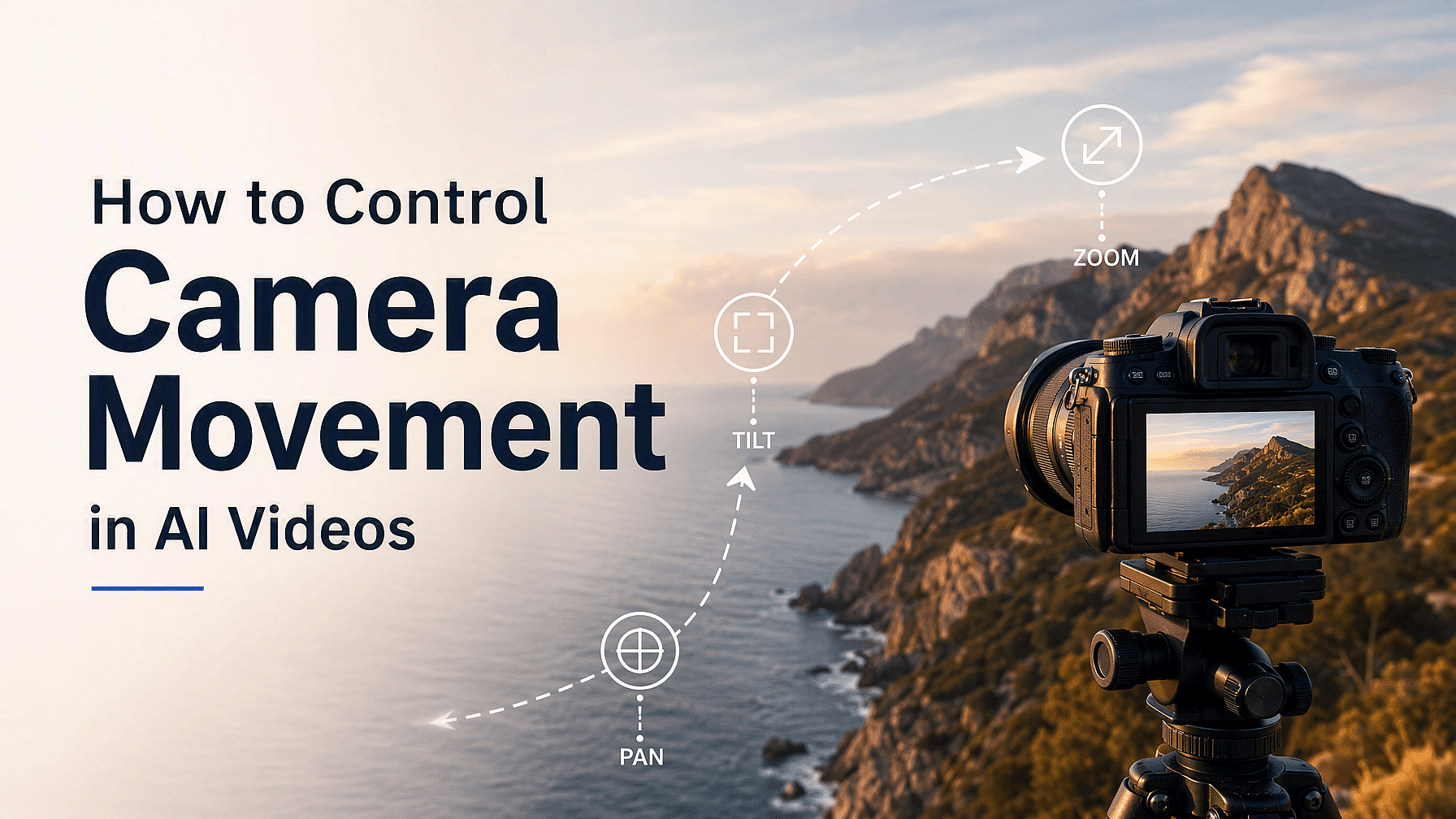

Camera movement separates AI video that looks generated from AI video that looks directed. Prompt language and platform controls shape it, as does tool selection. Use standard camera vocabulary and platform controls, then choose the right model and endpoint workflow to produce repeatable moves from static images.
What makes an AI video generator good for camera movement
Four criteria separate the platforms that deliver from the ones that only claim cinematic camera control:
- プロンプト忠実度: Testing identical inputs, creator Sophia Banton found Veo 3 "most obedient to prompts in terms of both subject matter and camera movement," while Runway Gen-4 was "less effective with complex animation requests."
- テキスト以外のUIコントロール: Sliders and presets survive the ambiguity of language. Motion brushes do too. Kling ships six named movements plus four compound presets, while OpenArt offers rotation sliders and Luma offers named motion presets.
- Motion fidelity: Kuaishou built Kling 2.5 Turbo for "more dynamic motion and camera movement with greater amplitude."
- アーティファクト耐性: 素早いパンやオービットはAI動画が崩れやすいポイントです。顔がゆがみ、背景が溶け、ジオメトリがずれていきます。
VBench の研究者たちは、「時間的一貫性に優れたモデルは、この 2 つの要素がある程度トレードオフの関係にあるため、Dynamic Degree(動きの度合い)が低くなることが多い」と指摘しています。最も安定したカメラワークは動きの少ないモデルから生まれるので、このトレードオフのどちら側が必要かを見極めて選びましょう。
AI camera movement terminology: pan, tilt, zoom, orbit, crane, and more
Models respond to the same vocabulary cinematographers use, and Google's Veo prompt guide documents most of it as supported keywords.
| Movement | 概要 | Example prompt phrase |
|---|---|---|
| Pan | Camera rotates horizontally left or right from a fixed position | "slow pan left across the harbor" |
| チルト | 固定位置からカメラが上下に垂直に回転します | 「ブーツからライダーの顔へティルトアップ」 |
| プッシュイン(ドリーイン) | Camera physically moves toward the subject | "slow push-in on the singer's face" |
| Pull-back (dolly out) | Camera physically moves away from the subject | 「滑らかに引いて、下の峡谷を映し出す」 |
| トラック | Camera moves laterally left or right | "truck right along the market stalls" |
| Pedestal | Camera moves straight up or down while staying level | "pedestal up past the bookshelf" |
| Orbit (arc) | Camera circles the subject in a curved path | "camera orbits the product in a slow, deliberate arc" |
| Crane | Camera rides a crane arm through vertical or sweeping paths | 「クレーンショットが机に向かってなめらかに下降する」 |
| Rack focus | Focus shifts from one subject or distance to another mid-shot | 「ケースから証人の顔へゆっくりラックフォーカス」 |
| Crash zoom | Camera remains in place while the lens changes focal length extremely rapidly | "rapid, aggressive crash zoom on the subject's eyes" |
| Handheld | Operator-held camera with jitter and shake | 「激しく揺れる手持ちカメラが通りを追う」 |
| POV | キャラクターの視点からの撮影 | 「ライダー視点の一人称POV」 |
| Drone / aerial | 航空機やドローンからの高高度ショット | "aerial drone shot rising over the coastline" |
ドリーはパララックスとフレーム内すべての相対位置を変えます。ズームはその空間関係を保ったままフレームを拡大します。ラックフォーカスはショット中に被写体間でレンズのピントを移すもので、一部のモデルがこれを光学効果のキーワードとして扱うのはそのためです。
How to write camera direction prompts that work
Put the camera move first. Practitioner testing on Sora 2 found the model "weights early tokens heavily for camera intent," and one practitioner guide reports Ray "responds strongly to 'slow dolly in,' 'orbit,' 'low tracking shot.'"
The major vendors publish their own structures, and they converge on the same anatomy:
- Runway: Its Gen-4 guide sequences the prompt as subject motion, camera motion, scene motion, then style descriptors.
- Google: The Veo 3.1 guide orders it as cinematography, subject, action, context, then style and ambiance.
- Kling: Its format is subject, subject movement, scene, then camera language, lighting, and atmosphere.
- Luma: Its guidance tells you to describe the specific camera technique and movement style.
Phrase everything positively. Runway's Gen-4 prompting guide warns against "No camera movement. The camera doesn't move. NO MOVEMENT" and recommends "Locked camera. The camera remains still." instead. Curious Refuge reports the same for Luma 3.14: it "doesn't respond well to negative prompting."
Luma's guidance lists "slowly," "rapidly," "gently," "smoothly," and "precisely" as pacing controls.
Subject distance changes how fast the same move feels. Objects closer to the lens appear to move faster than distant ones, so a dolly past a foreground element reads quicker than the identical dolly in an empty frame. Wide-angle framing close to the subject makes motion toward the camera feel faster; long-lens framing from far away slows it down while exaggerating lateral movement.
If your generated dolly feels sluggish, prompt for foreground elements near the camera rather than a faster move.
Text prompts vs. motion brushes vs. UI sliders: choosing your control method
Text prompts and interface controls cover most camera work; some platforms also support motion reference.
| Method | Where you get it | おすすめの用途 |
|---|---|---|
| テキストプロンプト | Runway Gen-4.5、Veo 3.1、Kling、Luma、OpenArt | Complex or combined moves; full creative range |
| UI sliders and presets | Kling's six movements and four Master Shots, Luma's Pan/Orbit/Crane/Push presets, OpenArt Camera Angle Control | promptの試行錯誤なしで再現可能な結果を |
| Motion brush | Kling (up to six elements, plus a Static Brush that locks pixels) | フレームの他の部分を保ったまま、1つの要素だけを動かす |
| Motion reference | OpenArt Motion Sync, Kling's motion-reference video upload | 実写映像からモーションを再現 |
Runway retired its six-slider Camera Control along with Gen-3 Alpha and Gen-3 Alpha Turbo in July 2026 and replaced it with a documented camera-terminology prompt library for Gen-4.5.
カメラ用語は初めて?プリセットやスライダーから始めましょう。Luma で「Orbit Left」を選んだり、Kling で Master Shot を選んで出力を研究してみて。語彙に慣れれば、構造化されたテキスト prompt で、どのプリセットメニューにもない動きが出せます。既存の映像に動きを合わせる必要があるときは、モーション参照が最も直接的な方法です。
Best AI video generators for camera movement
カメラワークに最適なAI動画ジェネレーターは、スライダーレベルの精度が必要か、生のモーション品質が必要か、それとも1つのプランで複数の最新動画モデルが必要かによって変わります。
Runway
Runway released its flagship Gen-4.5 in December 2025 and reported that it topped the Artificial Analysis Video Arena at launch, beating Veo 3 and Sora 2 Pro; the exact Elo figure varies by source and live preference boards reshuffle constantly, so treat any specific ranking as a snapshot. Camera direction is text-prompt based, backed by an official camera terms reference library with worked examples for dolly, pan, zoom, handheld, crane, and orbit; Director Mode was a Gen-2-era control with no Gen-4.5 equivalent. Among the platforms reviewed here, Runway is the only vendor whose guide explicitly encourages combining terms "especially for cinematic sequences."
The Animate with Keyframes app anchors starting and ending frames, and a Last Frame utility node in Workflows extracts final frames for chaining clips. Native clips max out at 10 seconds.
Field results are mixed. A Futureproof Studios test of Gen-4 found Runway's running motion "jerky and unnatural" with glitched arms. Check Runway's own pricing page for current plan details, since rates change.
Kling
Kuaishou launched Kling 3.0 in February 2026, adding native 4K output, longer clips, and multi-shot storyboarding on top of Kling's existing camera toolkit. That toolkit is still the most granular non-prompt system among the single-model platforms reviewed here: the camera control guide 6つの基本的な動き(水平、垂直、ズーム、パン、ティルト、ロール)に加え、4つのマスターショットのプリセットを備えています。Motion Brushは最大6つの要素を同時に操作でき、Static Brushはピクセルを固定して、ブラシで塗った範囲のカメラの動きを抑えます。
Multi-Shotはシーン切り替えを自動で計画します。さらにプロンプトに基づいて、ショットのフレーミングやカメラアングルの変化も設計します。
Element binding keeps subjects stable during zooms and pans. It also supports tilts.
A 2024 image-to-video comparison by creator Adrian Rohnfelder found that "in over 90% of cases, KLING AI offers the best animation in terms of movement, dynamics and coherence." Kling disables camera presets when you activate Motion Brush or add an end frame. Check Kling's own pricing page for current plan details.
Google Veo
Among the platforms reviewed here, Veo 3.1 has the deepest documented camera vocabulary, with official keyword support for pan, tilt, dolly, truck, pedestal, zoom, crane, aerial, handheld, whip pan, and arc shots. Its プロンプトガイド adds timestamp prompting, so [00:04-00:06] Tracking shot... 次に [00:06-00:08] Wide, high-angle crane shot... 1回の生成で異なるショットを作り出します。
In a Futureproof Studios field test, Veo 3 produced "smooth, fluid, and natural" output and ranked as the clear cinematic winner. It also generates synchronized audio natively, in clips from 4 to 8 seconds at two-second increments and 24 FPS, natively 720p with upscaling to 4K. Consumer access runs through Google AI Pro at $19.99/month; the Vertex API runs roughly $0.50 per generated second without audio and $0.75 with audio, though rates should be confirmed on Google's current pricing page before budgeting a campaign.
Luma Dream Machine
Luma's current models are Ray3.14 and Ray3.2, and its camera system is the most structured for developers among the platforms reviewed here. Named presets (Pan, Orbit, Crane, Move, Push In, Pull Out) appear when you type "Camera" in the web UI, and the Ray 2 API exposes named camera motion concepts, from dolly_zoom と pedestal_up へ bolt_cam と tiny_planet, as machine-readable strings. Rohnfelder's 2024 comparison, run on Gen-3-era models, singled this out: "With Camera Motion, LUMA AI offers a reliable method of determining a camera movement. The other two providers use the prompt to control the camera, but this works very unreliably or not at all."
Ray3 adds Visual Annotation, where you scribble directions on the start frame to guide motion. Ray3.2 supports Camera Motion Transfer from source footage. Check Luma's own pricing page for current plan details.
OpenArt
OpenArt takes a model-agnostic approach: instead of one model's camera system, you get Seedance 2.5, Veo 3.1, Wan 2.7, Kling Omni, LTX 2.3, and the rest of a 100+ model catalog under one plan, plus its own camera tools layered on top. Camera strength is model-specific.
Four OpenArt features target camera work directly:
- カメラアングル制御 reframes any image from a new angle. You set rotation on both axes, pick a lens type (default, wide-angle, or close-up), and choose fast or ultra output quality.
- スマートショット turns one prompt into a multi-cut sequence of shots. It generates a storyboard you can edit first, and it applies real camera techniques such as orbit shots, dolly movements, push-ins, and pans.
- マルチビュー 1枚の画像から9つのアングルを生成するので、動画にクレジットを使う前にフレーミングを選べます。
- モーションシンク copies movement from a reference clip onto your character.
OpenArt Director ストーリーボードをベースに、ショット間でキャラクターや環境の一貫性を保ちながら、最長5分の動画を作成します。
特定のカメラワークで静止画をアニメ化する方法
Image-to-video is where camera control pays off most: the still locks composition, so the prompt only carries the move. The workflow:
- Generate or upload your still. On OpenArt, run it through Camera Angle Control or Multi-View first to set the starting framing.
- Pick the model. Kling for motion coherence, Veo 3.1 for realism and audio, or Luma for structured keyframe control.
- Set the start frame: your image becomes frame one, and it carries composition, subject, lighting, and style into the video.
- Add an end frame where the model supports it. Kling, Veo 3.1, and Luma Ray3.14 all interpolate between two anchored images; OpenArt's video generator lets you set both frames directly for the models that offer this.
- Write a camera-first prompt; Google's own example describes a smooth 180-degree arc from a front-facing view of the singer to a POV shot from behind her on stage.
- Generate, then scrub the middle frames before approving. Endpoints can be perfect while hands, faces, backgrounds, and geometry drift in between.
最初/最後のフレームでの固定は、最も強力な一貫性ツールの一つです。両端の画像は似せておきましょう。Klingの公式ドキュメントでは、フレーム間の差が大きいと「レンズの切り替わりが起きる可能性がある」と警告されています。また、モデルは2枚のフレームが示す間を埋めるため、被写体のスケール、照明の向き、衣装、主要なシーン構造を両フレームで揃えておきましょう。
Runway handles multi-clip continuity differently, through sequential chaining: extract the last frame of a finished clip and feed it as the first frame of the next.
Combining multiple camera movements in one generation
The default rule is one primary camera move per clip. Practitioner guides converge on the same finding: combining several moves in a 5-second shot makes the model average them into a blur, while stacked simultaneous moves produce jitter and confused output. Runway Gen-4.5 is the documented exception; its guide encourages combined terms and gives an example that sweeps in a horizontal arc around the subject, then crash-zooms to a sharp focus on the eyes.
お使いのプラットフォームが認識するシーケンス構文を使いましょう:
- Timestamps (Veo 3.1 and Runway):
[0:00-0:03] Wide establishing, slow dolly. [0:03-0:06] Medium close-up, tracking.Each block gets one move. - Numbered shots (Kling 3.0 Multi-Shot): Number each shot and put it on a new line. This signals the model to make a cut. Give each shot one action and one camera instruction.
- フレームチェーン(すべてのプラットフォーム): Generate the push-in, extract its last frame, and use it as the first frame of the orbit. Two clean 5-second moves beat one warped 10-second hybrid.
- 角括弧(Hailuo/MiniMax): Use separate brackets to sequence moves and comma-separated terms inside one bracket for simultaneous moves.
Keep clips in the 5–8 second range; past 10 seconds models invent secondary motion, and Kling 3.0 "will often cut to a different shot even with multishot toggled off." Prompt for eased moves rather than constant-speed ones; per practitioner testing, "Gradual acceleration at the start and gradual deceleration at the end is the single biggest factor in whether a camera move reads as natural or synthetic."
Lens simulation and cinematic effects: anamorphic, rack focus, and film stock
Veo 3.1 documents the deepest lens vocabulary among the platforms reviewed here: wide-angle, telephoto, shallow depth of field, lens flare, rack focus, fisheye, and the vertigo effect (dolly zoom), in which "the background perspective changes dramatically." Runway's Gen-4 Image guide lists "anamorphic lens" and "35mm" film-grain keywords; OpenAI's Sora 2 guide goes furthest on film stock, with prompt examples covering Kodak-inspired grades, gate weave, halation, and grain.
Expect variance: per practitioner testing, "even when using identical seeds and reference images, the position and intensity of a lens flare can vary between generations." It matters most when you're matching AI shots to real footage or holding one grade across a campaign; OpenArt covers lens selection with the lens type options inside Camera Angle Control.
Troubleshooting camera movement problems: warping, distortion, and inconsistency
Each common artifact has a working fix:
- Warping during fast pans: Slow the move, cut the clip to 5–6 seconds, or split one fast pan into two chained slower ones. The model loses track of detail when the frame moves too far, too fast.
- Backgrounds that melt or morph: Lock subjects with Kling's element binding, or anchor the shot with an end frame so the model has a geometric target. These models hold no 3D map of the scene.
- Orbits that fall apart mid-rotation: Prompt partial arcs, or build full orbits from Camera Angle Control stills chained as keyframes. A practitioner test of Kling 3.0 held environmental geometry for roughly 120 degrees before shoulder morphing appeared.
- Flickering textures: A touch of film grain in post hides minor imperfections, and Topaz Video AI smooths choppy motion.
- Unwanted drift on locked shots: Prompt positively ("Locked camera. The camera remains still."), and on Kling paint the Static Brush across the frame bottom. One Kling user reported roughly 10 renders to get a clip without unwanted movement.
- Characters that change between clips: Chain last frames or feed reference images; Veo 3.1 accepts up to three. OpenArt's Characters library saves a character once so you can reuse the same face and look across every clip.
Choosing the right tool for your workflow
For cinematic film work, Futureproof Studios' test found Veo 3 delivered the most believable motion among the models it compared. Veo 3.1 also provides native audio and the deepest documented camera vocabulary among the platforms reviewed here; pair it with first-and-last-frame interpolation for controlled reveals. Kling 3.0 is the pick when the move itself carries the shot, based on its manual controls, element binding, and Multi-Shot planning. Runway earns its place for editing-heavy pipelines, where frame chaining and its keyframe apps matter more than clip length.
For product video, the orbit is the money shot, and OpenArt handles the whole sequence. Set the angles with Multi-View or Camera Angle Control, then set a start and end frame in OpenArt's video generator to anchor the rotation. OpenArt Director's UGC ads use case handles the campaign cut. Runway suits one-off VFX shots; OpenArt suits a brand that needs the same character across dozens of them.
For social content at volume, access to multiple models can matter more than committing to a single model. Camera behavior differs enough between Veo, Kling, Seedance, and other models that the practical workflow is testing the same shot across models and shipping the winner. A shared workspace and credit pool avoid separate subscriptions while you test.
OpenArt's paid plans include commercial use, so everything you generate on those plans is yours to run in paid ads and client work without additional licensing. Check the OpenArt料金ページ for current plan names, credit amounts, and rates.
よくある質問
These answers cover control precision, prompting methods, endpoint anchoring, model selection, and lens effects.
Which tool gives the most precise camera control?
Among the platforms reviewed here, Kling has the most granular manual controls, with six movements, four presets, and Motion Brush with a Static Brush. Luma has a structured system for developers with named API motion concepts. OpenArt combines rotation sliders for reframing any image with model-agnostic generation.
The right choice depends on whether you want manual dials or structured API strings; OpenArt adds image reframing.
How do I write a prompt for a specific camera move?
Lead with a standard cinematography term and add a speed adverb: "slow push-in on the chef plating the dish." Follow your platform's structure (Runway: subject motion, camera motion, scene motion, style) and phrase moves positively: Runway recommends "Locked camera. The camera remains still." over negative phrasing.
What's the difference between text prompts, motion brushes, and sliders?
Text prompts describe the move in language and offer the widest range but the least repeatability. Sliders and presets constrain the model to a named move, which trades flexibility for consistency.
Motion brushes work at the element level. They direct what moves inside the frame while leaving camera direction to another control.
How do first and last frames keep camera moves consistent?
Anchoring both endpoints forces the model to interpolate a path between two compositions you chose instead of inventing one. Keep the two frames similar in subject scale, lighting, wardrobe, and layout; Kling warns that large differences can trigger an unwanted lens switch.
Runway vs. Kling vs. Veo vs. Luma: which wins for camera movement?
In Futureproof Studios' test, Veo 3 produced the smoothest motion among the compared models. Veo 3.1 also provides native audio and strong prompt adherence. Kling stands out for motion coherence and manual controls.
Luma offers structured, machine-readable camera concepts, while Runway supports combined moves and post-generation editing at the cost of a 10-second clip ceiling. OpenArt gives you Veo, Kling, and other current models under one plan, so you can match the model to the shot.
Can AI video simulate lens effects like anamorphic or rack focus?
Veo 3.1 documents rack focus and dolly zoom as supported prompt language. Sora 2 handles detailed film-stock direction, while Runway supports anamorphic and 35mm keywords in image generation. Expect variation between generations even with identical seeds, and plan a selection pass rather than a single render.