
 ChatGPT
 Perplexity
 Claude
 Gemini
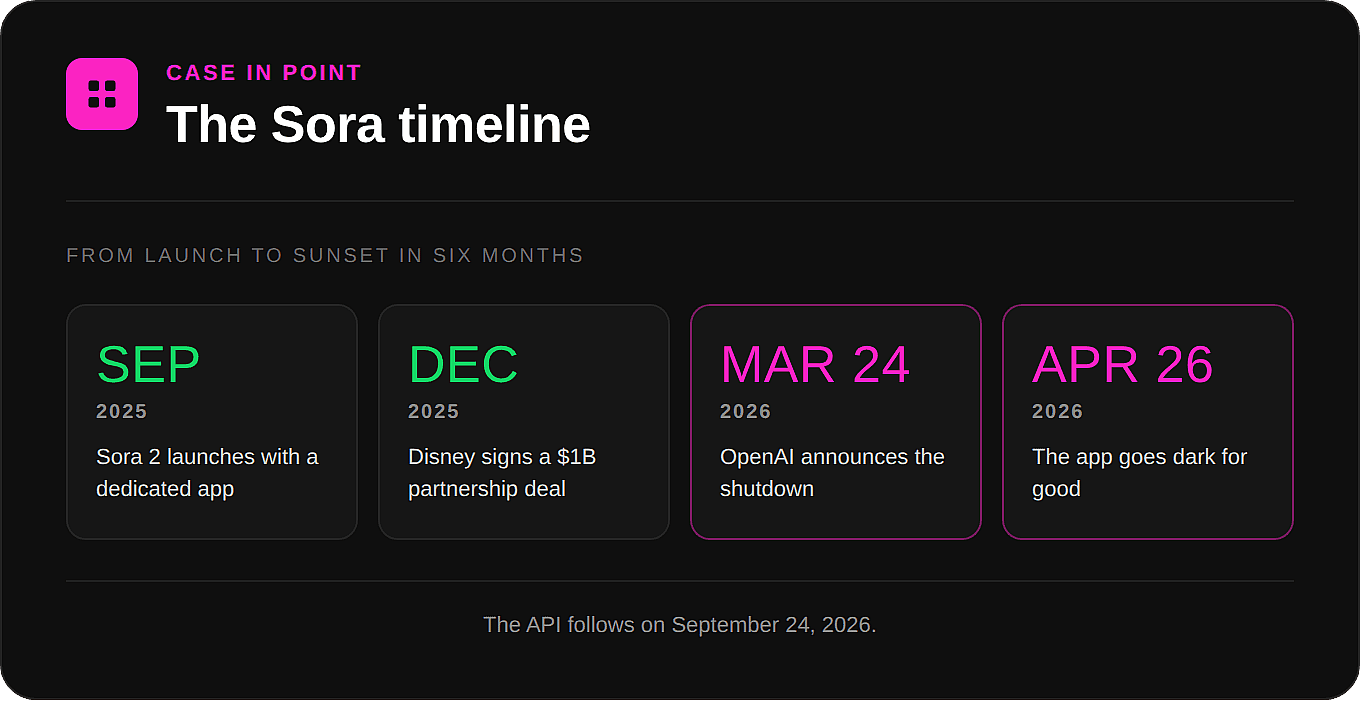
El 24 de marzo, OpenAI anunció que iba a cerrar Sora. La app se apagará el 26 de abril. La API le seguirá en septiembre. La colaboración multimillonaria con Disney firmada en diciembre se disolvió con ella y, según los informes, Disney se enteró menos de una hora antes que el resto del mundo.
Si tu flujo de trabajo creativo vivía dentro de Sora, tienes unas semanas para exportar tu trabajo y decidir qué hacer a continuación. Es el tipo de plazo que convierte un debate abstracto sobre estrategia de IA en un problema muy concreto.
También plantea una pregunta que merece la pena reflexionar con calma: en un campo tan volátil, ¿cuál es la forma correcta de construir una práctica creativa sobre las herramientas de IA? Es una pregunta a la que OpenArt lleva dando una respuesta concreta desde el principio. Pero antes de llegar a esa respuesta, conviene ver por qué la pregunta cada vez es más difícil de evitar.
El panorama no va a estabilizarse
Cuando algo avanza rápido, existe el instinto natural de esperar a que se calme. De elegir al ganador definitivo una vez que se asiente el polvo. Es un instinto razonable, pero no encaja del todo con lo que está pasando ahora mismo en la generación de imágenes y vídeos con IA.
The pace isn't slowing. If anything, it's picking up. In just the last few months, Midjourney shipped V8 with a rewritten engine and native 2K output. Black Forest Labs released Flux 2. Google's Nano Banana 2 became one of the fastest image models available. Imagen 4 raised the bar for photorealism again. Recraft V4 took over as the model people reach for when they need vectors. Ideogram keeps leading on text rendering. Kling and Seedance are pushing video forward on a near-monthly cadence. And Sora, which a year ago looked like the future of AI video, is being sunset.
The pattern isn't a market consolidating around a few stable winners. It's a research frontier where the leader changes regularly, capabilities leapfrog each other constantly, and the economics of running these models are demanding enough that even well-funded labs are making hard tradeoffs. Sora wasn't shut down because it was bad. By most accounts the underlying model is impressive. It was shut down because video generation is enormously expensive to run, the user numbers didn't justify the compute, and OpenAI needed those resources elsewhere. That same math applies, in some form, to almost every model in the space.
Ningún modelo es el mejor en todo
Una vez que trabajas con este panorama con regularidad, la pregunta de «qué modelo es el mejor» empieza a parecer la pregunta equivocada. ¿El mejor para qué?
Un esbozo rápido de cómo están las cosas ahora mismo:
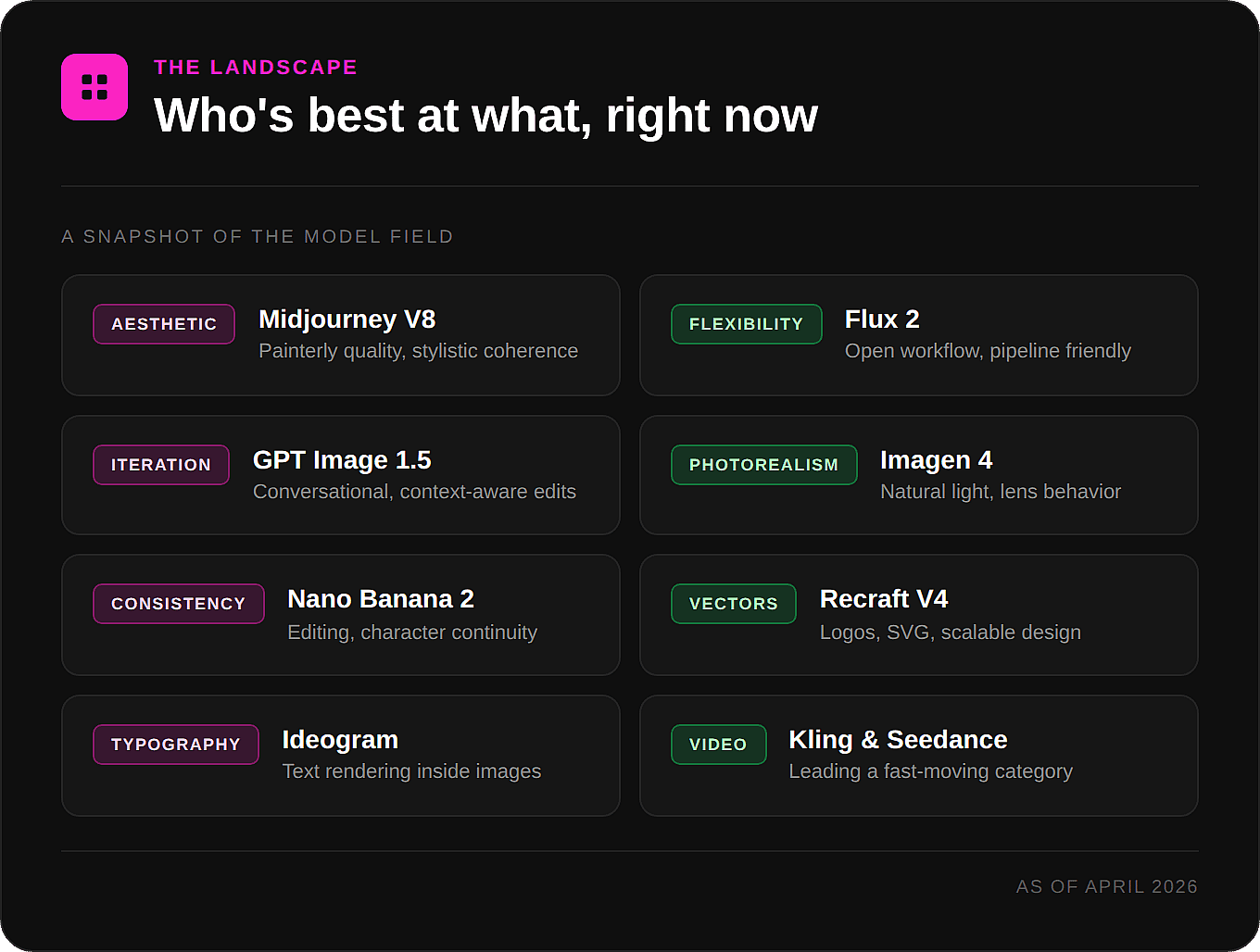
Midjourney sigue marcando el listón en calidad estética y coherencia estilística. Si quieres una imagen que se vea preciosa nada más generarse, muy poco se le acerca. La contrapartida es un ecosistema cerrado, sin una API real, con integración limitada en flujos de trabajo más amplios y un modelo basado en Discord y suscripción que no encaja en todos los casos de uso.
Flux 2 es donde ha aterrizado gran parte de la comunidad de flujos de trabajo de código abierto. Es flexible, controlable y encaja bien con el ecosistema más amplio de ajuste fino, LoRAs y herramientas de pipeline. Si necesitas encadenar cosas o crear algo a medida, es difícil de superar.
GPT Image 1.5 está pensado para iterar. La interfaz conversacional te permite refinar una imagen igual que hablarías con un colaborador. Haz esta parte más cálida, mueve ese elemento, prueba de nuevo con otro fondo. El modelo mantiene el contexto durante toda la conversación, y ese bucle de iteración es el verdadero producto.
Google Imagen 4 y Nano Banana 2 están haciendo un trabajo extraordinario en fotorrealismo y velocidad. Nano Banana 2, en concreto, se ha convertido en el modelo de referencia para editar y mantener la coherencia de personajes, ese tipo de problema de infraestructura poco vistoso que determina si puedes terminar un proyecto o solo generar impresionantes piezas sueltas.
Recraft V4 es el modelo al que recurrir cuando necesitas vectores, logos o diseños que deban escalar de forma limpia.
Ideogram sigue liderando en la representación de texto, algo que importa más de lo que la gente espera en cuanto empiezas a intentar poner palabras dentro de las imágenes.
Kling y Seedance lideran ahora mismo la conversación sobre vídeo, con nuevas versiones apareciendo a un ritmo que hace que cualquier afirmación de "mejor modelo de vídeo" parezca temporal por definición.
La conclusión no es que una de estas sea la respuesta correcta. Es que un fotógrafo, un artista conceptual, un pequeño empresario que crea maquetas de producto y un cineasta que planifica una escena necesitan cosas distintas, y el modelo que mejor le va a uno rara vez es el mejor para los demás.
El coste de quedarte atado
Cuando confías todo tu proceso creativo a un solo modelo, asumes más de lo que crees. Heredas sus limitaciones, sus cambios de precio, sus caídas de calidad cuando sale una nueva versión y sus riesgos si la empresa que hay detrás cambia de rumbo. Pierdes la flexibilidad para aprovechar lo que se lance el mes que viene. Y asumes ese tipo de riesgo extremo que, hasta hace muy poco, mucha gente trataba como algo teórico.
El cierre de Sora es el ejemplo más sonado hasta ahora, pero no es el único. Los modelos quedan obsoletos. Los precios cambian. Las API desaparecen. A veces la calidad varía de formas que rompen flujos de trabajo que funcionaban perfectamente el día anterior. Nada de esto significa que un modelo concreto sea mala elección. Solo significa que tratar un único modelo como la base de tu trabajo es más frágil de lo que parece.
La apuesta de OpenArt
La alternativa a encasillarse no tiene nada de dramático. Consiste simplemente en tratar los modelos de IA como los fotógrafos tratan los objetivos, o como los músicos tratan los instrumentos. Aprendes para qué sirve cada uno, echas mano del adecuado cuando el trabajo lo pide y no te encariñas demasiado con ninguno.
That's the premise OpenArt was built on. Not "we have more models than the other guys" as a feature checklist, but a position about where the power in a creative practice should sit: with the person making the work, not with whichever lab happens to be in the lead this quarter. The Suite is designed so that the right model for the job is one click away, rather than another subscription, another interface, and another file format to wrangle. When a new model launches, it shows up in the workflow you're already using. When a model shuts down, and more will, the work moves with you instead of getting stranded.
En OpenArt creemos que los creadores no deberían tener que cambiar de plataforma cada vez que el panorama se transforma, y que el trabajo de una herramienta creativa es proteger tu obra de ese tipo de vaivenes, no traspasártelos. Por supuesto, hay otras formas de mantener la flexibilidad. Puedes montar tu propio flujo de trabajo multiherramienta repartido entre varias plataformas, y mucha gente lo hace. Lo importante, sea cual sea el camino que elijas, es que alguna versión de la flexibilidad es cada vez más el único enfoque sensato.
Algunos principios prácticos
Si intentas averiguar cómo enfocar esto en tu propio trabajo, aquí van algunas cosas que hasta ahora han funcionado bien:
Ajusta el modelo al resultado, no al revés. Si notas que estás retocando tu idea para que encaje con lo que un modelo puede hacer, es una señal que merece atención.
Mantén tu trabajo portátil. Los prompts, las bibliotecas de referencia, las decisiones y las exportaciones son más fáciles de trasladar si los creas pensando en moverlos desde el principio.
Mantén la curiosidad por los nuevos modelos, sobre todo por los que están fuera de lo que ya usas. El modelo que hoy es el mejor para tu trabajo probablemente no será el mejor dentro de seis meses, y eso es motivo de entusiasmo, no de ansiedad.
Y no confundas la familiaridad con la elección adecuada. Quedarte con un modelo porque lo conoces bien es distinto a quedarte con él porque es el mejor para la tarea.
En qué punto nos deja esto
A estas alturas, la era multimodelo no es realmente una predicción, sino simplemente una descripción del presente. El cierre de Sora es un recordatorio contundente de por qué importa la flexibilidad, pero no es el primero ni será el último. Los creadores y equipos que triunfarán en esta etapa son probablemente los que tratan los modelos de IA como una caja de herramientas y no como un compromiso, los que prestan atención a en qué destaca de verdad cada modelo y los que dejan evolucionar sus flujos de trabajo a medida que lo hace el panorama.
Esa es la apuesta sobre la que se construye OpenArt, y es la apuesta que seguiremos haciendo cada vez que otro modelo surja, caiga o reescriba las reglas. Nada de esto exige abandonar los modelos que te encantan, solo significa aferrarte a ellos con un poco menos de fuerza y dejar sitio para lo que venga después.