

 ChatGPT
 Perplexity
 Claude
 Gemini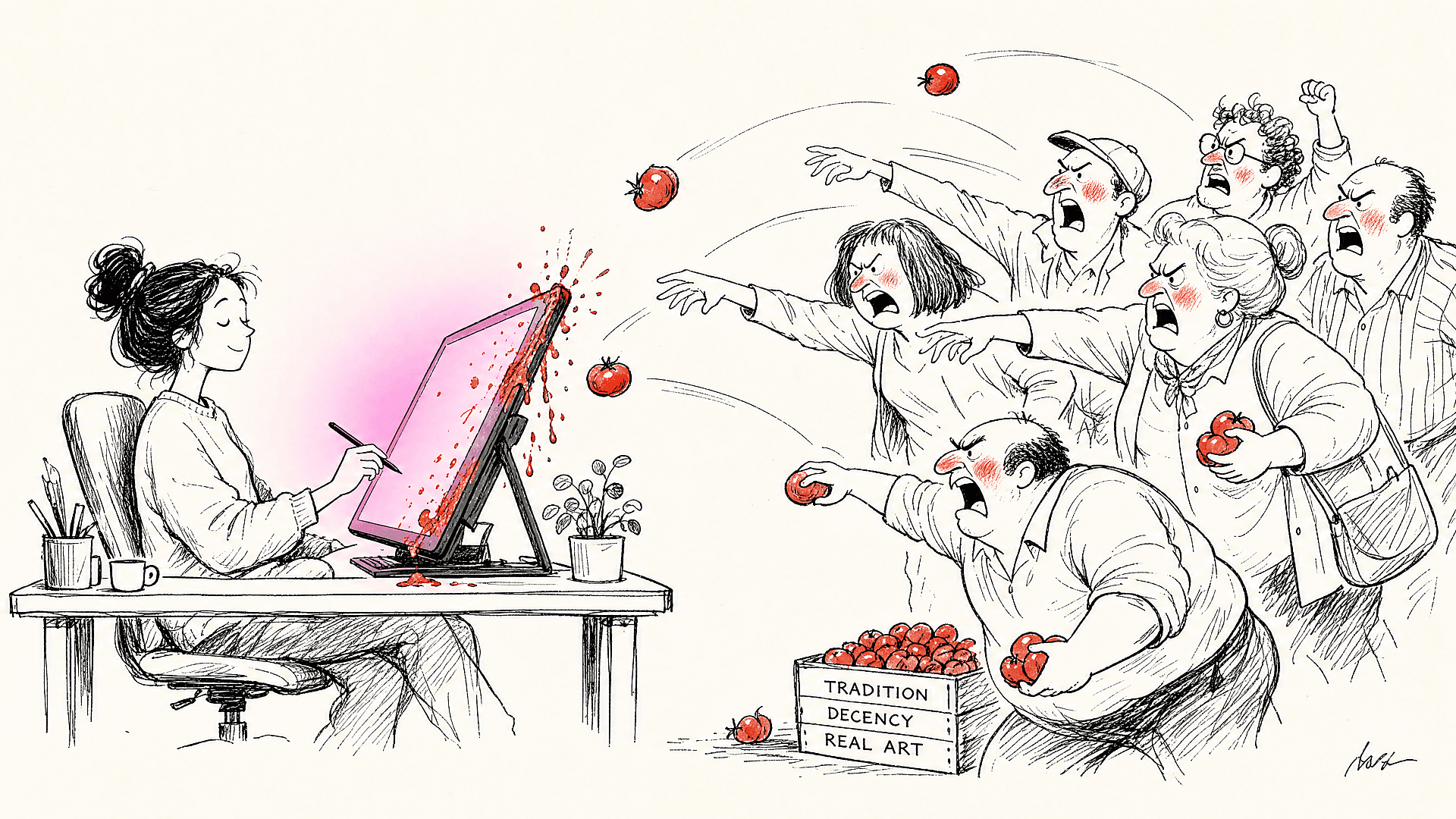
If you're even remotely online right now, you've seen the comments. They show up under any post that looks slightly AI-adjacent, in the quote-tweets, in the half-second verdict someone delivers out loud in their own video while reacting to someone else's: "ugh, this is AI." Sometimes it's "ew, AI, unfollowing," sometimes it's a single disgusted word, sometimes it's a long paragraph about everything wrong with the world. The wording barely matters because the sentiment is always the same, a mix of disgust and finality, the sound of a door closing. And it's become common enough that creators are now quietly engineering their work to avoid setting it off, adding disclaimers, obfuscating their process, over-explaining how much human effort went in, or backing away from the tools altogether.
Ça vaut le coup de prendre le temps de regarder ce qui se cache vraiment derrière cette réaction, parce que ce qui ressemble à un mur de refus n'est bien souvent que quatre objections distinctes comprimées en un seul réflexe, et ils ne sont pas tous aussi justes, ni aussi ciblés sur toi, ni gérables de la même façon. Les distinguer se révèle être la chose la plus utile qu'un créateur puisse faire, à la fois pour sa tranquillité d'esprit et pour la qualité de la conversation que tout le monde n'arrive pas à avoir.
D'abord, la médiocrité
La première objection cachée dans cette réaction concerne le contenu bâclé, car quelque part dans la mémoire récente de la personne se trouve un défilement sans fin de contenu généré en masse et sans effort : les cinq mêmes visages, le même éclairage plastique, les mêmes carrousels à appâts à engagement produits par milliers. Cette réaction est tout à fait raisonnable, car le contenu bâclé est réel, partout, et dégrade vraiment l'expérience en ligne pour tout le monde. Mais l'objection porte en réalité sur effort et intention plutôt que sur l'outil lui-même, et la négligence existe depuis quelques milliers d'années avant l'IA. Un travail réfléchi réalisé avec ces outils n'a rien à voir avec le contenu bâclé, si ce n'est la technologie sous-jacente, ce qui fait que le « beurk, de l'IA » revient un peu à refuser de lire du tout parce que certains livres sont mal écrits.
Puis, le vol
The second objection has real teeth, and it's about theft. Many image models were trained on the work of living artists who never consented and were never paid, and a great deal of the legitimate anger about AI traces directly back to that fact, which deserves to be taken seriously rather than waved off. What's worth noticing is that this is a specific grievance about how certain models were built and how the industry has handled consent, not a blanket indictment of everyone who's ever opened one of the tools. It points toward genuine questions about training data, licensing, and which platforms a creator chooses to work with, but it doesn't actually resolve into the conclusion that toi, personnellement, sont méprisables pour avoir créé quelque chose.
Il y a aussi le coût
The third objection is about cost in the most literal sense, since the energy and water required to train and run large models at scale is a real environmental concern that's entirely fair to raise. Like the others, though, it operates at the level of infrastructure rather than the level of the individual, a question about how these systems are built and powered and at what scale, which sits with companies, energy grids, and the regulatory bodies meant to hold them accountable rather than with one person making one image on a random Tuesday.
On a déjà connu ça avec d'autres angoisses environnementales, où la responsabilité est discrètement transférée des institutions qui pourraient vraiment faire bouger les choses vers les gens ordinaires qui vaquent à leurs occupations. L'idée même d'une « empreinte carbone » personnelle a été popularisé au début des années 2000 par une campagne publicitaire du géant pétrolier BP, explicitly to shift responsibility for climate change away from fossil fuel companies and onto individual consumers, and the same move has been run on recycling and a dozen other problems. It works because guilt is easier to manufacture than systemic change. Pointing disgust at a single creator follows the same logic, and it belongs in the conversation about AI's real costs the same way your recycling bin belongs in the conversation about climate: it's not nothing, but it's not where the actual leverage is.
Et sous tout ça, la peur
La quatrième objection est celle qui plane discrètement sous toutes les autres, et c'est celle qui génère vraiment le dégoût : le sentiment que la créativité de l'IA menace quelque chose d'essentiel dans le fait d'être humain. La recherche sur le sujet est étonnamment directe. Une étude couvrant six expériences a constaté que les gens dévaluent une œuvre dès qu'elle est étiquetée comme générée par IA, même quand ils admettent ne pas pouvoir la distinguer d'un travail humain, et même quand on leur dit qu'un humain a collaboré dessus. Une autre étude de l'UBC a constaté que ce biais est le plus fort chez les gens qui croient que la créativité est un trait uniquement humain, et qu'ils sont prêts à payer plus pour une œuvre qu'ils pensent faite par une personne. Ce que cela révèle n'est pas tant un argument qu'un réflexe d'identité. Ça vient d'un endroit compréhensible, la peur que si une machine peut créer quelque chose de beau, notre singularité soit soudain remise en question, mais c'est un sentiment sur la condition humaine qui a été projeté sur tes créations.
Si ça te paraît sombre, ça ne devrait pas, car on a déjà vu exactement cette peur se jouer et on sait comment l'histoire se termine. Au 19e siècle, la photographie était rejetée comme sans âme et mécanique, une insulte à la vraie peinture, avant de devenir l'une des formes les plus expressives que nous ayons. Un siècle plus tard, les synthétiseurs allaient rendre les musiciens obsolètes, jusqu'à ce qu'ils deviennent le pilier de presque toutes les chansons que tu adores. La panique à l'idée qu'une chose cesse d'être humaine dès qu'une machine intervient n'est pas nouvelle, et elle a perdu à chaque fois. Rien ne laisse penser que cette manche se terminera différemment.
Le tour de passe-passe, et pourquoi c'est si dur à contredire
Something clarifying happens when you set these four objections side by side. Slop is a problem of effort, theft is a problem of consent and law, environmental cost is a problem of infrastructure, and the "it's not real" reaction is a problem of philosophy and identity, which means they have different causes, different solutions, and different people responsible for addressing them. Almost none of those people is the individual creator who made something with care and caught a stray "boooo AI 🍅" for the trouble.
C'est aussi pour ça que débattre avec ce genre de commentaires ne mène jamais vraiment nulle part. Tu réponds à l'argument du contenu bâclé et la personne bascule sur le vol ; tu traites le vol et elle pivote vers « c'est juste sans âme » ; tu réponds à ça et te voilà soudain à parler de centres de données. L'objection ne cesse de se déplacer parce qu'elle n'a jamais été un argument cohérent au départ, juste plusieurs ressentis à moitié triés regroupés ensemble, et chaque fois que tu en traites un, les autres restent là, à attendre qu'on les ramasse.
Ce que ça change pour les créateurs
The goal, then, isn't to win the argument but to unravel it, because once the four objections come apart two things become clear at the same time. The legitimate concerns, theft and labor and environmental cost, genuinely deserve to be taken seriously, and the right response to them is engagement, not denial: choosing tools built responsibly, being honest about your process, pushing for better practices across the industry. The identity panic, meanwhile, the part doing most of the emotional work behind AI shaming, was never really about your work at all. It was about someone else's relationship to a changing world, and it's not a verdict you're obligated to accept on their behalf.
None of this makes the shaming stop, and it'll probably get louder before it settles, because we're living through the noisy early stretch of a real cultural adjustment and those stretches always sound like this. But the disgust, loud as it is, was mostly aimed at slop, at extractive companies, at energy infrastructure, and at a philosophical anxiety as old as every previous technology that ever made people wonder what would be left for humans to do. Très peu de tout cela t'était réellement destiné. Alors crée tes œuvres, sers-toi des nouveaux outils pour les faire, et prends les vraies questions assez au sérieux pour avoir de vraies réponses quand elles arrivent. Les créateurs qui traverseront bien cette époque ne seront ni ceux qui cachent leur processus ni ceux qui font mine que les inquiétudes sont bidon, mais ceux capables de tenir tout le tableau à la fois, et cette clarté-là vaudra toujours plus qu'un avertissement.