
 ChatGPT
 Perplexity
 Claude
 Gemini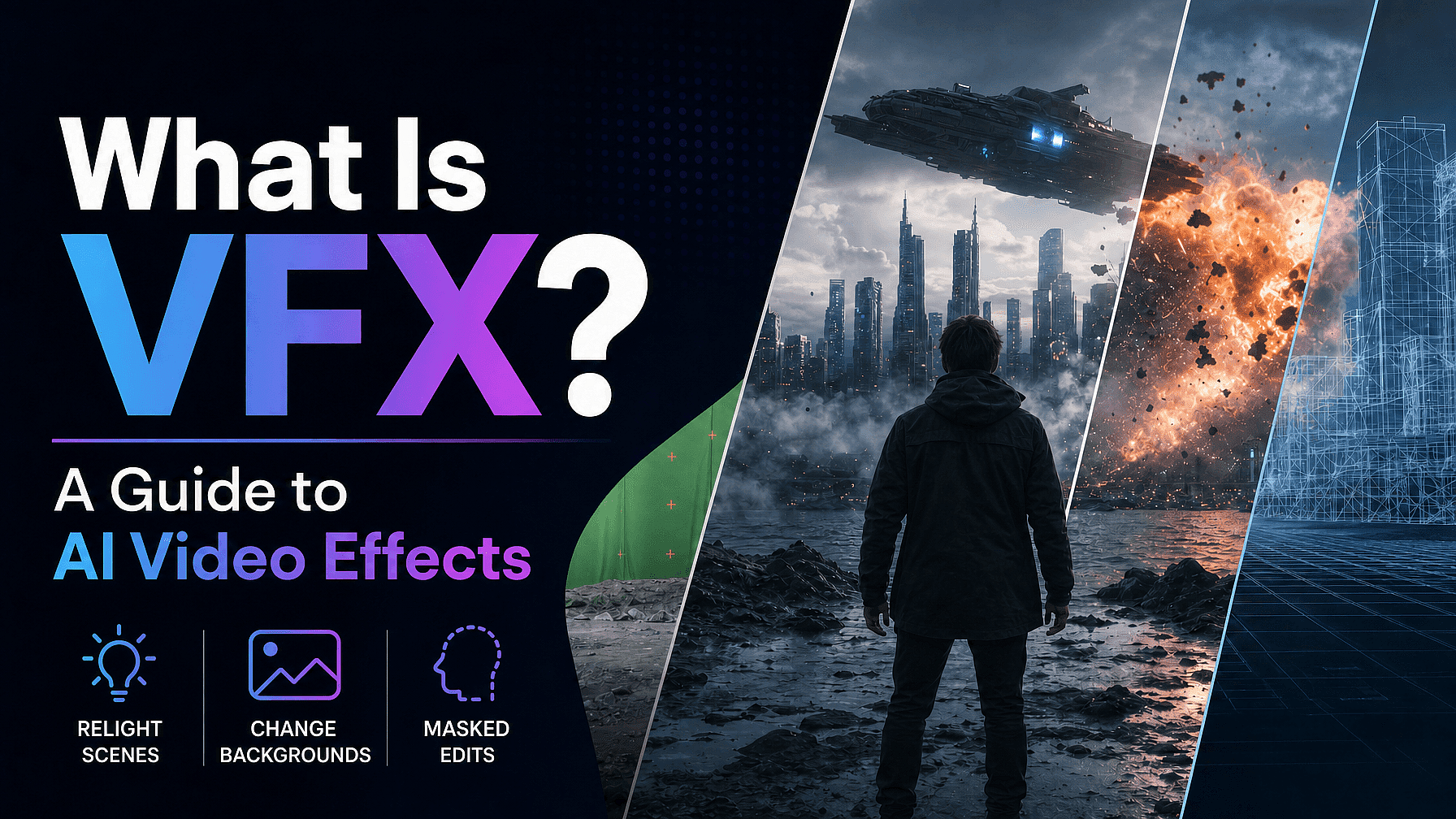
VFX signifie effets visuels : les images créées ou modifiées après le tournage d'une scène. Cela va du ciel remplacé à la créature entièrement numérique, et on en trouve dans presque tous les films, séries et pubs que tu regardes.
Pendant longtemps, les VFX rimaient avec fond vert, logiciels coûteux et équipe de spécialistes. Tout ça change vite, car l'IA peut désormais accomplir une grande partie du même travail à partir d'une simple vidéo téléchargée.
Ce guide explique ce qu'est le VFX, en quoi il diffère du CGI et des SFX, les principaux types que tu rencontreras, et comment les effets vidéo par IA te permettent de le faire sans installation de fond vert ni véritable studio.
Points clés à retenir
- Les VFX (effets visuels) sont des images créées ou modifiées en post-production, une fois les séquences tournées.
- La CGI est un sous-ensemble des VFX (images entièrement générées par ordinateur), et les SFX sont des effets réels réalisés en direct sur le plateau.
- Les types de VFX les plus courants sont le compositing, la CGI, la capture de mouvement, le matte painting et le rotoscoping.
- Les VFX traditionnels nécessitent un fond vert, un compositeur et un logiciel comme Nuke ou After Effects.
- Les effets vidéo IA gèrent les changements d'arrière-plan, le relighting et les retouches masquées à partir d'un seul import, sans fond vert ni expérience du montage.
Qu'est-ce que les VFX ?
VFX signifie effets visuels. C'est le processus de création ou de modification d'images en dehors d'une prise de vue réelle, puis leur intégration dans les images pour que tout paraisse réel.
Les VFX existent parce que certains plans sont trop coûteux, trop dangereux ou tout simplement impossibles à filmer en prise réelle. Une ville détruite, une planète lointaine ou un fond net derrière une pièce en désordre : tout cela est plus facile à créer en post-production que sur un plateau.
Le détail clé, c'est le timing : les VFX interviennent après le tournage, pas pendant. C'est ce qui les distingue des effets pratiques, et c'est aussi pourquoi l'IA a pu en reprendre une grande partie.
VFX vs CGI vs SFX
Ces trois termes sont utilisés de façon interchangeable, mais ils ne veulent pas dire la même chose. Comprendre la différence rend bien plus facile de saisir ce que fait vraiment un outil d'effets vidéo IA.
VFX est le terme générique. Il couvre toute imagerie créée ou manipulée en post-production, y compris le compositing, le matte painting, le motion tracking et la CGI.
CGI, ou imagerie générée par ordinateur, est un sous-ensemble des VFX. Il s'agit d'images entièrement créées par ordinateur, comme une créature 3D ou un environnement entièrement numérique. Toute CGI est du VFX, mais tout VFX n'est pas de la CGI.
SFX, ou effets spéciaux, sont des effets pratiques réalisés en direct sur le plateau. Les explosions contrôlées, la fausse pluie, les prothèses et les animatroniques sont tous des SFX, car ils se produisent devant la caméra plutôt qu'en post-production.
Les principaux types de VFX
La plupart des effets visuels se répartissent en quelques catégories. Les effets vidéo IA reprennent les mêmes principes, donc mieux vaut connaître d'abord les versions traditionnelles.
Fusionner les calques des images distinctes dans un seul cadre. La forme la plus courante est le travail sur fond vert, où un sujet est filmé devant une toile verte, puis un nouvel arrière-plan est incrusté derrière lui par la suite.
CGI crée des éléments de toutes pièces sur ordinateur, des personnages jusqu'à des mondes entiers. Le matte painting prolonge un décor avec un paysage peint ou numérique, et le motion tracking fixe les éléments CGI sur des images en mouvement pour qu'ils restent en place.
Motion capture enregistre le mouvement d'un acteur et le transpose sur un personnage numérique. Le rotoscopage est le travail manuel qui consiste à détourer un sujet image par image pour le séparer de son arrière-plan.
Comment fonctionnent les VFX traditionnels, et pourquoi c'est difficile
Le pipeline VFX classique est puissant, mais il est lent et coûteux. C'est précisément cet écart que les effets vidéo IA sont conçus pour combler.
Un plan classique nécessite un studio sur fond vert, un éclairage contrôlé et une plaque propre. Après le tournage, un compositeur détoure l'arrière-plan, nettoie les bords à la main et fait correspondre l'éclairage pour que la nouvelle scène paraisse crédible.
Ce travail passe par des logiciels comme Nuke ou Adobe After Effects, souvent sur une ferme de rendu, et peut demander des jours pour quelques secondes de séquence. Il exige aussi une vraie formation, ce qui rend les VFX traditionnels inaccessibles à la plupart des créateurs solo et des petites équipes.
Comment l'IA a transformé les VFX
Les effets vidéo IA sautent l'essentiel de ce pipeline. Au lieu de faire le keying, le rotoscoping et le compositing à la main, un modèle IA lit ta séquence et fait la séparation à ta place.
Les modèles vidéo modernes sont entraînés à isoler un sujet, reconstruire l'éclairage sur toute l'image et modifier des zones précises sans fond vert ni détourage manuel. Tu importes un clip normal, tu décris le résultat souhaité, et le modèle le génère en quelques minutes.
C'est encore plus pratique si tu produis déjà du contenu vidéo sur un Générateur de vidéos IA au lieu du tournage traditionnel.
Sur OpenArt VFX, ceci fonctionne sur SwitchX de Beeble, un modèle vidéo-vers-vidéo conçu pour une isolation nette du sujet, un rééclairage plein cadre et des retouches par zones masquées. Il utilise ta séquence source comme guide direct, pour que le mouvement et l'identité de ton sujet restent intacts au lieu de dériver d'une image à l'autre.
Les trois modes VFX par IA, associés aux VFX classiques
OpenArt VFX te propose trois modes à partir d'un seul upload. Chacun est la version IA d'une technique d'effets visuels traditionnelle.
Change l'arrière-plan sans fond vert
Modificateur d'arrière-plan vidéo est la version IA du compositing et de l'incrustation chroma. Il isole ton sujet et remplace le décor derrière lui, sans fond vert ni découpe manuelle. Tu choisis un préréglage, importes une image ou génères un nouvel environnement avec l'IA.
Ré-éclairer toute la scène
AI Video Relight le mode fait à la fois le travail d'un éclairage et d'un étalonnage. Il reconstruit la lumière, la couleur et l'ambiance sur toute l'image au lieu d'ajouter un filtre plat, pour des ombres et des hautes lumières réalistes. Ton jeu d'acteur et tes mouvements de caméra restent exactement comme filmés.
Protège une zone masquée et transforme le reste
Mode inpainting est la version IA du rotoscoping et du masquage. Tu peins un masque sur la partie de l'image que tu veux conserver, comme un visage ou un produit, et cette zone reste exactement telle qu'elle a été filmée pendant que tout le reste se transforme. Tu ne masques que la première image, et le modèle suit la zone protégée sur chaque image suivante.
Cette vidéo YouTube te donne une idée concrète de comment réussir ça dans OpenArt VFX :
Comment ajouter des effets vidéo IA à un clip
Le workflow complet tient en trois étapes et quelques minutes, sans rien à installer.
Importe ta vidéo.
Importe n'importe quel clip MP4 ou MOV. Les effets vidéo IA fonctionnent sur des séquences prises dans n'importe quelle pièce, sans fond vert ni studio.
Choisis ton mode.
Choisis Arrière-plan, Rééclairage ou Inpainting. Dirige-le avec un préréglage, une image de référence ou un prompt textuel.
Génère et compare.
SwitchX génère ton clip en quelques minutes. Prévisualise le résultat côte à côte, affine si besoin et télécharge un MP4.
Qui utilise les effets vidéo IA
L'attrait est large, car la barrière à l'entrée est désormais très basse. Les créateurs social changent d'arrière-plan ou rééclairent des séquences maison pour se créer un look signature sans plateau.
Filmmakers and directors get compositing and relighting without Nuke or After Effects, turning reshoots into a mask and a prompt. Brand and marketing teams film once, then apply different backgrounds and moods per campaign, so a single shoot becomes a full content library.
En résumé
Le VFX est l'art de créer et de modifier des images après le tournage d'un plan, et pendant des décennies il a nécessité un studio, un compositeur et des logiciels spécialisés. Les effets vidéo par IA conservent le même contrôle en supprimant le fond vert, le pipeline et la courbe d'apprentissage.
Si tu veux l'essayer sur des rushes que tu as déjà, OpenArt VFX réalise des changements d'arrière-plan, des rééclairages et des retouches par masque à partir d'un seul upload, propulsé par le modèle SwitchX de Beeble.
Questions fréquentes
Que signifie VFX ?
VFX signifie effets visuels. Ce sont les images créées ou modifiées après le tournage d'une scène, puis intégrées aux rushes pour donner l'impression qu'elles font partie du plan original.
Les VFX, c'est la même chose que la CGI ?
Non. La CGI (imagerie de synthèse) est un type de VFX, entièrement créé par ordinateur. Les VFX sont la catégorie plus large qui inclut aussi le compositing, le matte painting et le motion tracking, donc toute CGI est un VFX mais tous les VFX ne sont pas de la CGI.
Quelle est la différence entre le VFX et le SFX ?
Le VFX se fait en post-production, après le tournage. Les SFX (effets spéciaux) sont des effets réels créés en direct sur le plateau, comme des explosions, de la fausse pluie ou des prothèses.
Peux-tu faire du VFX sans fond vert ?
Oui. Les effets vidéo par IA isolent ton sujet et remplacent ou rééclairent la scène sans fond vert ni détourage manuel. OpenArt VFX gère les changements d'arrière-plan, le rééclairage et les retouches masquées à partir d'un seul import.
Faut-il de l'expérience pour faire des VFX ?
Plus maintenant. Les modes arrière-plan et rééclairage sont pensés pour un usage en un clic avec un préréglage ou une référence. Les retouches de zone masquée récompensent un masquage soigné, mais aucun logiciel de compositing ni formation en post-production n'est requis.
De quel logiciel as-tu besoin pour les VFX ?
Les VFX traditionnels tournent sur des outils comme Nuke ou Adobe After Effects, souvent avec une ferme de rendu. Les effets vidéo par IA fonctionnent dans le navigateur : tu importes un clip, tu choisis un mode et tu télécharges le résultat, sans rien à installer.