

 ChatGPT
 Perplexity
 Claude
 Gemini
There is a version of creative development that gets talked about constantly: consume voraciously, collect references obsessively, surround yourself with work you love until your own work starts to reflect it. Build a mood board. Fill a swipe file. Study the people you admire. This advice is not wrong, but it is incomplete, because it points you toward your enthusiasms and asks you to build a creative identity from them, and enthusiasm alone is one of the least reliable guides to a genuine point of view.
Enthusiasm is diffuse, because it wants to say yes to too many things. It's moved by quality wherever it finds it, which means it is moved by contradictory things, incompatible aesthetics, ideas that can't coexist in the same body of work. Every creative person who has spent time carefully curating a collection of things they love has also experienced the paralysis that comes with it: the references pull in ten directions at once, and instead of clarifying your aesthetic, the collection just reflects the breadth of your taste rather than the specificity of your vision.
Ce qui affine vraiment un point de vue, c'est le refus, car le « non » est plus précis que le « oui », et souvent plus révélateur. Quand tu tombes sur un travail qui te fait reculer, ne serait-ce qu'un peu, non pas parce qu'il est mauvais mais parce qu'il n'est fondamentalement pas toi, tu te rapproches davantage de la forme de ton identité esthétique réelle que toute la collecte d'inspiration du monde ne pourrait le faire.
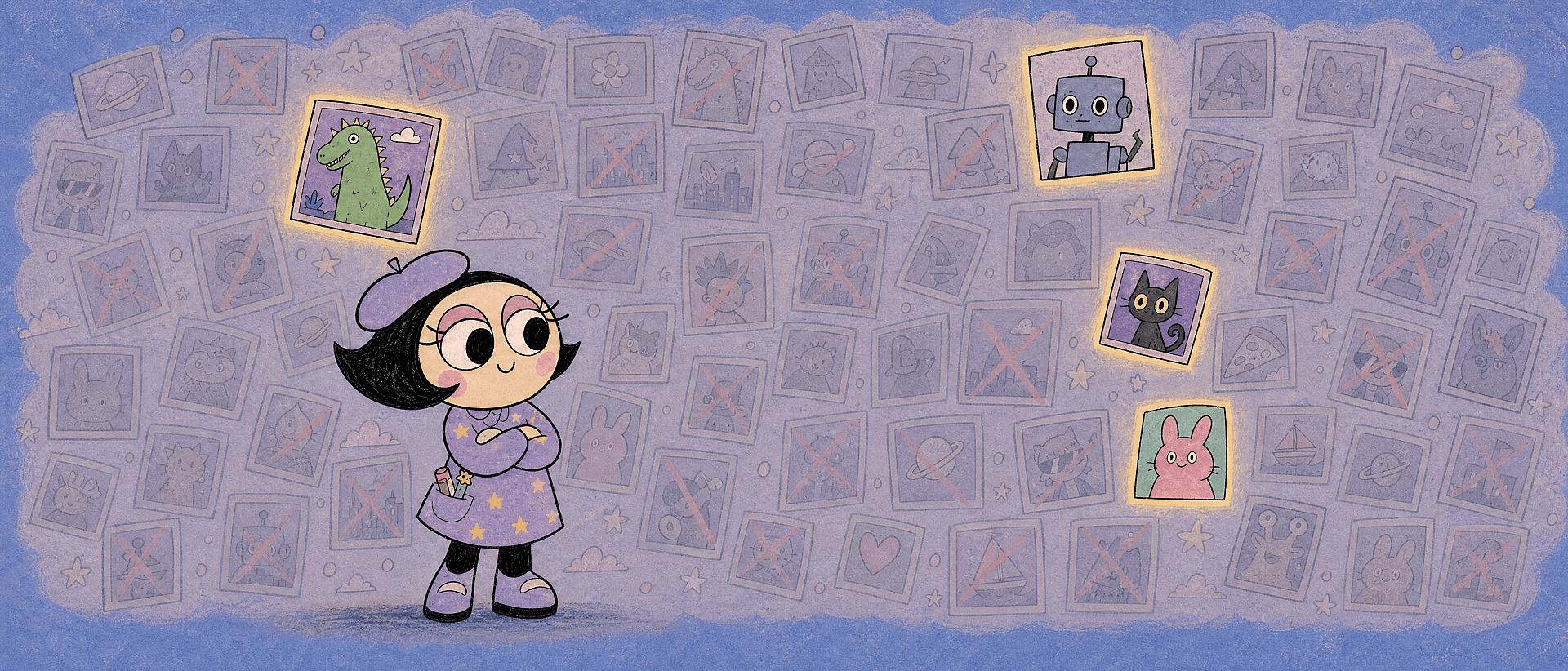
Think about the creatives whose work you can identify instantly across mediums and years. What makes them recognizable is not just what they chose to include but what they conspicuously excluded: the designer who never uses more than two typefaces, the photographer who won't touch a golden hour shot, the illustrator who refuses sentimentality even when the subject invites it, the AI creator who generates fifty images and throws away anything that feels safe. These aren't arbitrary constraints; they're the result of a thousand small refusals, each one carving the work a little closer to something that couldn't have come from anyone else.
The "no" is also more durable than the "yes," because the reality is that enthusiasms shift. The references that move you at 22 are not the ones that move you at 35. Influences come and go and leave their marks in ways that are hard to predict and harder to control. But the things you've decided you genuinely cannot stand tend to be more stable, more structural, more connected to something fundamental about your point of view. The refusals accumulate into a kind of negative space that holds its shape even as everything inside it changes.
This is especially true in an era when the volume of available reference material is essentially infinite and the tools to generate more of it are equally unlimited. The challenge is no longer finding inspiration, it's maintaining the ability to refuse, edit, and curate. When everything is possible and everything is fast and the model will happily produce whatever you describe, the creative muscle that needs the most deliberate exercise is not imagination, but discernment. It's the voice that says "not that, not quite, not yet, keep going."
Développer cette petite voix demande de prêter une attention particulière à tes propres réactions, surtout les négatives, et de les prendre suffisamment au sérieux pour les formuler dans le processus créatif. Pas juste « je n'aime pas ça », mais « je n'aime pas ça parce que la composition est trop centrée, la palette en fait trop et l'ambiance semble empruntée à quelque chose que j'ai vu cent fois ». La précision du rejet ce sont les données. Avec le temps, ces données forment un ensemble de positions, et ces positions constituent ton point de vue.
The practical version of this is simple: start keeping a rejection file alongside your reference library. Not screenshots of bad work, but screenshots of work that is technically accomplished, clearly professional, and somehow still not you: the kind of work you could imagine someone else making but that you would never make, and that you can articulate precisely why. Review it as often as you review your inspirations, because you'll learn more about your aesthetic from studying the conviction in your refusals than from studying your endlessly shifting enthusiasms.
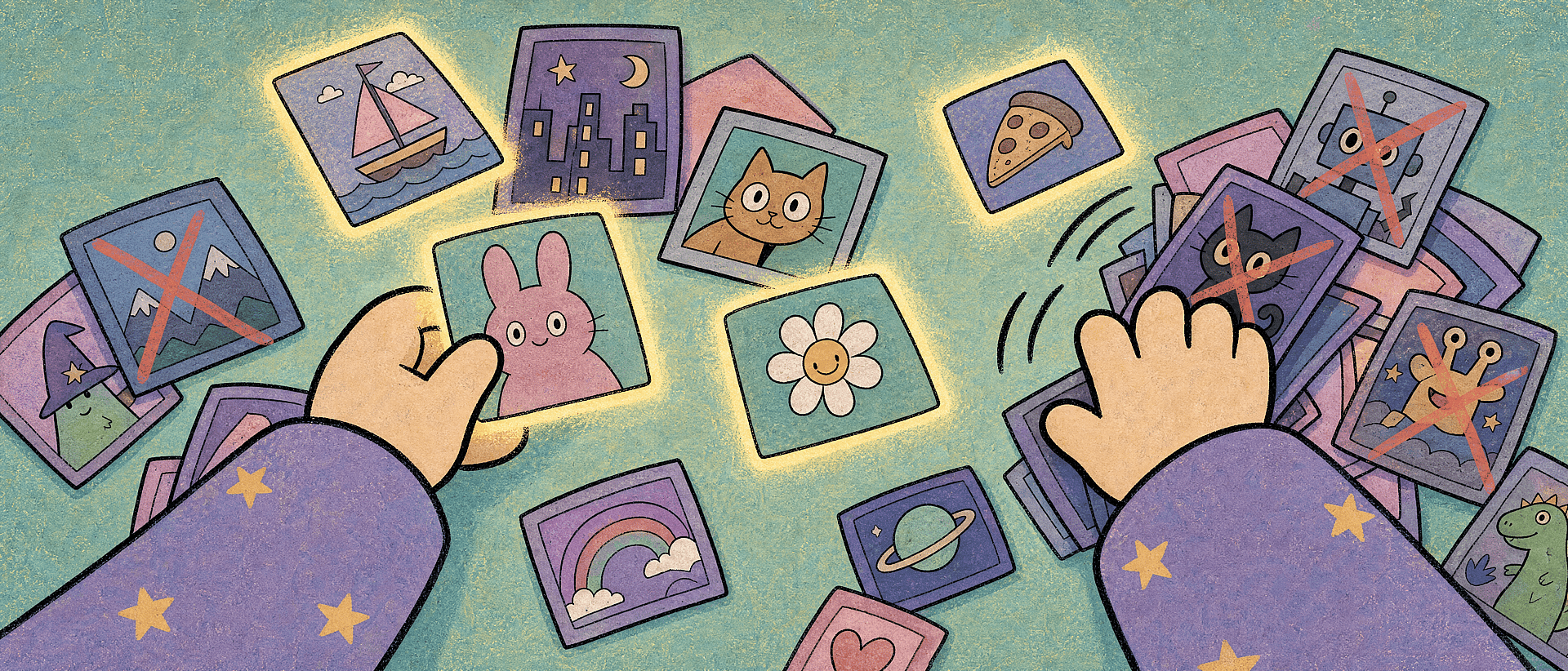
Un point de vue créatif n'est pas une collection de choses que tu aimes, mais un ensemble de positions que tu défends (et oui, une position exige une opposition claire). Le « oui » ne signifie quelque chose que par rapport au « non ». L'œuvre la plus profondément tienne est celle qui n'aurait pas pu être créée par quelqu'un ayant d'autres refus, et pour y parvenir, il ne s'agit pas d'accumuler plus d'inspiration, mais d'être très clair, très précis et très honnête sur ce que tu refuses de faire.
L'espace de travail multi-modèles d'OpenArt est fait exactement pour ce genre de discernement : la capacité de générer en volume, de passer d'un outil à l'autre et de continuer à sélectionner jusqu'à ce qu'il ne reste que ce qui est vraiment de toi. Les outils ne valent que par l'œil qui les dirige, et chaque fois que tu dis « non », l'œil s'affine et la voix créative se fait plus forte.