

 ChatGPT
 Perplexity
 Claude
 Gemini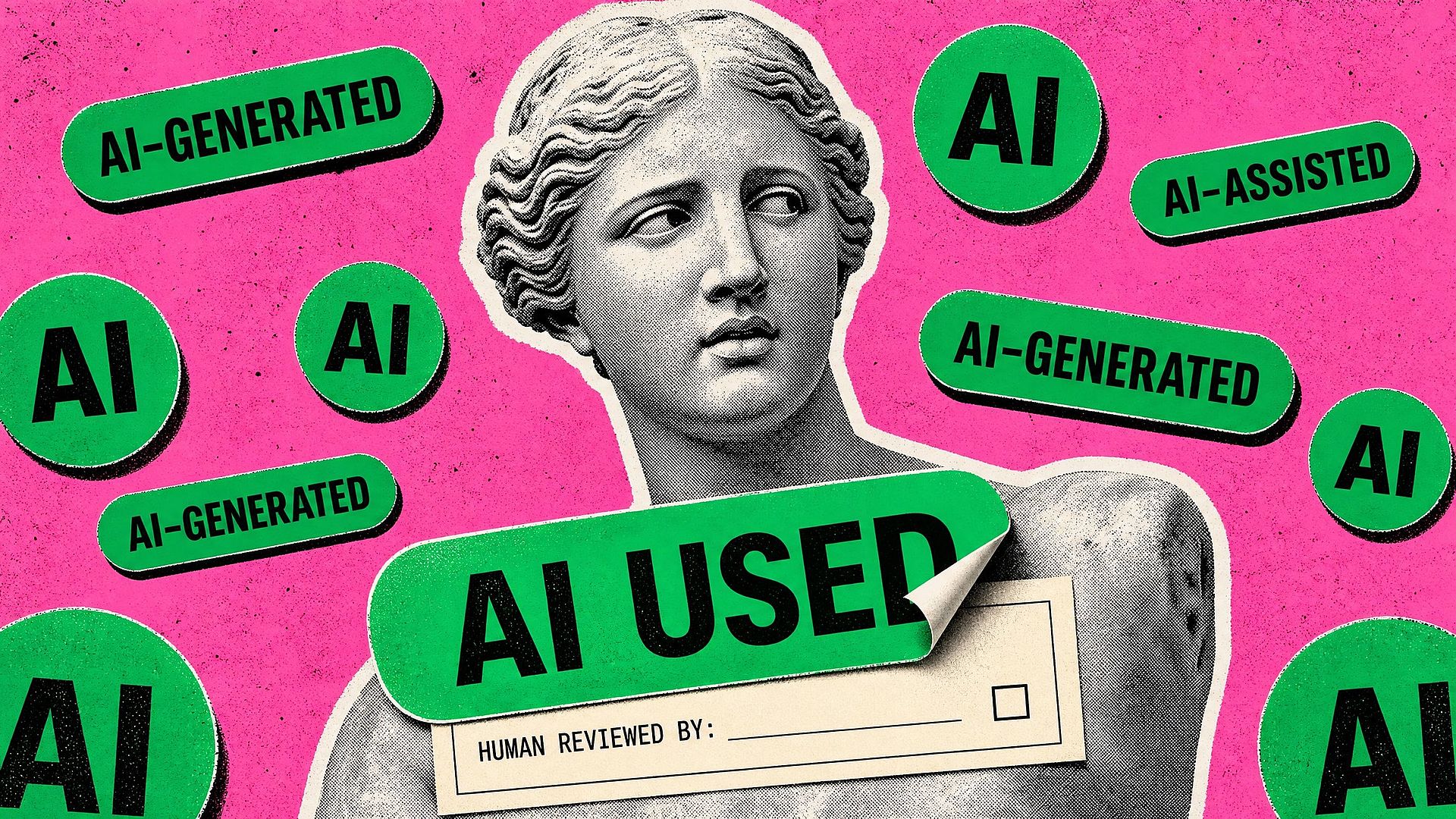
Côté demande, l'argument ne fait pas débat. L'enquête 2026 de Fractl auprès de plus d'un millier de consommateurs found that 84 percent want written AI content labeled, 91 percent want it on video, 90 percent on images, 87 percent on audio, with strongly-agree responses alone clearing half in every category. The supply side isn't close either, just in the other direction: only 20 percent of organizations say they always disclose AI use to their audience, and 33 percent say they never do. Framed that way, this looks like a straightforward compliance gap. Get more companies labeling their content, close the gap, problem solved.
Sauf qu'une paire d'études de 2026 publiées dans la revue Digital Journalism suggère que ce n'est pas vraiment là que se situe le problème de confiance. D'abord, une expérience conjointe avec des consommateurs de médias chiliens, a demandé aux gens de comparer directement les politiques IA des médias et a révélé que la supervision humaine, et pas la simple divulgation, était le facteur le plus déterminant dans la crédibilité d'un média et le choix de le lire. Qu'un média utilise l'IA pour des tâches ingrates ou pour personnaliser des formats ne changeait presque rien, dans un sens comme dans l'autre. Ce qui comptait, c'était de savoir si une personne avait relu ce que l'IA avait produit. Une étiquette répond à une seule question : y a-t-il eu de l'IA. Il s'avère que c'est rarement la question que le public se pose vraiment.
La deuxième étude, basé sur des interviews plutôt que sur des expériences, a trouvé quelque chose de plus précis : les étiquettes peuvent carrément se retourner contre toi. One participant described their reaction to seeing an AI label as "I probably need to fact-check this and try and find another article," which is the opposite of what a disclosure label is supposed to accomplish. Others saw AI use itself as a kind of professional shortcut, with one interviewee putting it bluntly about a fully AI-written article: "You can do that as an 11-year-old. You don't need the training for that if you're going to use AI to generate your entire article." A vague, generic label doesn't resolve that instinct. It just confirms the suspicion without giving anyone a reason to set it aside.
What the same research found does help: specificity about degree, not just presence. Interview subjects drew a real line between an article labeled as fully AI-generated and one labeled as AI-assisted, treating those as different claims requiring different levels of scrutiny, and they wanted that distinction visible at the top of a piece rather than buried in a footer where it could look like it was trying not to be noticed. None of that is about whether to disclose. It's about whether the disclosure actually tells someone what happened and whether a person was accountable for it.
C'est justement la distinction que le cadre de la conformité rate complètement. Une loi peut imposer qu'un label existe. Elle ne peut pas imposer que ce label fasse le vrai travail de reconstruction de la confiance, car la confiance dépend de la conviction du public qu'une personne compétente était toujours dans la boucle, pas de la présence du label sur la page. Amener les 33 % qui ne le déclarent jamais à commencer à le faire compte en soi. Mais la question plus difficile et plus utile qui se cache en dessous, c'est de savoir si ce qui est divulgué apprend vraiment quelque chose à quelqu'un, ou si ça se contente de cocher une case sans toucher à ce qui inquiétait réellement les gens au départ.