

 ChatGPT
 Perplexity
 Claude
 Gemini
It's 10pm. You're horizontal, phone overhead, thumb on autopilot. You scroll past a child presenting an impossibly elaborate birthday cake captioned "this is my first cake." Swipe. Jesus fused with a crustacean rising from the sea. Swipe. An elderly stranger's AI-generated face asking you to wish them a happy birthday. Swipe. With every hollow flash of the screen, your memories of a quieter internet flicker faintly and fade. This feeling — of being duped into a dissociative doomscroll — is the result of enshittification, what happens when platforms built to share your stories and showcase your creativity quietly become machines for extracting your attention instead.
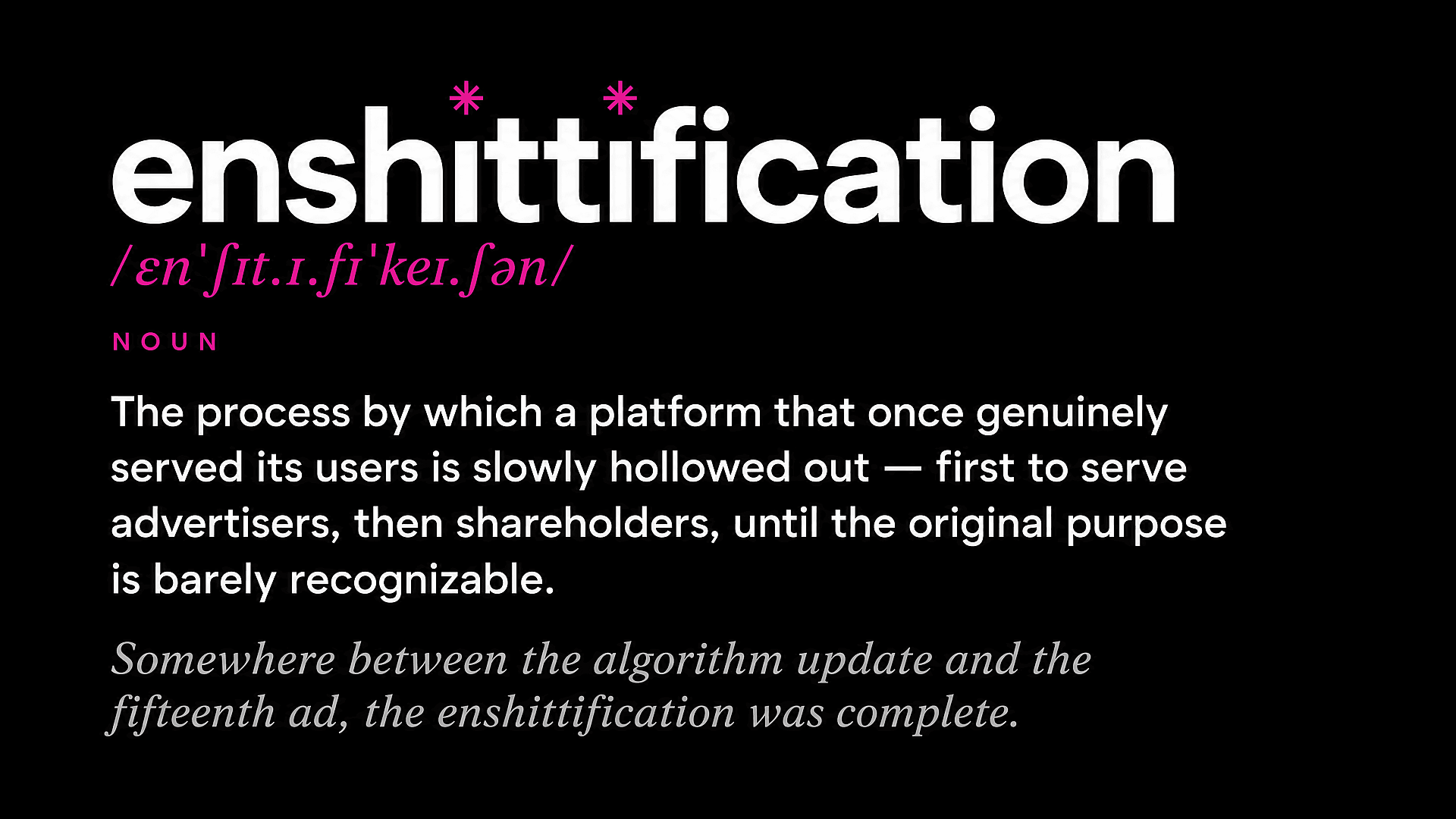
L'écrivain Cory Doctorow a inventé le terme « enshittification » il y a quelques années pour décrire un schéma qu'il observait sans cesse dans la tech : les plateformes sont d'abord vraiment utiles pour les utilisateurs, puis pressent lentement les utilisateurs au service des annonceurs, puis pressent tout le monde pour maximiser les retours pour les actionnaires. C'est le cycle de vie de chaque plateforme sociale que tu as adorée avant de t'en lasser peu à peu. Ce qui arrive à ton fil en ce moment, c'est ce processus qui touche la couche de contenu — et c'est l'IA générative qui l'a rendu possible à cette vitesse et à cette échelle.
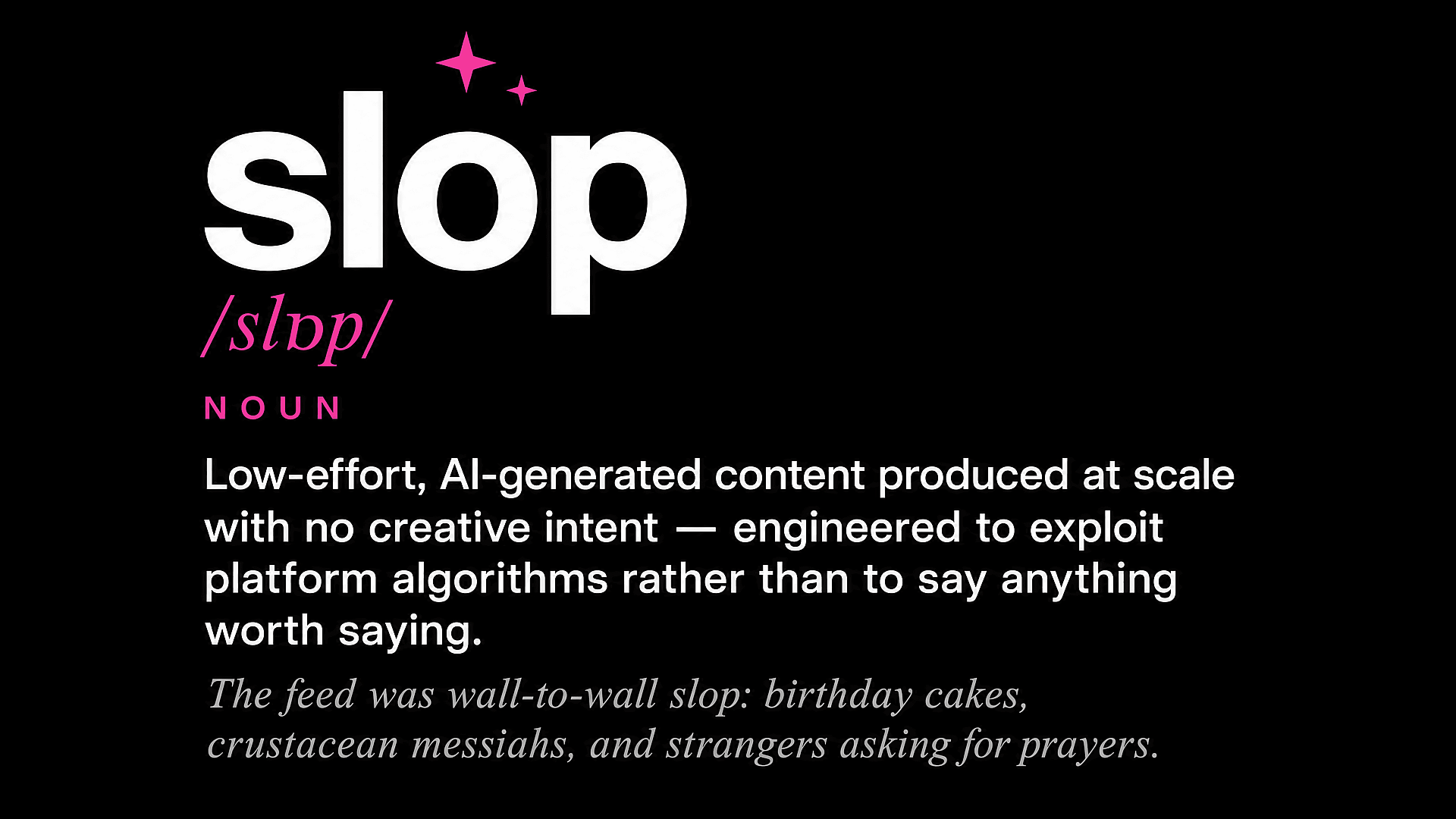
L'objectif n'est plus de te montrer quelque chose de pertinent, mais de te faire continuer à scroller. Parce que chaque seconde que tu passes, c'est une impression publicitaire de plus vendue. Et le moyen le plus rapide et le moins cher de faire ça à grande échelle, c'est le slop : du contenu produit en masse par des individus ou de petites structures qui ciblent délibérément les marchés publicitaires à forte valeur, générant et publiant à un volume inhumain uniquement pour exploiter la monétisation des plateformes. Un créateur kenyan s'adressant au magazine New York raconte avoir demandé à ChatGPT d'écrire des prompts censés « générer un fort engagement sur Facebook », puis de les injecter dans un générateur d'images, et de répéter le cycle à l'infini. Un étudiant en médecine de 22 ans en Inde a déclaré à WIRED il gagnait quelques milliers de dollars par mois en créant un influenceur IA, sans y consacrer plus de 30 à 50 minutes par jour. Rien de tout cela n'était pour toi. Tout ça créé à toi. Et le fil se dégrade un peu plus.

Slop works by stopping the scroll, not by earning it. Shrimp Jesus goes viral because it's so bizarre you can't look away, not because it's telling a compelling story. The quality is obviously low, the artificiality is plain to see — and everybody knows it. Shock is a one-time transaction. It arrests your attention for a second and deposits you back into the same hollow feeling you were scrolling to escape. No resonance, no point of view, nothing to return to. And the more of it there is, the more people can feel the difference between content that stops the scroll and content that actually means something.
C'est pour ça que l'enshittification, malgré tous les dégâts qu'elle cause, ne peut pas tuer le goût. La préférence des consommateurs pour les contenus générés par IA s'est effondrée, passant de 60 % en 2023 à 26 % en 2025, d'après une étude de Billion Dollar Boy. Le public n'est pas seulement indifférent au slop ; il devient de plus en plus rapide à le repérer. La vallée dérangeante du contenu IA — la peau trop lisse, l'arrière-plan qui se dissout dans le vide si tu regardes de près, la main à sept doigts — est devenue un raccourci culturel à part entière. Ce qui arrête le pouce aujourd'hui, ce n'est pas la chose la plus léchée du fil. C'est la plus spécifique. Le plus incontestablement fait par quelqu'un, pour quelqu'un.
Le retour de bâton redéfinit déjà les comportements. Les marques demandent désormais explicitement aux créateurs de pas surproduire — laisser la chemise froissée, la vaisselle sale, l'éclairage imparfait. Le contenu porté par le fondateur et les coulisses est surpassant les visuels de marque soignés de 3 à 8 fois sur Meta et TikTok. L'authenticité devient la ressource la plus rare dans le feed, et la rareté crée de la valeur.

Les lecteurs de ce blog ne sont pas le problème du contenu médiocre. Ils en sont l'antidote. Becky Owen, directrice marketing de Billion Dollar Boy, a déclaré à Digiday: « La majorité du mauvais contenu IA qui a inondé nos fils d'actualité ne venait pas des créateurs. Elle venait de gens qui pensaient que l'IA allait libérer l'étincelle créative magique en eux, avant de découvrir cruellement que ce n'était pas le cas. » Le problème du slop n'a jamais été l'IA. Il s'agissait d'utiliser l'IA comme substitut au fait d'avoir quelque chose à dire, plutôt que comme un outil pour mieux le dire.
Si tu es ici, c'est que tu as déjà quelque chose à dire. Tu as du goût, un point de vue, un univers visuel que tu construis ou une histoire à raconter. Ce que ces outils t'apportent, ce n'est pas un remplacement de tout ça, mais un multiplicateur de force. Et en ce moment, ce multiplicateur se trouve sur un terrain où presque personne d'autre ne l'exploite bien. Les fermes de contenu produisent du volume, les marques produisent du léché, et presque personne ne produit vision — fonctionnent avec une personne claire derrière, une raison d'exister au-delà de remplir une case dans un calendrier de publication, une esthétique cohérente sur tout ce qu'ils touchent.

Cet écart t'appartient. Un travail indéniablement le tien ne se contente pas de sortir du lot : ça devient ce pour quoi les gens reviennent, l'oasis dans le doomscroll, ce qui redonne brièvement à la plateforme l'impression d'avant. L'antidote à l'enshittification, ce n'est pas moins d'IA, parce que franchement, on ne peut plus revenir en arrière. Ce qu'on peut faire, c'est créer avec intention, faire quelque chose qui mérite d'être trouvé dans ce feed chaotique.
C'est la raison d'être d'OpenArt. Depuis le début, nous construisons pour les conteurs visuels ; des gens avec un vrai point de vue, une vraie histoire et l'ambition de la raconter de la plus belle façon possible. Les outils sont là, mais le vide dans le feed est réel. La seule question, c'est ce que tu vas créer pour le bousculer.