

 ChatGPT
 Perplexity
 Claude
 Gemini
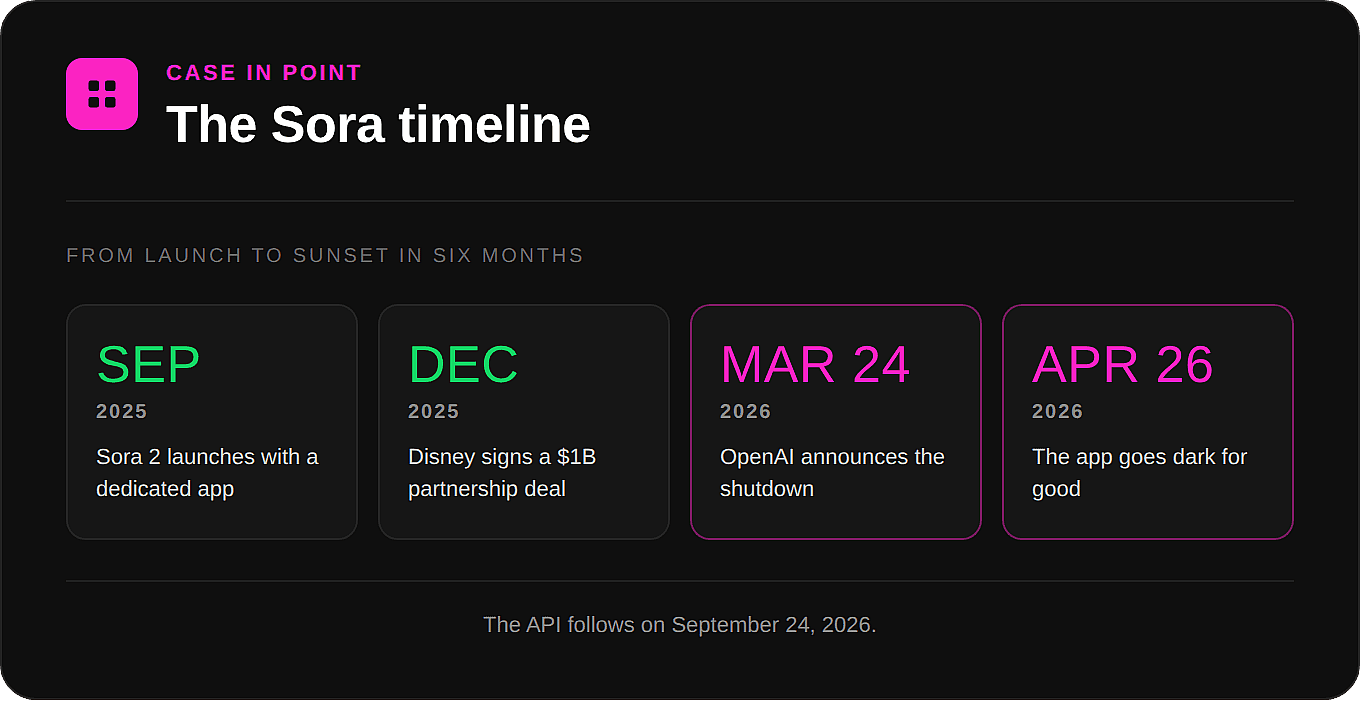
Le 24 mars, OpenAI a annoncé la fermeture de Sora. L'appli s'éteint le 26 avril. L'API suit en septembre. Le partenariat à un milliard de dollars signé avec Disney en décembre s'est dissous avec elle et, selon certaines sources, Disney l'a appris moins d'une heure avant le reste du monde.
Si ton workflow créatif vivait dans Sora, tu as quelques semaines pour exporter ton travail et trouver la suite. C'est le genre de délai qui transforme un débat abstrait sur la stratégie IA en un problème très concret.
Ça soulève aussi une question qui mérite réflexion : dans un domaine aussi instable, quelle est la bonne façon de bâtir une pratique créative sur des outils d'IA ? C'est une question à laquelle OpenArt construit une réponse bien précise depuis le début. Mais avant d'en arriver là, il vaut la peine de comprendre pourquoi cette question devient de plus en plus difficile à éviter.
Le paysage n'est pas près de se stabiliser
Face à quelque chose qui évolue vite, on a un instinct naturel : attendre que ça ralentisse. Miser sur le vainqueur une fois la poussière retombée. C'est un réflexe raisonnable, mais il ne colle pas vraiment à ce qui se passe en ce moment dans la génération d'images et de vidéos par IA.
The pace isn't slowing. If anything, it's picking up. In just the last few months, Midjourney shipped V8 with a rewritten engine and native 2K output. Black Forest Labs released Flux 2. Google's Nano Banana 2 became one of the fastest image models available. Imagen 4 raised the bar for photorealism again. Recraft V4 took over as the model people reach for when they need vectors. Ideogram keeps leading on text rendering. Kling and Seedance are pushing video forward on a near-monthly cadence. And Sora, which a year ago looked like the future of AI video, is being sunset.
The pattern isn't a market consolidating around a few stable winners. It's a research frontier where the leader changes regularly, capabilities leapfrog each other constantly, and the economics of running these models are demanding enough that even well-funded labs are making hard tradeoffs. Sora wasn't shut down because it was bad. By most accounts the underlying model is impressive. It was shut down because video generation is enormously expensive to run, the user numbers didn't justify the compute, and OpenAI needed those resources elsewhere. That same math applies, in some form, to almost every model in the space.
Aucun modèle n'excelle en tout
Une fois que tu travailles régulièrement dans cet univers, la question « quel est le meilleur modèle » commence à sembler mal posée. Le meilleur pour quoi ?
Un aperçu rapide de la situation actuelle :
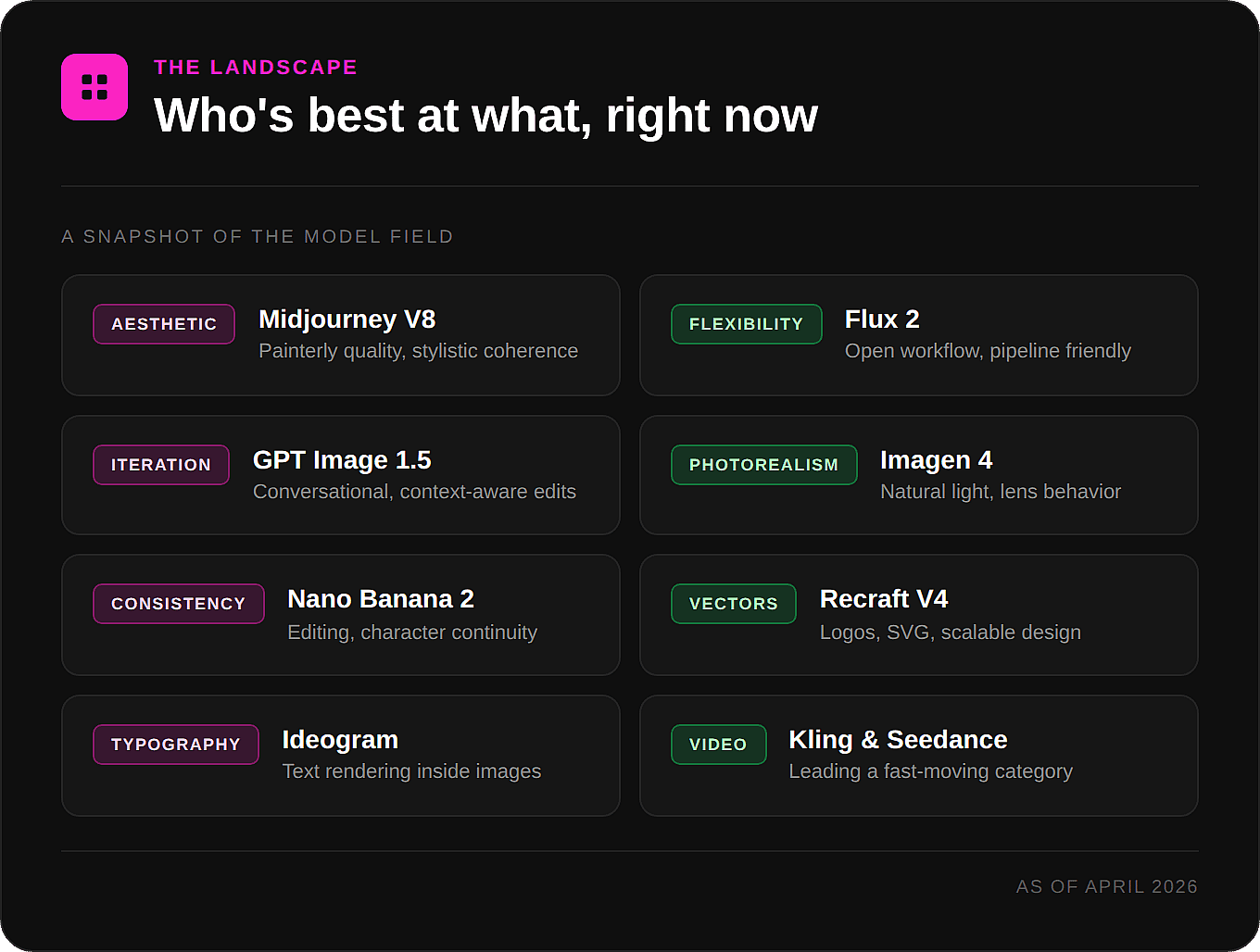
Midjourney continue de placer la barre haut en matière de qualité esthétique et de cohérence stylistique. Si tu veux une image magnifique dès la génération, il n'y a presque rien à retoucher. En contrepartie, c'est un écosystème fermé, sans réelle API, avec une intégration limitée aux workflows plus larges et un modèle Discord-et-abonnement qui ne convient pas à tous les usages.
Flux 2 est là où une grande partie de la communauté des workflows open source s'est installée. C'est flexible, contrôlable, et ça s'intègre bien dans l'écosystème plus large du fine-tuning, des LoRAs et des outils de pipeline. Si tu dois enchaîner des étapes ou créer quelque chose de sur mesure, difficile de faire mieux.
GPT Image 1.5 est conçu autour de l'itération. L'interface conversationnelle te permet d'affiner une image comme tu parlerais à un collaborateur. Rends cette partie plus chaleureuse, déplace cet élément, réessaie avec un autre arrière-plan. Le modèle garde le contexte tout au long de la conversation, et cette boucle d'itération est le vrai produit.
Google Imagen 4 et Nano Banana 2 font un travail remarquable en matière de photoréalisme et de vitesse. Nano Banana 2 en particulier est devenu une référence pour l'édition et la cohérence des personnages, ce genre de problème d'infrastructure peu glamour qui détermine si tu peux terminer un projet ou juste générer d'impressionnants coups isolés.
Recraft V4 est le modèle à privilégier quand tu as besoin de vecteurs, de logos ou de designs qui doivent monter en échelle sans perte de qualité.
Ideogram reste en tête pour le rendu du texte, ce qui compte plus qu'on ne le pense dès qu'on essaie d'intégrer des mots dans les images.
Kling et Seedance dominent la conversation vidéo en ce moment, avec de nouvelles versions qui arrivent à un rythme qui rend toute affirmation de « meilleur modèle vidéo » temporaire par définition.
L'idée n'est pas qu'un seul de ces choix soit la bonne réponse. C'est qu'un photographe, un concept artist, un petit entrepreneur qui réalise des maquettes produits et un cinéaste qui storyboarde une scène ont tous des besoins différents, et le modèle idéal pour l'un est rarement le meilleur pour les autres.
Le coût de l'enfermement
Quand tu confies tout ton processus créatif à un seul modèle, tu t'engages plus que tu ne le crois. Tu hérites de ses limites, de ses changements de tarifs, de ses régressions de qualité à chaque nouvelle version, et de ses risques si l'entreprise derrière change de cap. Tu perds la souplesse de profiter de ce qui sortira le mois prochain. Et tu t'exposes à ce genre de risque extrême que, jusqu'à très récemment, beaucoup considéraient comme purement théorique.
L'arrêt de Sora est l'exemple le plus retentissant à ce jour, mais ce n'est pas le seul. Des modèles deviennent obsolètes. Les tarifs changent. Les API disparaissent. La qualité évolue parfois de façons qui cassent des workflows qui fonctionnaient parfaitement la veille. Rien de tout cela ne signifie qu'un modèle en particulier est un mauvais choix. Cela veut simplement dire que faire d'un seul modèle le socle de ta pratique est plus fragile qu'il n'y paraît.
Le pari d'OpenArt
L'alternative au verrouillage n'a rien de spectaculaire. Il s'agit juste de traiter les modèles IA comme les photographes traitent leurs objectifs, ou comme les musiciens traitent leurs instruments. Tu apprends à quoi chacun est bon, tu prends le bon quand le travail l'exige, et tu ne t'attaches pas trop à un seul d'entre eux.
That's the premise OpenArt was built on. Not "we have more models than the other guys" as a feature checklist, but a position about where the power in a creative practice should sit: with the person making the work, not with whichever lab happens to be in the lead this quarter. The Suite is designed so that the right model for the job is one click away, rather than another subscription, another interface, and another file format to wrangle. When a new model launches, it shows up in the workflow you're already using. When a model shuts down, and more will, the work moves with you instead of getting stranded.
Chez OpenArt, nous pensons que les créateurs ne devraient pas avoir à changer de plateforme chaque fois que le paysage évolue, et que le rôle d'un outil créatif est de protéger le travail de ce genre de bouleversements, pas de le leur faire subir. Il existe bien sûr d'autres façons de rester flexible. Tu peux créer ton propre flux de travail multi-outils sur des plateformes distinctes, et beaucoup de gens le font. Ce qui compte, quel que soit le chemin que tu choisis, c'est qu'une certaine forme de flexibilité est de plus en plus la seule approche sensée.
Quelques principes pratiques
Si tu essaies de comprendre comment aborder ça pour ton propre travail, voici quelques points qui ont bien tenu jusqu'ici :
Choisis le modèle en fonction du résultat, pas l'inverse. Si tu te retrouves à remodeler ton idée pour l'adapter aux capacités d'un modèle, c'est un signal qui mérite ton attention.
Garde ton travail portable. Prompts, bibliothèques de références, décisions et exports sont tous plus faciles à déplacer si tu les conçois dès le départ pour être déplacés.
Reste curieux des nouveaux modèles, surtout ceux que tu n'utilises pas déjà. Le modèle le plus adapté à ton travail aujourd'hui n'est probablement pas celui qui le sera dans six mois, et c'est une raison de s'enthousiasmer, pas de s'inquiéter.
Et ne confonds pas familiarité et bon choix. Garder un modèle parce que tu le connais bien, ce n'est pas la même chose que le garder parce que c'est le meilleur pour la tâche.
Où cela nous mène
L'ère du multi-modèle n'est plus vraiment une prévision à ce stade, c'est simplement une description du présent. La fermeture de Sora rappelle brutalement pourquoi la flexibilité compte, mais ce n'est ni le premier ni le dernier rappel. Les créateurs et les équipes qui tireront leur épingle du jeu dans cette période sont sans doute ceux qui voient les modèles d'IA comme une boîte à outils plutôt qu'un engagement, qui prêtent attention à ce que chaque modèle fait vraiment bien, et qui laissent leurs workflows évoluer au rythme du paysage.
C'est le pari sur lequel repose OpenArt, et c'est le pari que nous continuerons de faire à chaque fois qu'un modèle émerge, disparaît ou réécrit les règles. Rien de tout ça ne t'oblige à abandonner les modèles que tu aimes : il s'agit juste de t'y attacher un peu moins fort, et de laisser de la place à ce qui viendra ensuite.