

 ChatGPT
 Perplexity
 Claude
 Gemini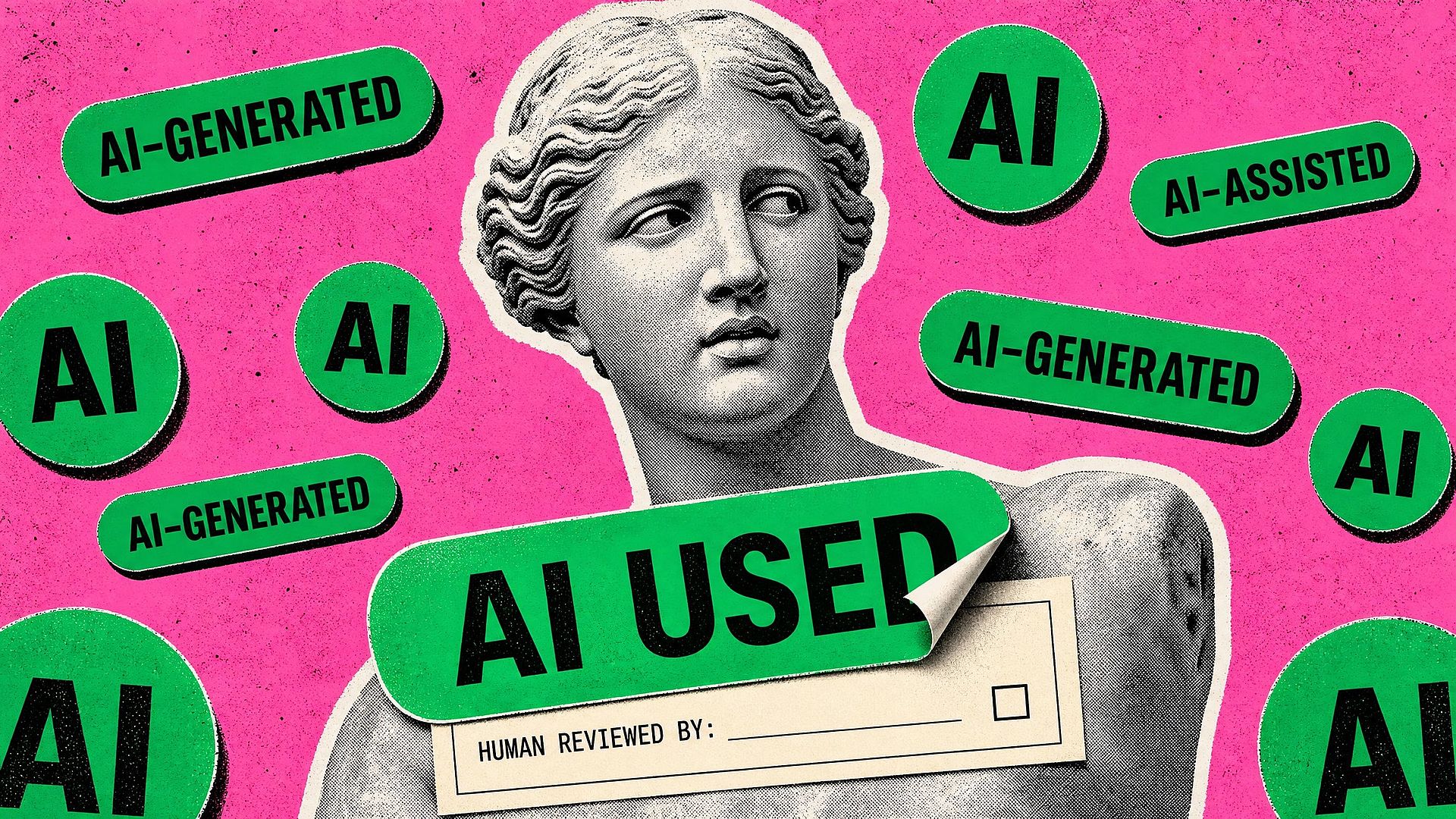
El lado de la demanda de este argumento no está ni cerca. La encuesta de Fractl de 2026 a más de mil consumidores found that 84 percent want written AI content labeled, 91 percent want it on video, 90 percent on images, 87 percent on audio, with strongly-agree responses alone clearing half in every category. The supply side isn't close either, just in the other direction: only 20 percent of organizations say they always disclose AI use to their audience, and 33 percent say they never do. Framed that way, this looks like a straightforward compliance gap. Get more companies labeling their content, close the gap, problem solved.
Salvo que un par de estudios de 2026 publicados en la revista Digital Journalism sugieren que esa brecha no es realmente donde vive el problema de confianza. Uno, un experimento conjoint con consumidores de medios chilenos, pidió a las personas que compararan las políticas de IA de distintos medios lado a lado y descubrió que la supervisión humana, y no la divulgación por sí sola, era el factor más influyente para determinar qué medio les parecía creíble y elegían leer. Que un medio usara IA para tareas rutinarias o para personalizar formatos apenas movía la aguja en un sentido u otro. Lo que sí la movía era si una persona había revisado lo que la IA produjo. Una etiqueta responde una pregunta: si hubo IA involucrada. Resulta que esa rara vez es la pregunta que la audiencia realmente se hace.
El segundo estudio, basado en entrevistas en lugar de experimentos, encontró algo más agudo: las etiquetas pueden resultar contraproducentes. One participant described their reaction to seeing an AI label as "I probably need to fact-check this and try and find another article," which is the opposite of what a disclosure label is supposed to accomplish. Others saw AI use itself as a kind of professional shortcut, with one interviewee putting it bluntly about a fully AI-written article: "You can do that as an 11-year-old. You don't need the training for that if you're going to use AI to generate your entire article." A vague, generic label doesn't resolve that instinct. It just confirms the suspicion without giving anyone a reason to set it aside.
What the same research found does help: specificity about degree, not just presence. Interview subjects drew a real line between an article labeled as fully AI-generated and one labeled as AI-assisted, treating those as different claims requiring different levels of scrutiny, and they wanted that distinction visible at the top of a piece rather than buried in a footer where it could look like it was trying not to be noticed. None of that is about whether to disclose. It's about whether the disclosure actually tells someone what happened and whether a person was accountable for it.
Esa es la distinción que el enfoque de cumplimiento pasa completamente por alto. Una ley puede exigir que exista una etiqueta, pero no puede exigir que esa etiqueta haga el trabajo real de reconstruir la confianza, porque la confianza depende de si la audiencia cree que una persona competente seguía involucrada, no de que la etiqueta aparezca en la página. Lograr que el 33 por ciento que nunca lo revela empiece a hacerlo importa por sí solo. Pero la pregunta más difícil y más útil que subyace es si lo que se divulga realmente le dice algo a alguien, o si solo marca una casilla que no toca lo que a la gente le preocupaba en primer lugar.